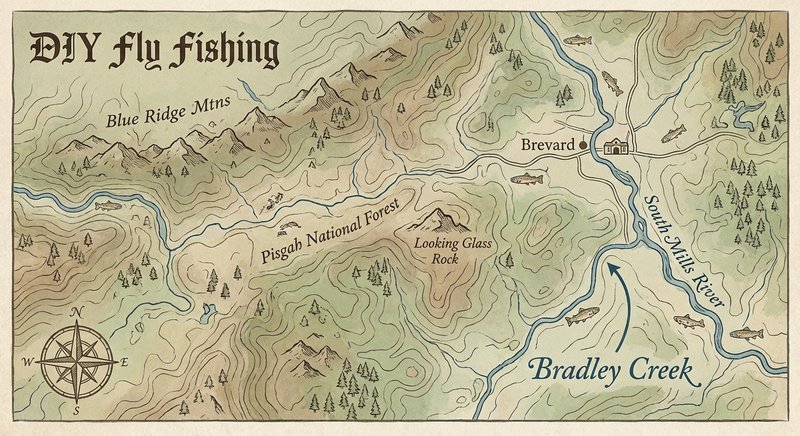
Bradley Creek
Fly fishing in North Carolina · Intermediate · Best seasons: Spring, Summer, Fall
Target Species
Brook Trout, Rainbow Trout
About This Water
Small stream in Pisgah with wild brook trout. Headwaters hold native fish.
Fishing Recommendations
Bradley Creek is one of the hidden gems of the Pisgah National Forest near Brevard, North Carolina. Often overshadowed by the larger South Mills River, Bradley Creek offers a quintessential "blue-lining" experience for anglers who prefer solitude, wild fish, and technical small-stream tactics.
As your guide, here is the deep dive into fishing this pristine Appalachian freestone stream.
🎣 Location Overview
Bradley Creek is a high-gradient tributary of the South Mills River. It is a classic Southern Appalachian freestone stream characterized by plunging pools, tight rhododendron-choked corridors, and crystal-clear water.
What makes it special is its wild character. Unlike the heavily stocked "Delayed Harvest" waters nearby, Bradley Creek is a dedicated Wild Trout water. You won't find 20-inch pellet-fed rainbows here; instead, you’ll find vibrant, scrappy, and incredibly beautiful wild fish that have lived their entire lives in these mountains. It is a "physical" creek—expect to scramble over boulders and crawl through brush.
🐟 Target Species & Behavior
The creek holds a healthy population of Wild Rainbow Trout in its middle and lower reaches, with Southern Appalachian Brook Trout (speckled trout) appearing as you climb into the higher-elevation headwaters.
- Behavior: These fish are highly opportunistic due to the nutrient-poor nature of freestone streams, but they are incredibly "spooky." The flash of a fly rod or a heavy footstep will send them darting under a rock for an hour.
- Holding Spots: Look for "the pocket behind the rock." In Bradley Creek, trout rarely sit in the middle of deep pools during the day; they prefer the heads of pools where oxygen is high or the "seams" where fast water meets slow water.
- Feeding: They primarily feed on aquatic macroinvertebrates (mayflies, stoneflies, caddis) and terrestrial insects that fall from the dense canopy.
📅 Best Times to Fish
Optimal Seasons
- Spring (Late March – June): This is the gold standard. As water temperatures hit the 50°F mark, the fish become aggressive. You’ll see the best aquatic insect hatches during this window.
- Summer (July – August): Best for high-elevation Brook Trout. While lower valley rivers get too warm, Bradley Creek stays cooler. Focus on the shaded, upper reaches.
- Fall (September – November): The brook trout spawn occurs in late fall (leave them be on their redds!). September and October offer spectacular foliage and aggressive rainbows looking to bulk up before winter.
Prime Windows
- Time of Day: In the heat of summer, fish early (6 AM – 10 AM) or late (6 PM – Dark). In the spring and fall, the "banker’s hours" (10 AM – 3 PM) are often best as the sun warms the water.
- Conditions: A day after a light rain is perfect. "Stained" water provides the trout with a sense of security, making them less likely to spook at your presence.
🪰 Recommended Flies & Techniques
Top Fly Patterns
- Dry Flies:
- Yellow Stimulator (Size 14-16): Mimics stoneflies and is highly visible in broken water.
- Parachute Adams (Size 16-20): The ultimate "searching" pattern.
- Elk Hair Caddis (Tan/Orange, Size 14-18): Great for skittering across plunge pools.
- Terrestrials (Summer):
- Greenie Weenie or Inchworm patterns.
- Black Foam Ants or Beetles (Size 16-18).
- Nymphs:
- Pheasant Tail (Size 16-18) – unweighted for shallow runs.
- Bead-head Prince Nymph or Copper John – to get deep in the plunge pools.
Effective Techniques
- The "Dry-Dropper": This is the most effective way to fish Bradley Creek. Use a buoyant dry fly (like a Stimulator) and hang a small Pheasant Tail nymph 18–24 inches below it.
- Bow-and-Arrow Cast: Because of the dense rhododendrons, a traditional backcast is often impossible. Master the bow-and-arrow cast to flick your fly into tight pockets.
- Stealth Approach: Always fish upstream. Approaching from behind the fish is the only way to stay out of their field of vision.
💡 Pro Tips & Local Knowledge
- Focus on the "Upper" Bradley: Access the headwaters via Yellow Gap Road (FS 1206). The fishing near the forest service road crossings is good, but the best fishing is found by hiking 20 minutes away from any bridge or pull-off.
- The "Two-Cast Rule": On a small creek like this, if you don't get a strike in your first two well-placed casts, move on. The fish are either not there or they’ve seen you.
- Light Tackle: Use a 2-weight or 3-weight rod, 7 to 8 feet in length. A 9-foot rod is often too cumbersome for the tight canopy. Use 6X or 7X fluorocarbon tippet; these fish have keen eyesight.
⚠️ Important Information
Access
- Access is primarily via Yellow Gap Road (FS 1206) or by hiking in from the Turkey Pen Gap trailhead.
- Note: Forest Service roads can be closed in winter or after heavy storms. Check the National Forest website for road status.
Regulations
- Wild Trout Waters: In North Carolina, this means Artificial Lures Only (no bait) and a Single Hook.
- Size/Creel: Most anglers on Bradley Creek practice 100% Catch and Release to preserve the fragile wild populations, though regulations do allow for a small harvest (check the latest NCWRC North Carolina Inland Fishing Regulations for current size and bag limits).
- License: A valid North Carolina Fishing License with the "Inland Fishing" trout privilege is required.
Special Considerations
- Safety: This is bear country. While black bears are generally shy, keep your snacks sealed.
- Slippery Rocks: The "Pisgah Grease" (didymo/algae on rocks) is legendary. Felt-soled boots or boots with carbide studs are highly recommended to avoid a fall.
- Cell Service: Expect zero cell service once you leave the main highway. Download your maps for offline use.
Bug Hatches & Matching Flies
| Hatch | Type | Peak months | Time of day | Hook sizes | Matching flies |
|---|---|---|---|---|---|
| Blue Winged Olive (BWO) Baetis / Pseudocloeon | mayfly | March, April, October, November | Late Morning/Afternoon | #18-22 | RS2 #20-22, Parachute Adams #18-22, Pheasant Tail Nymph #18-20 |
| Quill Gordon Epeorus pleuralis | mayfly | March, April | Mid-day | #12-14 | Quill Gordon Dry #12-14, Gold Ribbed Hare's Ear #12-14 |
| Hendrickson Ephemerella subvaria | mayfly | April | Afternoon | #12-14 | Red Quill #12-14, Hendrickson Emerger #14 |
| March Brown Maccaffertium vicarium | mayfly | May | Afternoon | #10-12 | March Brown Dry #10-12, March Brown Wet Fly #12 |
| Yellow Sally Isoperla | stonefly | May, June, July | Late Afternoon/Evening | #14-16 | Yellow Sally Dry #14-16, Little Yellow Stone Nymph #14-16 |
| Green Sedge Rhyacophila | caddis | May, June | Evening | #12-16 | Green Weenie #12-14, Elk Hair Caddis (Green) #14-16 |
| Light Cahill Stenacron / Stenonema | mayfly | June, July | Evening | #12-16 | Light Cahill #12-16, Cream Variant #14-16 |
| Golden Stonefly Acroneuria | stonefly | June, July | Morning/Evening | #8-12 | Pats Rubber Legs #8-12, Stimulator (Yellow/Orange) #8-12 |
| Terrestrials (Ants/Beetles) Formicidae / Coleoptera | terrestrial | July, August, September | All Day | #14-18 | Chernobyl Ant #12-14, Black Foam Beetle #16-18, Cinnamon Ant #16-18 |
| Midges Chironomidae | midge | December, January, February | Mid-day | #20-24 | Zebra Midge #20-22, Griffith's Gnat #20-22 |