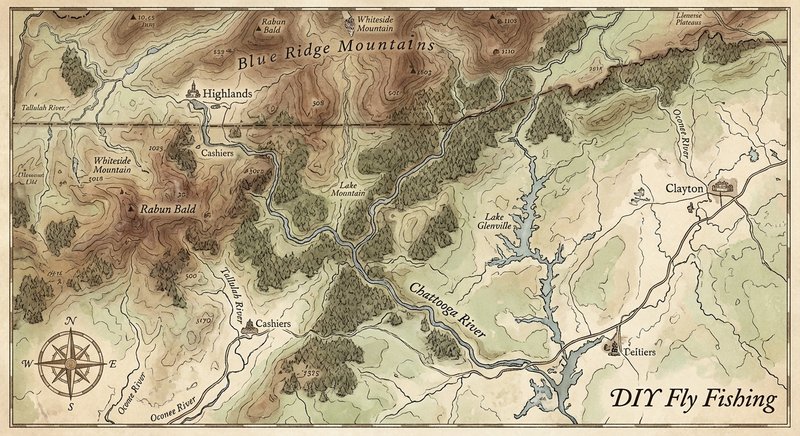
Chattooga River
Fly fishing in North Carolina · Advanced · Best seasons: Spring, Summer, Fall
Target Species
Brown Trout, Rainbow Trout
About This Water
Wild and scenic river forming NC-SC-GA border. Wild brown and rainbow trout.
Fishing Recommendations
The Chattooga River, designated as a "Wild and Scenic River," is one of the crown jewels of Southern fly fishing. Flowing through the high-elevation mountains of North Carolina before forming the border between Georgia and South Carolina, the North Carolina section (Section 0 and Section 1) offers some of the most remote and breathtaking trout water in the Eastern United States.
As your guide, here is the breakdown for tackling this legendary river.
🎣 Location Overview
The Chattooga is a freestone river, meaning its flow and temperature are dictated entirely by rainfall and weather. What makes it special is its wildness. Unlike many roadside streams in the Blue Ridge, much of the Chattooga requires a hike to access, rewarding adventurous anglers with solitude and unpressured fish.
The water characteristics vary from tight, laurel-choked headwaters to massive, deep pools separated by technical boulder gardens and plunging falls. The substrate is primarily granite and sand. Anglers love it because it feels prehistoric; you are fishing in a temperate rainforest where the rhododendron is thick, the water is crystal clear, and the fish are notoriously savvy.
🐟 Target Species & Behavior
- Rainbow Trout: These are the primary residents of the upper reaches. In the North Carolina section, you’ll find a mix of wild "bows" and some stocked fish near access points. They are opportunistic and often hold in the faster oxygenated "white water" at the heads of pools.
- Brown Trout: The Chattooga is famous for its wild Brown Trout. These fish are predators. They hold in the "giddy water" (the slow, deep edges of fast runs) and deep under-cut banks. The larger Browns are notoriously nocturnal or low-light feeders; they are wary and require stealthy approaches.
- Behavior: Because the water is so clear, these fish are "spooky." If they see your silhouette or a splashy line, the pool is done for an hour. They feed heavily on macroinvertebrates (mayflies, stoneflies, caddis) but the big ones are looking for a calorie-dense meal like a sculpin or a crayfish.
📅 Best Times to Fish
Optimal Seasons
- Spring (March – May): The absolute prime time. This coincides with the major hatches (Quill Gordons, Hendricksons, and March Browns). Water temperatures are rising into the 50s, making fish aggressive.
- Fall (October – November): A favorite for targeting large, spawning-run Brown Trout. The colors of the Cashiers valley are world-class, and the cooling water triggers a secondary feeding frenzy.
- Summer (June – August): Best for the high-elevation headwaters. While lower sections can get too warm, the NC headwaters stay cool. This is the season for terrestrial fishing (ants and beetles).
Best Times of Day
- Early Morning: Best for streamer fishing for big Browns.
- Late Afternoon/Dusk: Essential for dry fly action during the "evening rise."
- Overcast Days: A cloudy day on the Chattooga is worth three sunny ones. The lack of shadows makes the big fish feel safe enough to move into shallow water.
🪰 Recommended Flies & Techniques
Top Fly Patterns
- Dry Flies:
- Stimulators (Orange or Yellow, size 12-16) – Great attractor/indicator fly.
- Parachute Adams (Size 14-20) – The gold standard for matching small mayflies.
- Elk Hair Caddis (Tan or Olive, size 14-18).
- Nymphs:
- Pheasant Tail (Size 16-20) – Always effective.
- Girdle Bug/Pat’s Rubber Legs (Black/Coffee) – Crucial for the large stoneflies found in the Chattooga’s boulders.
- Frenchies or Perdigons – For fast-sinking Euro-style techniques.
- Streamers:
- Woolly Buggers (Black or Olive).
- Sculpzilla – To mimic the natural bottom-dwellers.
Effective Techniques
- Dry-Dropper: This is the most effective way to cover the Chattooga. Use a buoyant dry fly (like a Stimulator) and hang a weighted nymph 18-24 inches below it.
- Tight-Line Nymphing: In the heavy boulder sections, traditional indicators often get caught in conflicting currents. Using a "Euro" or tight-line rig allows you to get deep into the pockets where the big Browns sit.
- Stealth Presentation: Use longer leaders (9ft to 12ft) and 5X or 6X fluorocarbon tippet. Wear earthy colors to blend into the forest.
💡 Pro Tips & Local Knowledge
- Focus on "The Cliffs": The area around the Iron Bridge and the sections accessible via the Chattooga River Trail offer deep plunge pools that hold the largest fish.
- The "Shadow" Cast: Because the canopy is thick, many fish hold on the seam between the sun and the shade. Always cast into the shadows first.
- Terrestrials are King: From July through September, don't overlook a size 14 foam beetle or a Dave’s Hopper. The fish are looking at the banks for insects falling off the rhododendrons.
- Move Frequently: If you don't get a strike in a pocket after 5-10 good drifts, move on. The Chattooga rewards the angler who covers ground.
⚠️ Important Information
- Access: Key access points include the Iron Bridge (Bullpen Road) and the Whiteside Cove Road area. Be prepared for steep, strenuous hikes if you leave the main trail.
- Regulations:
- In North Carolina, the upper Chattooga is mostly Wild Trout Water (Artificial lures/flies only, 7-inch minimum, 4 fish limit).
- Note: The section from the SR 1100 bridge to the SC state line is Delayed Harvest from October to June (Catch and Release only, high fish density).
- Safety: This is a rugged area. Cell service is non-existent. Always tell someone where you are going. The rocks are incredibly slippery—felt soles or aluminum-studded boots are highly recommended.
- Licensing: You must have a valid North Carolina fishing license. If you cross into the GA/SC border sections, ensure you have the appropriate reciprocal licenses (though NC/SC/GA generally honor each other's licenses on the river itself where it forms the border, the NC headwaters are strictly NC jurisdiction).
Bug Hatches & Matching Flies
| Hatch | Type | Peak months | Time of day | Hook sizes | Matching flies |
|---|---|---|---|---|---|
| Quill Gordon Epeorus pleuralis | mayfly | March, April | Mid-day | #12-14 | Quill Gordon Dry #12-14, Hare's Ear #12-14 |
| Blue Winged Olive Baetis spp. | mayfly | March, April, October, November | Afternoon | #18-22 | RS2 #18-22, Blue Winged Olive #18-22, Pheasant Tail #18-20 |
| Hendrickson Ephemerella subvaria | mayfly | April | Afternoon | #12-14 | Red Quill #12-14, Hendrickson Emerger #12-14 |
| Yellow Sally Isoperla spp. | stonefly | May, June, July | Late Afternoon/Evening | #14-16 | Yellow Stimulator #14-16, Yellow Sally Nymph #14-16 |
| Golden Stonefly Acroneuria spp. | stonefly | June, July | Morning/Evening | #8-12 | Golden Stone Nymph #8-12, Kaufmann's Stone #8-12 |
| Light Cahill Stenonema/Stenacron | mayfly | May, June | Evening | #12-14 | Light Cahill Dry #12-14 |
| Tan Caddis Hydropsyche spp. | caddis | April, May, September | Morning/Evening | #14-18 | Elk Hair Caddis #14-18, Holy Grail #14-16, Peeping Caddis #14-16 |
| Giant Black Stonefly Pteronarcys dorsata | stonefly | March, April | All Day | #4-8 | Pat's Rubber Legs #4-8, Black Stimulator #8 |