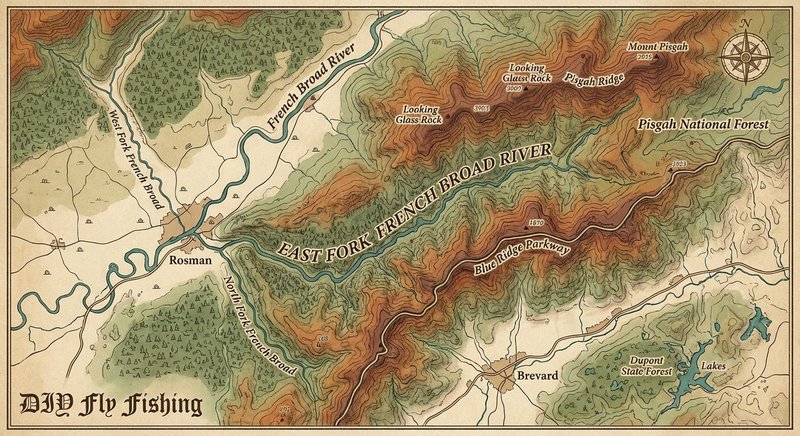
East Fork French Broad
Fly fishing in North Carolina · Beginner · Best seasons: Spring, Fall, Winter
Target Species
Brown Trout, Rainbow Trout
About This Water
Delayed harvest waters with excellent fishing. Easy access near Rosman.
Fishing Recommendations
As an expert guide in the Southern Appalachians, it is a pleasure to break down one of Western North Carolina’s most beloved stretches of water: the East Fork of the French Broad River.
Located just outside of Brevard in Transylvania County, this river is a quintessential Appalachian freestone stream. It offers a perfect blend of accessibility and technical challenge, making it a favorite for both novice anglers and seasoned fly-casters.
🎣 Location Overview
The East Fork of the French Broad is a medium-sized freestone river that flows through a mix of private and public lands, eventually joining the West Fork to form the main stem of the French Broad.
What makes this water special is its Delayed Harvest (DH) designation. This section, which runs for several miles along East Fork Road, is heavily stocked by the North Carolina Wildlife Resources Commission. The river is characterized by massive granite boulders, deep plunge pools, long glassy runs, and classic "pocket water." It feels intimate and wild, yet it’s incredibly easy to access from the roadside, making it a "blue-ribbon" experience without the grueling hike.
🐟 Target Species & Behavior
The primary targets here are Rainbow Trout and Brown Trout.
- Rainbow Trout: These are the "gymnasts" of the East Fork. They tend to hold in faster water—heads of pools, riffles, and oxygenated runs. They are aggressive and often the first to hit a well-presented nymph or attractor dry fly.
- Brown Trout: The East Fork holds some surprisingly large "holdover" Browns. These fish are more calculated. They prefer the "living room" of the river—undercut banks, the dark shadows beneath boulders, and the slow tail-outs of pools during low light.
- Behavior: During the DH season, these fish transition from being "naive" (hitting bright, flashy patterns) to "highly educated" within a few weeks of stocking. By mid-winter, you’ll need to downsize your tippet and refine your presentation.
📅 Best Times to Fish
The East Fork is primarily a cool-weather fishery.
- Fall (October – November): This is the start of the Delayed Harvest season. The river is freshly stocked, the autumn colors are world-class, and the fish are very active as water temperatures drop into the 50s.
- Winter (December – February): This is the "thinking man’s" season. While the fish are slower, they congregate in deep, slow pools. On sunny afternoons, you can find incredible midge hatches that bring fish to the surface even in January.
- Spring (March – May): The absolute peak. As water warms, the aquatic insect life explodes. This is your best chance to catch fish on traditional dry flies.
- Best Time of Day: In the winter, wait for the water to warm up—11:00 AM to 3:00 PM is the "Golden Window." In the spring and fall, early morning and late evening (the "gray light") are most productive.
🪰 Recommended Flies & Techniques
Techniques
- Tight-Line (Euro) Nymphing: Because the East Fork is full of "pocket water" (small pockets of calm water behind rocks), a Euro-nymphing setup is deadly. It allows you to get flies deep into the pockets without drag.
- Indicator Nymphing: Best for the long, deep runs found near the bridge crossings. Use a yarn indicator for subtle takes.
- Dry-Dropper: Perfect for the late spring when fish are looking up but still feeding primarily sub-surface.
Top Fly Patterns
- Nymphs:
- The "Junk": Mop Flies (Chartreuse), Squirmy Wormies, and Egg patterns (great for fresh stockers).
- Natural: Pheasant Tail (size 14-18), Sexy Walt’s Worm, and Girdle Bugs (Black/White).
- Dry Flies:
- Spring: Quill Gordons, March Browns, and Yellow Sallies.
- Year-round: Parachute Adams (size 16-20) and Elk Hair Caddis.
- Streamers:
- Woolly Bugger (Olive or Black) - dead drift them through deep holes or swing them through tail-outs.
💡 Pro Tips & Local Knowledge
- The "Walking Rule": Most anglers fish within 100 yards of the pull-offs and bridges. If you walk 15 minutes upstream or downstream from any bridge crossing, you will find fish that haven't seen a fly all day.
- Size Matters: If you’re getting "refusals" (fish looking at your fly but not eating), drop your tippet size to 6X or 7X fluorocarbon and downsize your fly. A size 20 Zebra Midge is often the "secret weapon" on the East Fork.
- Observe the "Bubbles": On the East Fork, the food travels in the "bubble line." If your fly isn't drifting at the same speed as the bubbles on the surface, your presentation is unnatural.
- Glady Fork: Pay attention to the confluence where Glady Fork enters the East Fork; the mixing of water temperatures often creates a feeding frenzy.
⚠️ Important Information
Regulations (Delayed Harvest)
- Season: From October 1 until the first Saturday in June, the East Fork is Catch & Release only.
- Gear: Only artificial lures with a single hook are permitted. No bait, no multiple hooks (no treble hooks).
- License: You must have a valid North Carolina Inland Fishing License.
Access
- Access is excellent along East Fork Road. Look for the diamond-shaped "Delayed Harvest Trout Waters" signs. There are numerous gravel pull-offs.
- Wading: The river is generally easy to wade, but the rocks are extremely slippery. Felt-soled boots or studs are highly recommended.
Safety
- This is a freestone mountain river; it can rise rapidly after heavy rains in the headwaters. If the water looks "milky" or chocolate-colored, it’s best to stay out and wait for it to recede.
The East Fork of the French Broad is a gem of the Blue Ridge. Respect the water, pinch your barbs, and enjoy the beauty of North Carolina fly fishing!
Bug Hatches & Matching Flies
| Hatch | Type | Peak months | Time of day | Hook sizes | Matching flies |
|---|---|---|---|---|---|
| Blue Winged Olive Baetis | mayfly | March, April, October, November | Late Morning/Afternoon | #18-22 | Parachute Adams #18-22, RS2 #20-22, Pheasant Tail Nymph #18-20 |
| Quill Gordon Epeorus pleuralis | mayfly | March, April | Midday | #12-14 | Quill Gordon Dry #12-14, Guide's Choice Hare's Ear #12-14 |
| Hendrickson Ephemerella subvaria | mayfly | April | Afternoon | #12-14 | Hendrickson Dark #12-14, Red Quill #14, Pheasant Tail #12-14 |
| Yellow Sallie Isoperla | stonefly | May, June, July | Late Afternoon/Evening | #14-16 | Yellow Stimulator #14-16, Little Yellow Sloan #14-16 |
| Golden Stonefly Acroneuria | stonefly | May, June | Evening/Night | #6-10 | Golden Stone #8-10, Pat's Rubber Legs #6-10 |
| Green Sedge Rhyacophila | caddis | April, May, June | All Day/Evening | #12-16 | Elk Hair Caddis #14-16, Green Weenie #12-16, LaFontaine's Emergent Sparkle Pupa #14-16 |
| March Brown Maccaffertium vicarium | mayfly | May | Midday/Afternoon | #10-12 | March Brown American #10-12, Hare's Ear Nymph #10-12 |
| Isonychia (Slate Drake) Isonychia bicolor | mayfly | June, September, October | Evening | #10-12 | Iso Parachute #10-12, Zug Bug #10-12 |
| Terrestrials Formicidae / Coleoptera | terrestrial | July, August, September | All Day | #12-18 | Black Foam Beetle #14-16, Cinnamon Ant #16-18, Dave's Hopper #10-12 |
| Midges Chironomidae | midge | January, February, December | Midday | #20-24 | Zebra Midge #20-22, Griffith's Gnat #20-22 |