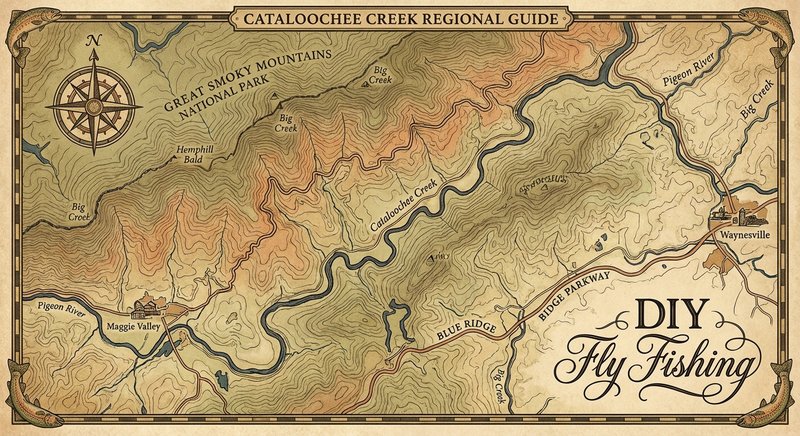
Cataloochee Creek
Fly fishing in North Carolina · Intermediate · Best seasons: Spring, Summer, Fall
Target Species
Rainbow Trout, Brown Trout, Brook Trout
About This Water
Wild trout stream in Great Smoky Mountains. Native brook trout in headwaters.
Fishing Recommendations
Welcome to one of the crown jewels of the Great Smoky Mountains National Park (GSMNP). As your guide, I can tell you that Cataloochee Creek offers an experience that feels like stepping back in time. Located in a remote valley on the North Carolina side of the park, it combines rich Appalachian history, a world-class elk population, and some of the finest wild trout fishing in the Southeast.
🎣 Location Overview
Cataloochee Valley is famous for its historic buildings and its elk reintroduction program, but for the angler, it’s a paradise of mid-sized freestone water. Unlike the larger, more pressurized rivers near the park entrances, Cataloochee remains relatively quiet due to the winding, unpaved "Cove Creek Road" required to reach it.
The creek is characterized by classic "stair-step" pool-and-drop pocket water, long runs, and deep, emerald-green pools. It is a high-gradient stream that stays cooler than many other valley streams, making it a reliable refuge for trout even during the warmer months.
🐟 Target Species & Behavior
All trout in the Cataloochee system are wild. There is no stocking here, so the fish are beautiful, hardy, and incredibly wary.
- Rainbow Trout: The most abundant species. They are found throughout the main stem of Cataloochee Creek. Look for them in the "fast water"—the heads of pools, riffles, and oxygenated pockets behind boulders.
- Brown Trout: The "kings" of the valley. These fish hold in deeper pools, under-cut banks, and beneath rhododendron overhangs. They are notoriously selective and often require low-light conditions or a perfectly swung streamer to coax out.
- Brook Trout (Specks): To find the native Southern Appalachian Brook Trout, you must head into the high-altitude tributaries like Palmer Creek or Rough Fork. They are small (5–8 inches) but possess stunning colors and a voracious appetite.
📅 Best Times to Fish
Optimal Seasons
- Spring (Late March – May): This is the peak. The water temperatures hit the "magic" 50–55°F mark, triggering massive hatches of Quill Gordons, March Browns, and Hendrickson mayflies.
- Summer (June – August): While other NC rivers get too hot, the shaded canopy and elevation of Cataloochee keep it fishable. This is Terrestrial Season (beetles, ants, and hoppers).
- Fall (September – early November): My personal favorite. The Brown trout become aggressive as they prepare for the spawn, and the changing leaves provide a spectacular backdrop.
Prime Windows
- Early Morning: Best during Summer to beat the heat.
- Mid-Day: Best in early Spring and late Fall when the sun warms the water enough to trigger insect activity.
- Evening: The "Caddis Hour" at dusk is legendary in the valley.
🪰 Recommended Flies & Techniques
Top Fly Patterns
- Dry Flies:
- Yellow Stimulator (Size 12–16): The universal "searching" pattern for the Smokies.
- Parachute Adams (Size 14–20): Mimics almost any mayfly hatch.
- Elk Hair Caddis (Tan or Olive, Size 14–18).
- Nymphs:
- Pheasant Tail (Size 14–18): Deadly for mimicking mayfly nymphs.
- Pat’s Rubber Legs (Size 8–12): Great for high-water or deep-pool dredging.
- Prince Nymph (Size 14–16).
- Terrestrials:
- Black Foam Ants and Green Weenie (Size 14–16) are essential in the summer.
Techniques
- The Dry-Dropper: This is the most effective way to fish Cataloochee. Use a buoyant Stimulator or Royal Wulff on top, with a 12–18 inch dropper to a Pheasant Tail nymph.
- Stealth Wading: The water is crystal clear. If you can see the fish, they have likely already seen you. Wear earthy colors, stay low, and cast upstream.
- Pocket Picking: Don't just fish the big pools. "Pick" the small pockets behind rocks; wild rainbows often hang there to snatch food passing in the current.
💡 Pro Tips & Local Knowledge
- The "Grand Slam": For a true challenge, try for the Cataloochee Grand Slam. Start low in the valley for a Brown, mid-valley for a Rainbow, and hike up into Palmer Creek for a Brookie—all in one day.
- Watch the Elk: During the Fall (the rut), the bulls are aggressive. If you are fishing near the fields, give them a wide berth. I've had to vacate a fishing hole more than once because a bull elk decided he wanted that section of the bank.
- Palmer Creek Confluence: The area where Palmer Creek and Rough Fork meet to form the main stem of Cataloochee is a "fishy" hotspot with great structure and depth.
- The "Green Weenie": Local secret—this simple chartreuse chenille fly is arguably the most effective pattern in the entire Park during the summer months when inchworms drop from the trees.
⚠️ Important Information
- Access: Access is via Cove Creek Road. It is a gravel road that can be narrow and dusty. A 4WD vehicle isn't strictly necessary in good weather, but high clearance is helpful.
- Regulations:
- You need a valid North Carolina OR Tennessee state fishing license. The Park honors both.
- Artificial Lures Only: No bait (corn, worms, etc.) is allowed.
- Single Hook Only: No treble hooks.
- Size/Creel: Check current GSMNP regulations at the trailhead, as rules on "Catch and Release" vs. "Harvest" can vary by year (most anglers here practice 100% Catch & Release to protect the wild biomass).
- Safety: Cell service is non-existent. Tell someone where you are going. This is bear country; keep your food secured in your vehicle.
- Parking Tag: As of 2023, the Great Smoky Mountains National Park requires a valid parking tag for any vehicle parking for more than 15 minutes. You can buy these online or at various locations outside the park.
Guide's Final Word: Cataloochee isn't about the size of the fish—it's about the soul of the place. Slow down, watch the elk, and enjoy the rhythm of the water. Tight lines!
Bug Hatches & Matching Flies
| Hatch | Type | Peak months | Time of day | Hook sizes | Matching flies |
|---|---|---|---|---|---|
| Quill Gordon Epeorus pleuralis | mayfly | March, April | Mid-day | #12-14 | Quill Gordon Dry #12-14, Quill Gordon Wet Fly #12-14 |
| Blue Winged Olive (BWO) Baetis | mayfly | March, April, October, November | Afternoon | #18-22 | Parachute Adams #18-22, Pheasant Tail Nymph #18-20 |
| Yellow Sally Isoperla | stonefly | May, June, July | Late Afternoon/Evening | #14-16 | Yellow Sally Stone #14-16, Iron Lotus #16 |
| Light Cahill Stenacron/Stenonema | mayfly | June, July | Evening | #12-14 | Light Cahill #12-14, Gold Ribbed Hare's Ear #14 |
| Cinnamon Caddis Hydropsyche | caddis | May, June, September | Evening | #14-18 | Elk Hair Caddis (Tan) #14-16, Holy Grail #16 |
| March Brown Maccaffertium vicarium | mayfly | April, May | Afternoon | #10-14 | March Brown Dry #12, Hare's Ear Nymph #10-12 |
| Giant Black Stonefly Pteronarcys dorsata | stonefly | May, June | All Day | #4-8 | Pat's Rubber Legs #6-8, Stimulator (Orange/Black) #8 |
| Terrestrials (Ants and Beetles) Formicidae / Coleoptera | terrestrial | July, August, September | All Day | #12-18 | Black Foam Beetle #14-16, Cinnamon Ant #16-18 |