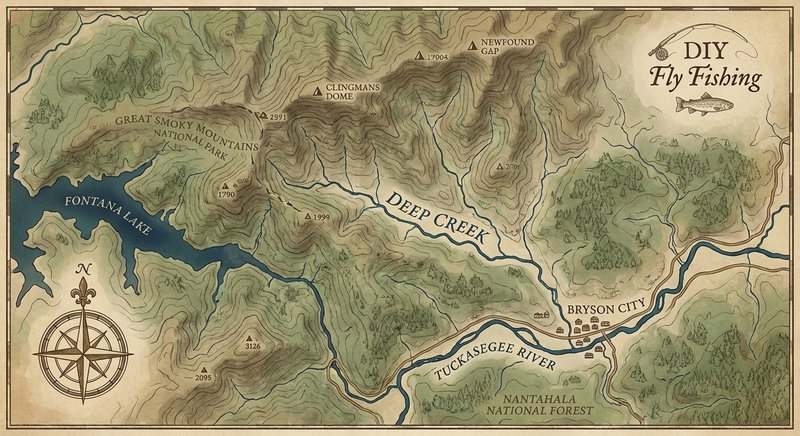
Deep Creek
Fly fishing in North Carolina · Beginner · Best seasons: Spring, Summer, Fall
Target Species
Rainbow Trout, Brown Trout, Brook Trout
About This Water
Popular stream near Bryson City in Great Smoky Mountains. Good family fishing.
Fishing Recommendations
Deep Creek, located just outside of Bryson City, North Carolina, is one of the "crown jewels" of the Great Smoky Mountains National Park (GSMNP). As a guide, I consider this one of the most versatile pieces of water in the Southeast because it offers everything from easy-access pocket water to high-elevation backcountry solitude.
Here is your comprehensive guide to fly fishing Deep Creek.
🎣 Location Overview
Deep Creek is a classic Appalachian freestone stream. It is characterized by its crystal-clear water, high gradient, and a diverse mix of large boulder gardens, deep emerald pools, and long glassy runs.
What makes it special is the accessibility vs. reward ratio. While the lower mile is heavily trafficked by tubers in the summer, a twenty-minute hike past the first waterfall (Tom Branch Falls) puts you into prime wild trout territory. The further you hike, the more the "pressure" drops and the "wildness" increases. It is a quintessential mountain stream where the fish are wild, beautiful, and—if your presentation is right—extremely aggressive.
🐟 Target Species & Behavior
Deep Creek is one of the few streams in the Park where you can legitimately catch a "Smoky Mountain Slam" (Rainbow, Brown, and Brook trout) in a single afternoon.
- Rainbow Trout: The most common resident. They hold in the "faster" water—the heads of pools, heavy riffles, and oxygenated pockets. They are opportunistic and will often move several feet to smash a dry fly.
- Brown Trout: Deep Creek is famous for holding some surprisingly large wild Browns (14–18+ inches). They are nocturnal and predatory. They hold in the deep, dark undercut banks or at the very tail-outs of pools during low light.
- Brook Trout: To find the "Speckles" (Southern Appalachian Strain Brookies), you must hike high. Once you get above the junction with Right Fork, or head into the high-elevation tributaries like Indian Creek, the Brookies become more prevalent. They are small (5–8 inches) but stunningly colored.
📅 Best Times to Fish
Optimal Seasons
- Spring (March – May): The gold standard. This is when the major hatches occur (Quill Gordons, March Browns, Yellow Sallies). The water temps hit the 50s, and the fish become highly active.
- Fall (October – November): My personal favorite. The Brown trout are moving and aggressive for the spawn (don't fish active redds!), and the scenery is world-class.
- Summer (June – August): Excellent fishing, but you must hike. The lower sections get too warm and too crowded with tubers. Head 3+ miles up-trail to find cool water and hungry fish.
Best Times of Day
- Spring/Fall: 10:00 AM – 4:00 PM (Wait for the sun to warm the water slightly).
- Summer: Dawn and Dusk. The "witching hour" before dark is prime for big Browns.
🪰 Recommended Flies & Techniques
Top Fly Patterns
- Dry Flies:
- Yellow Stimulator (Sizes 12-16) – Mimics Yellow Sallies and stoneflies.
- Parachute Adams (Sizes 14-18) – The best all-around searcher pattern.
- Never Sink Caddis (Size 14-16) – High visibility in rough water.
- Nymphs:
- Pheasant Tail (Flashback) (Sizes 14-18) – Mimics almost everything.
- Prince Nymph (Sizes 12-16) – Great for the deeper, faster runs.
- Pat’s Rubber Legs (Size 10-12) – For high water or targeting big Browns.
- Streamers:
- Olive or Black Wooly Bugger (Size 8-10) – Dead-drifted or swung through deep holes.
Techniques
- Dry-Dropper: This is the "bread and butter" on Deep Creek. Use a buoyant Stimulator or Foam Caddis as your "indicator" and hang a Pheasant Tail nymph 18–24 inches below it.
- High Sticking: Because the currents are complex, keep as much fly line off the water as possible. Long rods (9ft or 10ft 3-weights) are ideal here.
- Stealth: The water is gin-clear. If you can see the fish, they have already seen you. Always fish upstream and stay low.
💡 Pro Tips & Local Knowledge
- The "Mile 3" Rule: During the summer, the lower section becomes a "lazy river" for thousands of tubers. Don't even bother fishing the first 2 miles during the day. Hike 3 miles in to the Deep Creek Campground/Backcountry sites (like Site 60). The tubers stop, and the fishing begins.
- Look for "The Seams": In the large pools, don't just cast into the middle. Focus on the "seam" where fast water meets slow water. That is the conveyor belt of food.
- The "Thunderstorm" Effect: In the summer, a brief afternoon rain can "stain" the water slightly and drop the temperature. This often triggers a massive feeding frenzy. Don't leave just because it rains; put on a jacket and get ready.
⚠️ Important Information
Access
- Access is via the Deep Creek Entrance of the Great Smoky Mountains National Park near Bryson City.
- There is a large parking lot at the trailhead/campground. The Deep Creek Trail follows the water for miles, providing excellent access points.
Regulations & Permits
- License: You need either a North Carolina OR a Tennessee fishing license to fish any water inside the National Park.
- Limits: The Park is Wild Trout Water. You are allowed 5 fish per day (minimum 7 inches), but most anglers here practice Catch and Release to preserve the wild genetics.
- Lures: Artificial lures with a single hook only. No bait (corn, worms, powerbait) is allowed.
Special Considerations
- Bears: This is black bear country. Keep your food stored properly and be aware of your surroundings, especially if you are cleaning a fish (though releasing them is better!).
- Wading: The rocks in Deep Creek are notoriously "greasy" with algae. Felt-soled boots or studs are highly recommended to avoid a dunking.
Bug Hatches & Matching Flies
| Hatch | Type | Peak months | Time of day | Hook sizes | Matching flies |
|---|---|---|---|---|---|
| Quill Gordon Epeorus pleuralis | mayfly | February, March | Midday | #12-14 | Quill Gordon Dry #12-14, Quill Gordon Wet #12-14 |
| Blue Quill Paraleptophlebia | mayfly | March, April | Midday to Afternoon | #16-18 | Blue Quill Dry #16-18, Pheasant Tail Nymph #16-18 |
| March Brown Maccaffertium vicarium | mayfly | April, May | Afternoon | #10-14 | March Brown Dry #10-12, Gold Ribbed Hare's Ear #12-14 |
| Yellow Sally Isoperla | stonefly | May, June, July | Late Afternoon/Evening | #14-16 | Yellow Sally Stone #14-16, Little Yellow Stone Nymph #14-16 |
| Light Cahill Stenacron/Stenonema | mayfly | May, June | Evening | #12-14 | Light Cahill Dry #12-14, Sheep Creek Special #12-14 |
| Blue Winged Olive Baetis | mayfly | March, April, October, November | Midday | #18-22 | BWO Sparkle Dun #18-20, RS2 #20-22 |
| Cinnamon Caddis Hydropsyche | caddis | May, June, July, August | Evening | #14-16 | Elk Hair Caddis (Tan) #14-16, Holy Grail #14-16 |
| Golden Stonefly Acroneuria | stonefly | June, July | Morning/Evening | #6-10 | Kaufmann's Stimulator (Yellow/Orange) #8-10, Pat's Rubber Legs #8-12 |
| Terrestrials Formicidae / Coleoptera | terrestrial | July, August, September | All Day | #12-18 | Black Foam Beetle #14-16, Cinnamon Ant #16-18 |
| Giant Black Stonefly Pteronarcys dorsata | stonefly | April, May | Morning | #4-8 | Girdle Bug #6-8, Black Stimulator #8 |