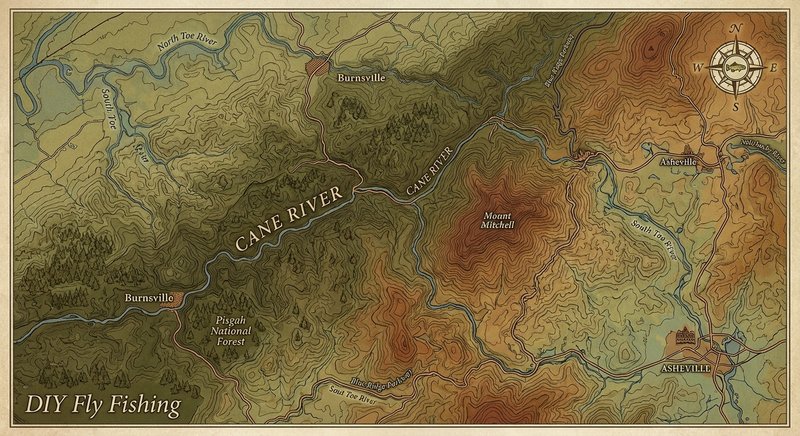
Cane River
Fly fishing in North Carolina · Beginner · Best seasons: Spring, Summer, Fall
Target Species
Brown Trout, Rainbow Trout
About This Water
Scenic stream in Yancey County with wild trout. Less pressured waters.
Fishing Recommendations
The Cane River, flowing through Yancey County near Burnsville, is one of Western North Carolina’s premier trout destinations. Originating on the slopes of Mt. Mitchell—the highest peak in the Eastern U.S.—it offers a diverse range of water, from high-gradient pocket water to wide, meandering valley runs.
Here is your comprehensive guide to fly fishing the Cane River.
🎣 Location Overview
The Cane River is a classic Appalachian freestone stream. What makes it special is its pedigree; because its headwaters are so high in elevation, the water stays cooler longer than many other rivers in the region.
The river is generally divided into three personalities:
- The Upper Headwaters: Small, tight, and brushy, holding wild brook and rainbow trout.
- The Delayed Harvest (DH) Section: This is the most popular stretch for fly anglers, located near the intersection of Hwy 19W and 19E. It is heavily stocked and managed for catch-and-release during the prime months.
- The Lower River: As it moves toward the Nolichucky, the river widens, the water warms, and you’ll find a mix of stocked trout and smallmouth bass.
Anglers love the Cane because it offers "big water" feel in the lower sections while maintaining the intimacy of a mountain stream in its upper reaches.
🐟 Target Species & Behavior
- Rainbow Trout: These are the primary residents of the DH section. They are aggressive and tend to hold in the faster "oxygenated" water—riffles, run-outs, and the heads of pools. They are suckers for colorful attractor nymphs and flashy streamers.
- Brown Trout: The Cane is known for producing some surprisingly large "holdover" browns. Unlike the rainbows, the big browns prefer the deep, dark guts of pools, undercut banks, and the shadows of the massive boulders that litter the riverbed. They are more nocturnal and predatory, often feeding on crawfish and sculpins.
📅 Best Times to Fish
- Spring (March – May): Prime Time. This is the peak of the Delayed Harvest season and the start of the major hatches (Quill Gordons and March Browns). Water levels are usually high but fishable.
- Summer (June – August): Focus on the Upper Cane or the shaded headwaters. The lower DH section can get too warm for ethical trout fishing in late July/August. Stick to "Hoot Owl" hours (dawn until 11:00 AM).
- Fall (October – November): Another Peak Window. The river is restocked for the DH season in October. The brown trout become aggressive as they prepare to spawn, and the fall colors in Yancey County are world-class.
- Best Window: Generally, 10:00 AM to 4:00 PM in the Spring/Fall. In the Summer, be on the water at first light.
🪰 Recommended Flies & Techniques
Top Fly Patterns
- Nymphs: Sexy Walt’s Worm (size 12-16), Pheasant Tail (size 14-18), Girdle Bug (Pat’s Rubber Legs) in Coffee/Black, and Mop Flies (Chartreuse) for newly stocked fish.
- Dry Flies: Yellow Sallies (size 14-16), Elk Hair Caddis (Tan, size 14), and the classic Parachute Adams.
- Streamers: Black or Olive Wooly Buggers, and Sparkle Minnows.
Effective Techniques
- European Nymphing: The Cane is a "pocket water" river. Using a long rod (10ft 3wt) with a tight-line setup allows you to pick apart the slots between boulders where fish hide from the current.
- Dry-Dropper: In the late Spring/Summer, a high-floating Stimulator with a small Pheasant Tail dropped 18 inches below is deadly in the riffles.
- Streamer Stripping: After a rain, when the water has a "stained" or "tannin" look, strip large streamers near the banks to entice a trophy brown.
💡 Pro Tips & Local Knowledge
- The "Big Rock" Strategy: The Cane is full of house-sized boulders. Don't just fish the pools behind them; fish the "cushion" directly in front of the rock. Large trout often sit there to get first dibs on drifting insects.
- Mind the Gauge: The Cane River can blow out quickly due to its steep drainage. Check the USGS gauge at Burnsville. If it’s spiking or over 400 cfs, it can be dangerous to wade. Ideally, you want it between 150-250 cfs for optimal wading.
- Stealth Matters: Even in the stocked sections, the water is exceptionally clear. Wear earthy tones (no white hats!) and use 5X or 6X fluorocarbon tippet to avoid spooking fish.
⚠️ Important Information
- Access: Much of the river runs along Hwy 19W and Riverside Drive. While there are many pull-offs, be respectful of private property lines—always look for the NCWRC "Public Mountain Trout Waters" signs (Green/White for Hatchery Supported, Blue/White for Delayed Harvest).
- Regulations:
- Delayed Harvest (Oct 1 – First Saturday in June): Catch and Release only, single-hook artificial lures only.
- Hatchery Supported: Open year-round, but specific harvest limits apply. Check the current NCWRC Inland Fishing Regulations.
- Safety: The rocks in the Cane are notoriously slick. Felt-soled boots with studs are highly recommended. A wading staff is a smart move if the water is over your knees.
Guide’s Final Word: The Cane River is a "thinking man's" river. It rewards those who take the time to read the water rather than just casting into the middle of the deep holes. Take your time, stay low, and enjoy one of the finest gems of the Blue Ridge Mountains.
Bug Hatches & Matching Flies
| Hatch | Type | Peak months | Time of day | Hook sizes | Matching flies |
|---|---|---|---|---|---|
| Blue Winged Olive Baetis spp. | mayfly | March, April, October, November | Mid-day/Afternoon | #18-22 | BWO Sparkle Dun #18-22, Pheasant Tail Nymph #18-20, RS2 #20-22 |
| Quill Gordon Epeorus pleuralis | mayfly | March, April | Mid-day | #12-14 | Quill Gordon Dry #12-14, Iron Blue Dun #14, Quill Gordon Wet Fly #12-14 |
| March Brown Maccaffertium vicarium | mayfly | April, May | Afternoon | #10-14 | March Brown Western Style #12-14, Hare's Ear Nymph #10-14, Gold Ribbed Hare's Ear #12-14 |
| Tan Caddis Hydropsyche spp. | caddis | April, May, June | Evening | #14-16 | Elk Hair Caddis #14-16, Holy Grail #14-16, Frenchie #14-18 |
| Yellow Sally Isoperla spp. | stonefly | May, June, July | Late Afternoon/Evening | #14-16 | Yellow Stimulator #14-16, Yellow Sally Nymph #14-16, Little Yellow Stone Dry #16 |
| Light Cahill Stenacron interpunctatum | mayfly | June, July | Evening | #12-14 | Light Cahill #12-14, Cream Variant #14, Cahill Wet Fly #14 |
| Golden Stonefly Acroneuria spp. | stonefly | May, June | Evening | #6-10 | Golden Stone Nymph #6-10, Pat's Rubber Legs #8-12, Chubby Chernobyl #8-10 |
| Terrestrials Formicidae / Coleoptera | terrestrial | July, August, September | All Day | #12-18 | Parachute Ant #16-18, Black Foam Beetle #14-16, Dave's Hopper #10-12 |