East Fork Pigeon River
Fly fishing in North Carolina · Intermediate · Best seasons: Spring, Summer, Fall
Target Species
Brown Trout, Rainbow Trout, Brook Trout
About This Water
Wild trout stream near Blue Ridge Parkway. Scenic high elevation fishing.
Fishing Recommendations
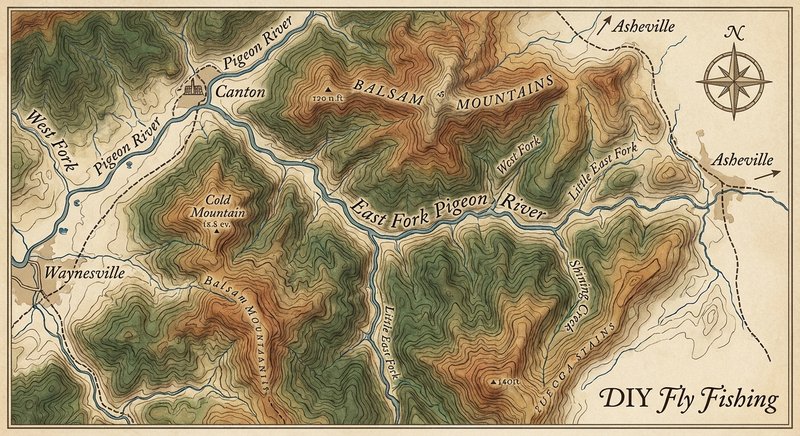
The East Fork of the Pigeon River is one of Western North Carolina’s premier fly fishing destinations. Flowing through the Shining Rock Wilderness and parallel to US-276, it offers a quintessential Appalachian trout fishing experience. Whether you are looking for technical "Wild Trout" water or high-sticking through "Hatchery Supported" runs, the East Fork provides a diverse playground for the discerning angler.
🎣 Location Overview
The East Fork is a medium-sized freestone stream that drains from the high elevations of the Blue Ridge Parkway. What makes it special is its two-faced personality:
- Lower Sections: Near the confluence with the West Fork, the river is wider with large boulders and deep pools.
- Upper Sections: As you move toward the headwaters, it tightens into a classic high-gradient mountain stream with plunging falls and tight rhododendron canopies.
The water is remarkably clear and remains cooler than many other regional rivers due to its high-altitude headwaters. Anglers love it because it offers easy roadside access without sacrificing the feeling of being deep in the Blue Ridge Mountains.
🐟 Target Species & Behavior
- Rainbow Trout: These are the most common residents, especially in the Hatchery Supported sections. They are aggressive and often hold in the faster "riffle" water where oxygen levels are highest.
- Brown Trout: The "kings" of the deeper pools. These are often wild and highly wary. They hold deep under undercut banks or behind massive boulders during the day, becoming more active during low-light hours or after a rain.
- Brook Trout: In the extreme upper reaches (near the Blue Ridge Parkway), you’ll find the native "Spec" or Southern Appalachian Brook Trout. They are small, vibrant, and incredibly opportunistic feeders in the nutrient-poor high-altitude water.
Feeding Behavior: In the lower sections, fish look for heavy stonefly nymphs and caddis. In the upper wild sections, they are opportunistic—if it looks like food and the drift is natural, they will usually strike.
📅 Best Times to Fish
Optimal Seasons
- Spring (March – May): The "Golden Age" on the East Fork. Water temperatures rise into the 50s, triggering massive hatches of Quill Gordons, Blue Quills, and Hendricksons.
- Summer (June – August): Best for the high-altitude stretches. While lower rivers get too warm, the East Fork stays fishable. Focus on terrestrial patterns (ants, beetles).
- Fall (September – November): The Brown Trout spawn makes them aggressive. The scenery is world-class, and the Blue-Winged Olive (BWO) hatches are consistent on cloudy days.
Best Times of Day
- Spring/Fall: Mid-day (10:00 AM – 3:00 PM) when the water warms slightly and bugs begin to move.
- Summer: Early morning (sunrise to 10:30 AM) and late evening (the "magic hour" before dark).
🪰 Recommended Flies & Techniques
Top Fly Patterns
- Dries: Yellow Stimulator (#12-16), Parachute Adams (#14-18), Elk Hair Caddis (Tan, #14-16), and Royal Wulff (#14).
- Nymphs: Pheasant Tail (#14-18), Frenchie (#14-16), Girdle Bug (Pat’s Rubber Legs) in Coffee/Black, and Hare’s Ear (#14-16).
- Streamers: Woolly Bugger (Olive or Black, #8-10) for the deeper pools after a rain.
- Terrestrials: Dave’s Hopper or a simple Cinnamon Ant (#16).
Effective Techniques
- Dry-Dropper: This is the "bread and butter" technique here. Use a buoyant Stimulator as your indicator and hang a Pheasant Tail nymph 18-24 inches below it.
- European Nymphing: Very effective in the high-gradient pocket water. Using weighted jig nymphs allows you to get deep into the small "buckets" behind rocks.
- Stealth Approach: Because the water is so clear, stay low and fish "upstream." If you stand at the head of a pool, the fish will see you before you ever cast.
💡 Pro Tips & Local Knowledge
- The "Hatchery" Transition: The section from the Bridges Camp Gap area down to the Sunburst Campground is heavily stocked. If you want high numbers of fish, stay here. If you want wild, solitary fishing, hike 2+ miles upstream from the last parking area into the Wilderness boundary.
- Check the Gauges: The East Fork reacts quickly to rain. If the USGS gauge shows a sharp spike, the water will be turbid. However, as it begins to "clear to a tea color," the streamer fishing for big Browns is world-class.
- The 6x Rule: These fish can be leader-shy in the slow pools. Use 6x fluorocarbon tippet for nymphs and 6x nylon for dry flies to ensure a natural drift.
- Look for "Ledges": The geology here creates underwater rock ledges. Even in shallow water, a 6-inch ledge can hold a 14-inch trout.
⚠️ Important Information
Access Information
Most of the river follows US-276 (Cruso Road). There are numerous pull-offs between the town of Bethel and the Blue Ridge Parkway.
- Sunburst Campground: A popular hub for access.
- Wilderness Access: Park at the Big East Fork Trailhead for access to the wilder, "hike-in" water.
Regulations & Permits
- Licensing: You must have a valid North Carolina Fishing License with a Trout Privilege.
- Classification: Be aware of the signs! Parts of the East Fork are Hatchery Supported (Closed in March, kept fish allowed in season), while other upper reaches fall under Wild Trout regulations (Barbless hooks, catch and release or strict size limits). Check the NCWRC website for the most current map.
Special Considerations
- Safety: The rocks in the East Fork are notoriously slippery. Felt-soled boots or studs are highly recommended.
- Wildlife: This is Black Bear country. While they generally avoid humans, keep your snacks sealed and be aware of your surroundings, especially in the Wilderness areas.
Bug Hatches & Matching Flies
| Hatch | Type | Peak months | Time of day | Hook sizes | Matching flies |
|---|---|---|---|---|---|
| Quill Gordon Epeorus pleuralis | mayfly | March, April | Midday | #12-14 | Quill Gordon Dry #12-14, Quill Gordon Nymph #12-14 |
| Blue Winged Olive Baetis spp. | mayfly | March, April, October, November | Afternoon | #18-22 | RS2 #20-22, Parachute BWO #18-22, Pheasant Tail Nymph #18-20 |
| March Brown Maccaffertium vicarium | mayfly | April, May | Midday to Afternoon | #10-14 | American March Brown #10-12, Hare's Ear Nymph #12-14 |
| Yellow Sally Isoperla spp. | stonefly | May, June, July | Late Afternoon/Evening | #14-16 | Yellow Stimulator #14-16, Little Yellow Sloan #14-16 |
| Light Cahill Stenacron interpunctatum | mayfly | May, June, July | Evening | #12-16 | Light Cahill #12-16, Cream Variant #14-16 |
| Tan Caddis Hydropsyche spp. | caddis | April, May, June | All Day/Evening | #14-18 | Elk Hair Caddis #14-18, Holy Grail Caddis #14-16, Pupa-Lezza #14-18 |
| Golden Stonefly Acroneuria spp. | stonefly | June, July | Morning/Evening | #8-12 | Golden Stone Nymph #8-12, Pat's Rubber Legs #8-12 |
| Blue-Winged Teal (Blue Quill) Paraleptophlebia adoptiva | mayfly | March, April | Midday | #16-18 | Blue Quill Dry #16-18, Pheasant Tail #16-18 |
| Terrestrials (Ants/Beetles) Formicidae / Coleoptera | terrestrial | July, August, September | All Day | #12-18 | Black Foam Ant #14-18, Jackson's Beetle #12-16 |