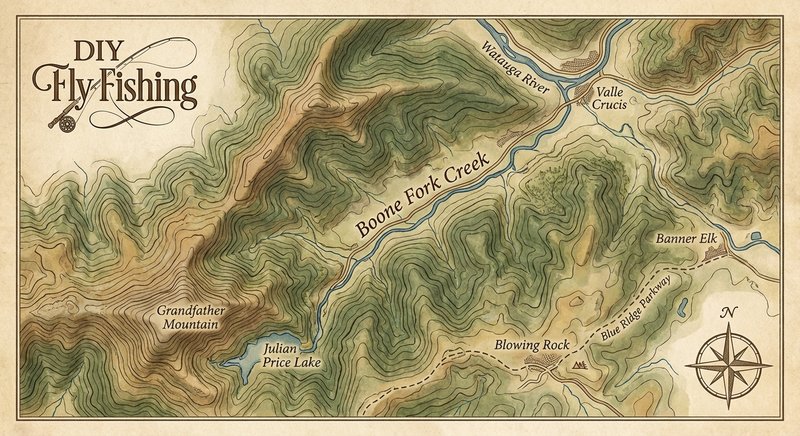
Boone Fork Creek
Fly fishing in North Carolina · Beginner · Best seasons: Spring, Summer, Fall
Target Species
Brown Trout, Rainbow Trout
About This Water
High country stream near Blue Ridge Parkway. Wild trout and beautiful scenery.
Fishing Recommendations
Welcome to the High Country of North Carolina. As your guide, I’m excited to introduce you to Boone Fork Creek. Located just off the Blue Ridge Parkway near Blowing Rock, Boone Fork is a "mountain gem" that offers a quintessential Southern Appalachian fly fishing experience.
🎣 Location Overview
Boone Fork Creek is a high-gradient mountain stream that flows through Julian Price Memorial Park. What makes this water special is its diversity of character. In its upper reaches, it meanders through a scenic, flat meadow (the "Price Lake" area), while further downstream, it plunges into a steep, rugged gorge filled with massive boulders, plunges, and deep crystalline pools.
Anglers love it because it offers a "choose your own adventure" experience: you can fish easy-access meadow water or hike deep into the gorge for a wild, backcountry feel. The water is exceptionally clear, cold, and well-oxygenated, supporting a healthy population of both wild and stocked trout.
🐟 Target Species & Behavior
- Wild Brown Trout: These are the "kings" of the deeper, darker holes in the gorge. They are notoriously spooky and thrive in the undercut banks of the meadow section and the shadows of the boulder gardens.
- Wild & Stocked Rainbow Trout: You’ll find rainbows in the swifter water—heads of pools and riffles. The wild fish are small but fiery, while the stocked fish (found near bridge access points) are larger but less selective.
Behavior: In the meadow, fish are "skinny water" experts; they see everything. In the gorge, they are opportunistic. Because mountain streams are nutrient-poor, these fish can't afford to pass up a meal, but they will bolt at the sight of a shadow or a sloppy cast.
📅 Best Times to Fish
- Spring (March – June): This is the prime window. As the water warms to the 50s, the insects become active. Late April and May provide the most consistent dry fly action.
- Summer (July – August): Unlike lower-elevation streams, Boone Fork stays relatively cool due to its elevation. However, fish early in the morning or late in the evening. This is "terrestrial season"—think beetles and ants.
- Fall (September – November): A magical time. The Brown trout become aggressive as they prepare to spawn. The fall colors in the gorge are world-class, and the Blue Winged Olive hatches pick up.
Optimal Window: 9:00 AM to 2:00 PM in the Spring; 6:00 AM to 10:00 AM in the Summer.
🪰 Recommended Flies & Techniques
Top Fly Patterns
- Dry Flies:
- Yellow Stimulator (Size 14-16) – Mimics stoneflies and looks like a general "snack."
- Parachute Adams (Size 16-20) – The gold standard for the meadow section.
- Elk Hair Caddis (Size 14-18) – Tan or Olive.
- Nymphs:
- Pheasant Tail (Size 16-18) – Flashy or natural.
- Bead-head Prince Nymph (Size 14-16) – Great for the faster pocket water in the gorge.
- Pat’s Rubber Legs (Size 10-12) – Effective for larger Browns in deep pools.
- Terrestrials:
- Black Foam Beetles or Chernobyl Ants (Summer months).
Techniques
- Dry-Dropper: This is the most effective way to fish Boone Fork. Use a buoyant dry fly (like a Stimulator) and hang a small nymph 18–24 inches below it.
- High-Sticking: In the boulder-heavy gorge, keep as much fly line off the water as possible to avoid drag caused by complex currents.
- Stealth: Kneel when approaching the meadow sections. If you can see the fish, they have likely already seen you.
💡 Pro Tips & Local Knowledge
- The "Price Lake" Meadow: Everyone fishes the bridge, but if you walk the Boone Fork Trail about a half-mile downstream from the picnic area, the pressure drops significantly.
- The Gorge Challenge: If you are physically fit, hike into the Boone Fork Gorge. The fishing is harder because of the terrain, but the fish are less "educated" and the scenery is spectacular.
- Wait for the "Drop": Boone Fork rises quickly after rain. The best fishing is often 24 hours after a rain event when the water is "tannic" (tea-colored) but clearing; this gives you a stealth advantage over the trout.
- Gear: Use a 7.5 to 8.5-foot 3-weight or 4-weight rod. A long rod is a liability in the tight rhododendron tunnels of the gorge.
⚠️ Important Information
- Access: Access is primarily via the Julian Price Memorial Park (Blue Ridge Parkway Milepost 296.4). The Boone Fork Trail (a 5-mile loop) follows the creek for a large portion of its length.
- Regulations: Boone Fork Creek is generally classified under "Wild Trout Waters" within the Blue Ridge Parkway boundaries, but parts are "Catch and Release Artificial Lures Only." Always check the latest NCWRC maps, as regulations can change at property boundaries.
- Permits: You need a valid North Carolina Fishing License with a Trout Ribbon/Privilege.
- Safety: The rocks in the gorge are "black snot" slippery. Felt-soled boots or studs are highly recommended. Also, be bear-aware; this is National Park land, and sightings are common.
Tight lines, and enjoy one of the finest small streams North Carolina has to offer!
Bug Hatches & Matching Flies
| Hatch | Type | Peak months | Time of day | Hook sizes | Matching flies |
|---|---|---|---|---|---|
| Quill Gordon Epeorus pleuralis | mayfly | March, April | Mid-day | #12-14 | Quill Gordon Dry #12-14, Iron Blue Dun #12-14 |
| Blue Quill Paraleptophlebia adoptiva | mayfly | March, April | Afternoon | #16-18 | Blue Quill Dry #16-18, Pheasant Tail Nymph #16-18 |
| March Brown Maccaffertium vicarium | mayfly | May | Afternoon | #10-12 | American March Brown #10-12, Gold Ribbed Hare's Ear #10-12 |
| Yellow Sally Isoperla | stonefly | May, June, July | Late Afternoon/Evening | #14-16 | Yellow Stimulator #14-16, Little Yellow Stone Nymph #14-16 |
| Light Cahill Stenacron interpunctatum | mayfly | June, July | Evening | #12-14 | Light Cahill #12-14, Cream Variant #14 |
| Golden Stonefly Acroneuria lycorias | stonefly | May, June | Morning/Evening | #6-10 | Pat's Rubber Legs #6-10, Golden Stone Dry #8-10 |
| Blue Winged Olive Baetis | mayfly | March, October, November | Mid-day/Overcast | #18-22 | BWO Sparkle Dun #18-22, Adams Parachute #18-22 |
| Eastern Terrestrials Formicidae / Coleoptera | terrestrial | July, August, September | All Day | #12-18 | Black Foam Ant #16-18, Crowe Beetle #14-16 |