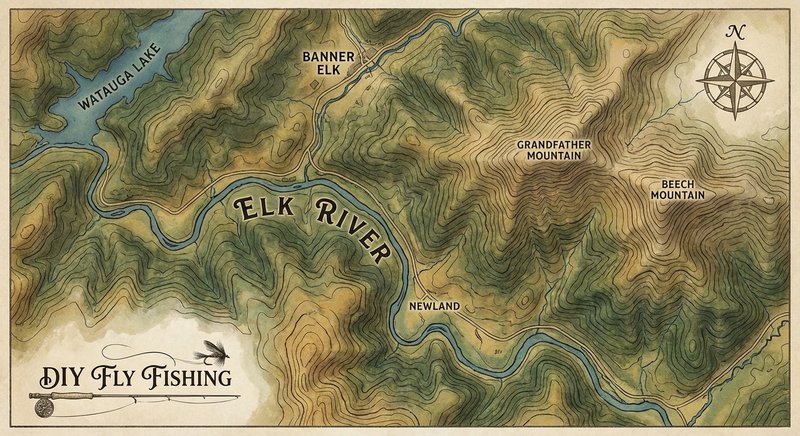
Elk River
Fly fishing in North Carolina · Intermediate · Best seasons: Spring, Summer, Fall
Target Species
Brown Trout, Rainbow Trout
About This Water
Mountain stream near Banner Elk with wild trout. Beautiful high country scenery.
Fishing Recommendations
The Elk River in North Carolina is one of the High Country’s most cherished fly fishing destinations. Flowing through the rugged terrain of Avery County near the towns of Banner Elk and Elk Park, it offers a quintessential Appalachian fly fishing experience. As your guide, I’m here to break down exactly how to find success on these waters.
🎣 Location Overview
The Elk River is a high-gradient freestone stream that originates on the slopes of Grandfather Mountain. It is a river of contrasts: in its upper reaches, it is a small, intimate creek; as it descends, it transforms into a medium-sized river characterized by massive boulders, deep plunges, and classic pool-and-riffle sequences.
What makes the Elk special is its Delayed Harvest (DH) section and its stunning scenery—most notably the 60-foot Elk River Falls. Anglers love the Elk because it offers a "big water" feel in a mountain setting, with enough room for technical casting while remaining accessible to those who enjoy wading.
🐟 Target Species & Behavior
The Elk River is primarily managed for Rainbow and Brown Trout.
- Rainbow Trout: These are the primary residents of the Delayed Harvest section. They are generally opportunistic and will hold in the faster "bubble trails" and at the heads of pools where oxygen levels are high.
- Brown Trout: The Elk is known for producing some truly large, wild-born Browns, especially in the deeper, boulder-choked pools. These fish are predatory and wary. They tend to hold deep under cut banks or in the shadows of large rocks during the day, becoming more active during low-light transitions or after a rain.
- Feeding Behavior: In the spring, fish are aggressive and key in on heavy aquatic insect hatches. In the heat of summer, they move to oxygenated riffles. By fall, the Brown trout become aggressive as they prepare for the spawn.
📅 Best Times to Fish
Optimal Seasons
- Spring (March – May): This is the crown jewel of the season. The Delayed Harvest section is heavily stocked, and the wild fish are waking up. You’ll see the best hatches of the year during this window.
- Fall (October – November): As water temperatures drop, the DH section is restocked, and the wild Browns begin to move. The foliage makes this the most scenic time to be on the water.
- Summer (June – August): Focus on the early mornings and late evenings. The upper, higher-elevation stretches stay cooler, but the lower sections can get warm, so carry a thermometer.
Prime Windows
- Time of Day: During the spring and fall, 10:00 AM to 4:00 PM is the "sweet spot" as the sun warms the water and triggers insect activity. In the summer, be on the water at dawn or dusk.
- Conditions: A "stained" river after a light rain is ideal for hunting large Browns with streamers.
🪰 Recommended Flies & Techniques
Top Fly Patterns
- Nymphs:
- Frenchie or Pheasant Tail (Size 14–18) — A staple for the Elk.
- Pat’s Rubber Legs (Size 8–12) — Essential for mimicking the large Golden Stoneflies found here.
- Sexy Walt’s Worm — Highly effective in the DH section.
- Dry Flies:
- Yellow Stimulator (Size 12–16) — Great for the high-floating pocket water.
- Parachute Adams (Size 14–20) — The go-to for matching most hatches.
- Elk Hair Caddis (Size 14–16) — Use this in the riffles.
- Streamers:
- Black or Olive Woolly Bugger (Size 6–10).
- Game Changer or Sex Dungeon — For those targeting trophy Browns in deep holes.
Techniques
- Tight-Line Nymphing (Euro Nymphing): Because the Elk is full of complex currents and pocket water, a tight-line approach is often more productive than using a bobber (indicator). It allows you to get your flies deep into the slots between boulders.
- Dry-Dropper: In the summer and early fall, a buoyant Stimulator with a small beaded nymph 18 inches below is deadly in the shallower runs.
- The "Swing": At the tail-outs of the large pools, swinging a soft hackle or a small streamer can trigger aggressive strikes from Rainbows.
💡 Pro Tips & Local Knowledge
- The "Banner Elk" Stretch: The water running through the town of Banner Elk (Tate-Evans Park) is an excellent place for beginners and families. It is well-stocked and easy to wade.
- Approach with Stealth: The water in the Elk can be crystal clear. Wear earthy tones and avoid "lining" the fish (casting your heavy fly line directly over their heads). Use long 5X or 6X fluorocarbon leaders for the best results.
- Target the "Micro-Eddies": On the Elk, some of the biggest fish hold in tiny pockets of calm water behind large boulders that most anglers walk right past.
- Respect the Private Property: The Elk River is famous for its private "trophy" clubs (like the Elk River Club). Ensure you are in the public/DH water or have permission before casting.
⚠️ Important Information
Access Information
- Delayed Harvest Section: This stretch starts at the NC 194 bridge at Banner Elk and extends downstream to the dam at Elk Park.
- Wild Water: Higher elevations above Banner Elk are classified as Wild Trout waters.
- Elk River Falls: There is a public parking area at the end of Elk River Road (SR 1303). The fishing below the falls is rugged but rewarding.
Regulations & Permits
- License: You must have a valid North Carolina Fishing License with a Trout "privilege" (trout stamp).
- Delayed Harvest Rules: From October 1 until the first Saturday in June, the DH section is Catch and Release Only and restricted to Single-Hook Artificial Lures. No bait is allowed during this time.
- Wild Trout Waters: These areas have a 7-inch minimum size limit and a 4-fish creel limit, but most local guides recommend 100% catch and release to preserve the fishery.
Safety
The rocks on the Elk River are notoriously slippery. Wading boots with felt soles or carbide studs are highly recommended. Also, be aware that the water can rise quickly during mountain thunderstorms.
Bug Hatches & Matching Flies
| Hatch | Type | Peak months | Time of day | Hook sizes | Matching flies |
|---|---|---|---|---|---|
| Blue Winged Olive (BWO) Baetis | mayfly | March, April, October, November | Midday | #18-22 | Parachute Adams #18-22, RS2 #20-22, Pheasant Tail Nymph #18-20 |
| Quill Gordon Epeorus pleuralis | mayfly | March, April | Afternoon | #12-14 | Quill Gordon Dry #12-14, Gold Ribbed Hare's Ear #12-14 |
| Hendrickson Ephemerella subvaria | mayfly | April, May | Afternoon | #12-14 | Hendrickson Parachute #12-14, Red Quill #14, Ephemerella Nymph #12-14 |
| Yellow Sally Isoperla | stonefly | May, June, July | Late Afternoon/Evening | #14-16 | Yellow Stimulator #14-16, Little Yellow Stone Nymph #14-16 |
| Tan Caddis Hydropsyche | caddis | April, May, June, September | Morning/Evening | #14-18 | Elk Hair Caddis #14-18, Holy Grail #14-16, Soft Hackle Hare's Ear #14-16 |
| March Brown Maccaffertium vicarium | mayfly | April, May | Afternoon | #10-12 | March Brown Dry #10-12, Gold Ribbed Hare's Ear #10-12 |
| Light Cahill Stenonema | mayfly | June, July | Evening | #12-14 | Light Cahill #12-14, Cream Variant #14 |
| Giant Black Stonefly Pteronarcys dorsata | stonefly | May, June | Morning/Afternoon | #4-8 | Pats Rubber Legs #6-8, Black Stimulator #8 |
| Cinnamon Caddis Ceraclea | caddis | July, August, September | Evening | #16-18 | Cinnamon Caddis Dry #16-18, Pupa (Caddis) #16-18 |
| Midges Chironomidae | midge | January, February, December | All Day | #20-26 | Zebra Midge #20-22, Griffith's Gnat #20-22, Mercury Midge #20-24 |