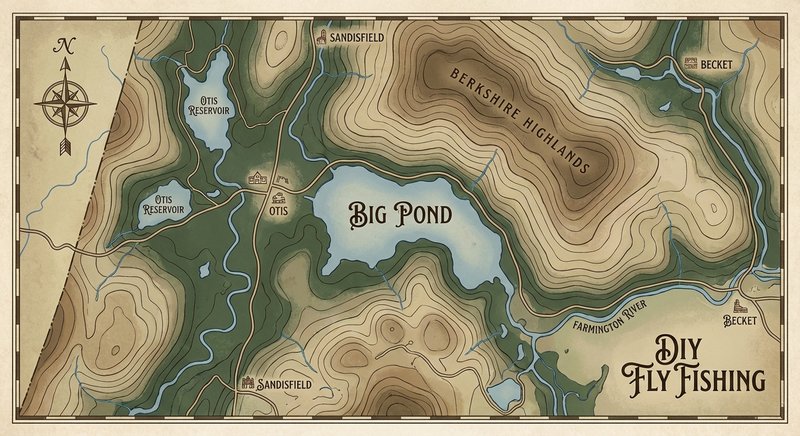
Big Pond
Fly fishing in Massachusetts · Beginner · Best seasons: Spring, Summer, Fall
Target Species
Brown Trout, Rainbow Trout
About This Water
Berkshire County pond with trout. Otis area fishing.
Fishing Recommendations
As an expert guide familiar with the Berkshire Highlands, I can tell you that Big Pond in Otis, Massachusetts, is one of the premier stillwater destinations in the state. While many fly anglers in Western Mass gravitate toward the Deerfield or Farmington Rivers, Big Pond offers a classic "lake fly fishing" experience that is rare in Southern New England.
Here is your comprehensive guide to fly fishing Big Pond.
🎣 Location Overview
Big Pond is a 330-acre "Great Pond" located in the town of Otis. Unlike many shallow Massachusetts ponds, Big Pond has a significant maximum depth of about 27 feet and an average depth of 14 feet.
What makes it special for fly anglers is its water quality and the Massachusetts Division of Fisheries and Wildlife (MassWildlife) stocking program. Because the water stays relatively cool and oxygenated at depth, it holds trout well into the warmer months. The shoreline is scenic but heavily developed with seasonal cottages, meaning the best way to fish it—and the way to truly experience its beauty—is from a boat, kayak, or float tube.
🐟 Target Species & Behavior
While Big Pond holds Smallmouth Bass and Pickerel, the fly angler’s primary targets here are:
- Rainbow Trout: These are the most abundant. They tend to cruise the upper 5–10 feet of the water column in spring and fall. They are opportunistic feeders, often schooling up and following hatches or baitfish schools.
- Brown Trout: The "glory" fish of Big Pond. Browns here are known to hold deeper and are more nocturnal/crepuscular. Some "holdover" browns survive the winter, growing to impressive sizes by feeding on the pond’s abundant yellow perch fry and crayfish.
- Behavior: In the spring, trout will be found near the shorelines and the northern inlet. As the water warms in summer, they retreat to the "kettle" holes and deeper basins in the center of the pond, requiring sinking lines to reach them.
📅 Best Times to Fish
- Spring (Late April – Early June): Prime Time. This is immediately following the spring stocking. The fish are near the surface and very aggressive. Mayfly hatches (specifically Quill Gordons and Hendricksons in the area) can bring fish to the surface.
- Summer (July – August): Challenging but rewarding. You must fish early in the morning (dawn till 8:00 AM) or late evening. You will need a Type 3 or Type 5 sinking line to get your flies down to the thermocline (15–20 feet).
- Fall (September – October): The "Second Season." As water temperatures drop, trout become active again in the shallows. This is the best time to target large, aggressive Brown Trout preparing for their spawning cycle.
🪰 Recommended Flies & Techniques
Top Fly Patterns
- Streamers: Woolly Buggers (Olive, Black, and White) size 6–10; Mickey Finn; Black Ghost; and small "Perch" imitations (to mimic the local forage).
- Nymphs: Gold-Ribbed Hare’s Ear (size 12–14), Zebra Midges (size 18–20), and Pheasant Tails.
- Dry Flies: Adams (size 14–16) for general hatches; Elk Hair Caddis; and Terrestrials (Ants and Beetles) in late summer near the overhanging shoreline trees.
- Attractors: Booby Flies or Blob Flies (fished on a sinking line) can be deadly for stocked rainbows.
Effective Techniques
- The "Slow Strip": Using an intermediate sinking line, cast streamers toward the rocky shorelines or submerged structures and use a slow, 6-inch stripping motion.
- Indicator Nymphing: In the spring, hang a Zebra Midge or a Chironomid 4–6 feet under a small indicator. Let the wind drift your boat and your fly—this "static" presentation is often more effective than stripping.
- Trolling the Fly: If you are in a kayak or canoe, simply let out 40–50 feet of line with a weighted streamer and paddle slowly. This covers water and locates schools.
💡 Pro Tips & Local Knowledge
- Focus on the West Shore: The western bank has some excellent rocky drop-offs where Brown Trout love to hide.
- The "Inlet" Factor: Look for the small northern inlet after a rainstorm. The influx of fresh, oxygenated water brings in insects and attracts trout like a magnet.
- Watch the Wind: Because Big Pond is relatively open, wind can be an issue. Use the wind to your advantage by "drift fishing" from the windward to the leeward side, covering the vast flats in the middle where rainbows cruise.
- The Evening Rise: Even if you don't see bugs, Big Pond often has a "midge hour" at dusk. Look for tiny dimples on the glassy surface. Switch to a size 20 Griffith's Gnat on a long, fine leader (6x).
⚠️ Important Information
- Access: There is a public boat ramp located on the southern end off of Algeree Road. It is well-maintained but can get crowded with powerboats on summer weekends.
- Regulations: Massachusetts fishing regulations apply. A valid MA freshwater fishing license is required. There are no "fly fishing only" restrictions, so be prepared to share the water with gear anglers.
- Safety: Big Pond allows motorized vessels. If you are in a float tube or kayak, stay visible (use a flag or bright clothing) and stay close to the shoreline during high-traffic midday hours.
- Cleanliness: The Otis lake community is very proactive about invasive species. Ensure your boat, trailer, and waders are "Clean, Drain, and Dry" to prevent the spread of zebra mussels or milfoil.
Guide’s Final Word: Big Pond is a "thinking man's" trout water. It requires patience and the ability to find the depth where fish are holding. Master the sinking line here, and you'll outfish everyone on the water.
Bug Hatches & Matching Flies
| Hatch | Type | Peak months | Time of day | Hook sizes | Matching flies |
|---|---|---|---|---|---|
| Midges Chironomidae | midge | April, May, September | All day | #18-24 | Zebra Midge #18-22, Griffith's Gnat #20-22, Palomino Midge #20-24 |
| Speckled Spinner / Callibaetis Callibaetis | mayfly | June, July, August | Late Morning/Afternoon | #14-16 | Callibaetis Spinner #14-16, Hare's Ear Nymph #14-16, Parachute Adams #14-18 |
| Giant Michigan Mayfly (Hex) Hexagenia limbata | mayfly | June, July | Dusk/Night | #6-10 | Hexagenia Dry #6-8, Hexagenia Nymph #6-10, Brooks Sprout Hex #8 |
| Cinnamon Caddis Hydropsyche | caddis | June, July | Evening | #14-18 | Elk Hair Caddis (Tan) #14-16, LaFontaine's Deep Sparkle Pupa #14-18, Iris Caddis #16 |
| Damselfly Enallagma | terrestrial | June, July, August | Late Morning/Afternoon | #10-14 | Marabou Damselfly Nymph #10-12, Adult Damsel (Blue) #12-14 |
| White Miller Ephoron leukon | mayfly | August | Evening/Dusk | #12-14 | White Wulff #12-14, Ephoron Dun #14 |
| Terrestrials (Ants/Beetles) Formicidae / Coleoptera | terrestrial | July, August, September | Afternoon | #12-20 | Black Foam Ant #16-20, Chernobyl Ant #10-12, Crowe Beetle #14-16 |
| Tricos Tricorythodes | mayfly | August, September | Early Morning | #20-24 | Trico Spinner #20-24, RS2 #20-22 |