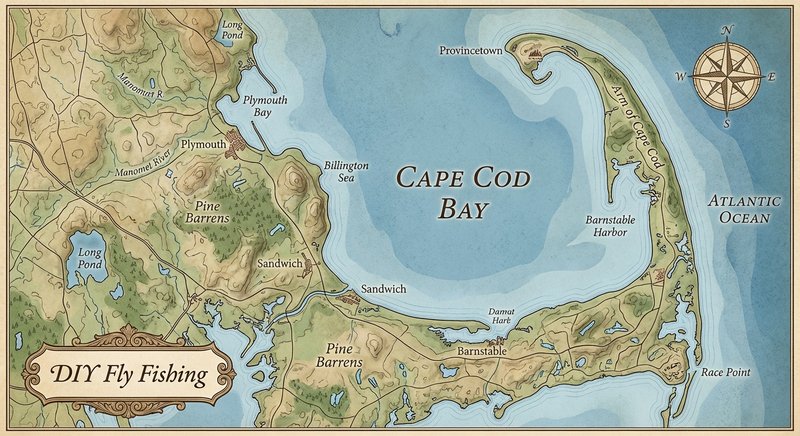
Cape Cod Bay
Fly fishing in Massachusetts · Intermediate · Best seasons: Spring, Summer, Fall
Target Species
Striped Bass, Bluefish, Flounder
About This Water
Excellent striped bass fishing with spring migration. Fly fishing the flats.
Fishing Recommendations
Welcome to Cape Cod Bay, one of the most storied saltwater fly fishing destinations in the world. As a guide, I consider this "The Arena." It’s a place where the tides dictate your life and the sight-fishing opportunities on the flats can rival anything you’d find in the Bahamas—only here, the targets are broad-shouldered Striped Bass.
🎣 Location Overview
Cape Cod Bay is a massive body of water tucked into the "arm" of Massachusetts. What makes it special is the Brewster Flats—the largest tidal flats system in North America. During low tide, the ocean retreats for miles, revealing a lunar landscape of sandbars, ripples, and "sloughs" (deeper channels).
The water is generally clear, with a sandy bottom that provides a perfect backdrop for sight-casting. It is a diverse ecosystem ranging from the deep, turbulent rips off Race Point to the marshy estuaries of Barnstable Harbor and the expansive, quiet sands of Wellfleet and Brewster.
🐟 Target Species & Behavior
Striped Bass (The King)
Stripers are the primary draw.
- Behavior: In the spring, "schoolies" (smaller fish) arrive first, followed by "cows" (large females). They are opportunistic. On the flats, they cruise the edges of sandbars looking for sand eels. In the marshes, they hold in the "drain" as the tide drops to intercept bait.
- Feed: Their diet is dominated by sand eels, but they also gorge on Atlantic Silversides, menhaden (pogy), crabs, and "mumpers" (juvenile herring).
Bluefish (The "Yellow-Eyed Devil")
Bluefish are the chaos factor.
- Behavior: They move in fast-moving schools, often identified by "blitzes" where the water looks like it’s boiling. They are aggressive, fast, and have teeth that will shred a fly (and a finger).
- Feed: Anything that moves. They are particularly fond of peanut bunker and silversides.
Winter Flounder
While primarily a bait-and-sinker fish, Flounder can be caught on a fly if you’re patient.
- Behavior: They are bottom-dwellers, camouflaged against the sand. They wait for small crustaceans or worms to drift by.
- Feed: Tiny shrimp, marine worms, and small crabs.
📅 Best Times to Fish
- Spring (May - June): This is the peak for flats fishing. As the water warms to the 50s and low 60s, the migration arrives hungry. June is the "Magic Month" for sight-casting.
- Summer (July - August): The flats get hot during the day. Focus on low-light hours (dawn/dusk) or night fishing. Deep water rips like Billingsgate Shoal hold larger fish seeking cooler temperatures.
- Fall (September - October): The "Fall Run." Fish are bulking up for the migration south. Expect intense surface activity (blitzes) as they corral bait against the beaches.
The Golden Rule of the Bay: The Tides. In Cape Cod Bay, the tide can swing 9 to 12 feet. Most fly anglers prefer the "push" (incoming tide) as fish move onto the flats to hunt, or the last two hours of the ebb (outgoing) when fish are forced into the deeper channels.
🪰 Recommended Flies & Techniques
Top Fly Patterns
- Sand Eel Imitations: The most critical fly in your box. Mushmouths, Jiggy Fleyes, or Epoxy Sand Eels in olive/white or chartreuse/white.
- Clouser Minnow: The universal soldier. Chartreuse/white or tan/white. Use these to get deeper in the channels.
- The Gurgler: For heart-stopping surface takes. Fish these over shallow grass or during a dusk "pop."
- Hollow Fleyes / Deceivers: Use these when larger bait (menhaden) are present, especially in the fall.
- Crab Patterns: Small tan Merkin-style crabs for stripers tailing in the skinny water.
Techniques
- The "Flats Walk": Move slowly. Use high-quality polarized glasses (amber or copper lenses are best for the Bay’s sand). Look for "shadows" or the nervous water of a cruising fish.
- The Two-Handed Strip: To mimic a fleeing sand eel, tuck the rod under your arm and use both hands to strip the line rapidly and smoothly.
- Blind Casting the Rips: In areas like Scorton Creek or Barnstable Harbor, cast across the current, let the fly swing, and strip it back through the seam.
💡 Pro Tips & Local Knowledge
- The "Brewster Bar" Warning: This is vital. When wading the flats, the tide comes in behind you, filling the sloughs first. You can easily get cut off from the shore by a 10-foot deep channel while you're still standing on a shallow bar a mile out. Always have a path back to shore.
- Match the Profile, Not Just the Color: Stripers are picky in clear water. If the sand eels are 3 inches long, don't throw a 7-inch Deceiver.
- Go Stealthy: On the flats, a heavy fly line landing over a fish's head will spook it. Aim 3-5 feet in front of a cruising fish and let them swim into the "strike zone."
- Scorton Creek: A legendary spot for shore-bound anglers. The mouth of the creek on an outgoing tide acts like a conveyor belt of food for bass.
⚠️ Important Information
Access
- Public Beaches: Many beaches (like Mayflower or Chapin) require resident parking stickers in the summer. However, before 8:00 AM and after 4:00 PM, restrictions are often relaxed.
- Wading: Most of the Bay's shoreline is sandy and easy to wade, but be mindful of private property lines above the high-water mark.
Regulations & Permits
- MA Saltwater Fishing Permit: Required for everyone age 16 and older. It’s cheap and available online.
- Striped Bass Regulations: Massachusetts has strict "slot limit" laws (currently 1 fish between 28" and less than 31" per day, though this changes frequently—check current Division of Marine Fisheries regs before you go). Most fly anglers practice 100% catch and release.
Safety
- Water Temps: Even in June, the water can be chilly. Breathable waders are standard.
- Sun: The reflection off the white sand is brutal. Buffs, hats, and sunscreen are non-negotiable.
Tight lines, and remember: Keep your tip down until you feel the weight of the fish! Don't trout-set on a Striper!
Bug Hatches & Matching Flies
| Hatch | Type | Peak months | Time of day | Hook sizes | Matching flies |
|---|---|---|---|---|---|
| Cinder Worm Alitta succinea | midge | May, June | Evening | #2-6 | Red Cinder Worm #2-4, Floating Worm #4-6 |
| Salt Marsh Midge Chironomidae | midge | June, July, August | Evening | #18-24 | Griffith's Gnat #18-22, Zebra Midge #20-22 |
| Flying Ants Formicidae | terrestrial | August, September | Afternoon | #12-18 | Black Ant #14-16, Chernobyl Ant #12-14 |
| Salt Marsh Grasshopper Melanoplus spp. | terrestrial | July, August, September | Afternoon | #8-12 | Joe's Hopper #10-12, Dave's Hopper #8-10 |
| Blue-Winged Olive Baetis | mayfly | April, May, September, October | Afternoon | #18-22 | BWO Sparkle Dun #18-20, Pheasant Tail #18-22 |
| Greenhead Fly Tabanus nigrovittatus | terrestrial | July | Morning/Afternoon | #10-14 | Deer Hair Beetle #12-14, Black Gnat #14 |
| Salt Marsh Beetle Cicindela dorsalis | terrestrial | June, July, August | Afternoon | #10-14 | Foam Beetle #12-14, Crow Beetle #14 |
| Coastal Trico Tricorythodes | mayfly | July, August | Morning | #20-24 | Trico Spinner #22-24, RS2 #20-22 |