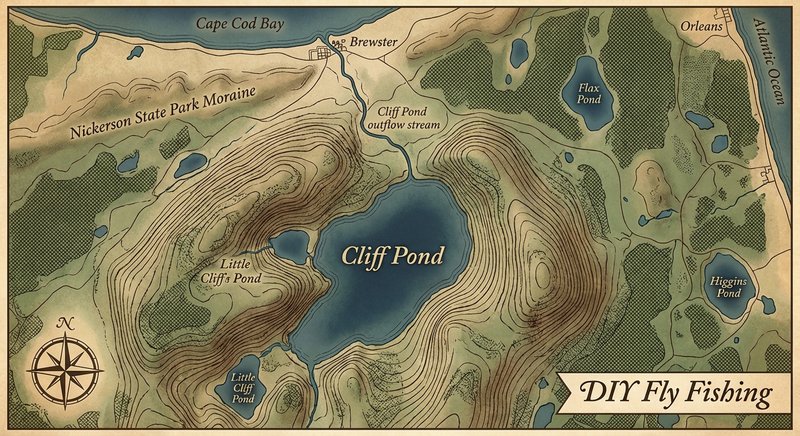
Cliff Pond
Fly fishing in Massachusetts · Beginner · Best seasons: Spring, Summer, Fall
Target Species
Brown Trout, Largemouth Bass, Pickerel
About This Water
Cape Cod pond in Nickerson State Park. Trout and bass.
Fishing Recommendations
Welcome to one of the crown jewels of Cape Cod fly fishing. As your guide, I can tell you that Cliff Pond in Nickerson State Park is a unique destination. Unlike many of the shallow, weedy ponds on the Cape, Cliff is a deep, crystal-clear "kettle hole" pond formed by retreating glaciers. Its depth and water quality make it one of the premier trout fisheries in Massachusetts, while still offering excellent warm-water action.
Here is your comprehensive guide to fly fishing Cliff Pond.
🎣 Location Overview
Cliff Pond is the largest body of water within Nickerson State Park in Brewster, MA. Covering roughly 200 acres with depths reaching over 80 feet, it is characterized by its sandy shoreline, startlingly clear water, and dramatic drop-offs.
What makes it special is the "Two-Story" fishery. Because it is so deep, the bottom layers of water stay cold and oxygenated throughout the summer, allowing stocked trout to "hold over" and grow to trophy sizes. Anglers love it because it offers a "big water" feel with the accessibility of a state park, allowing for both productive wading and excellent float-tube or kayak fishing.
🐟 Target Species & Behavior
Brown Trout
These are the prize of Cliff Pond. While the state stocks Rainbows and Brookies, the Browns are the ones that often survive multiple seasons.
- Behavior: They are wary and have excellent vision due to the water clarity. They cruise the "shelves" (where the sand flats drop into deep blue water) looking for landlocked smelt.
- Feeding: Primarily piscivorous (fish-eaters) once they reach 14+ inches, though they will rise for midge hatches and terrestrials.
Largemouth Bass
- Behavior: Found in the shallower coves and around any submerged timber or boulder piles.
- Feeding: They focus on crayfish, dragonfly larvae, and smaller sunfish. They are most active in the early morning and late evening during the summer months.
Chain Pickerel
- Behavior: The "ambush predators" of the pond. They haunt the weed edges and lily pads in the shallower fingers of the pond.
- Feeding: They will strike almost anything that moves. They are high-energy and provide great sport on a fly rod, though they are toothy and can nip off light leaders.
📅 Best Times to Fish
- Spring (April – May): Prime Time for Trout. The water is cool from top to bottom. Trout will be cruising very close to the shore. This is the best window for dry fly action and shallow nymphing.
- Summer (June – August): Bass & Night Fishing. During the day, trout retreat to 30–50 feet of water (hard to reach with a fly rod). Switch your focus to Largemouth Bass along the edges at dawn/dusk. Pro Tip: Large Brown trout often move into the shallows under the cover of total darkness in July.
- Fall (September – November): The "Second Spring." As water temperatures drop, trout move back to the shallows. The Brown trout become aggressive as they enter their spawning cycle (though they don't successfully spawn in the pond).
🪰 Recommended Flies & Techniques
For Brown Trout
- Patterns:
- Streamers: Gray Ghost, Black or Olive Woolly Buggers, and Marabou Muddlers (Size 6-10). Most importantly: White or Silver Smelt patterns (like a Mike's Meal Ticket or a Zonker).
- Nymphs: Zebra Midges (Size 18-22), Pheasant Tails (Size 14-16).
- Technique: Use a clear intermediate sinking line. This is vital. In the clear water, a bright floating line can spook fish. Strip streamers with an erratic "injured baitfish" motion along the drop-off shelves.
For Bass & Pickerel
- Patterns:
- Topwater: Deer hair poppers, Gurglers (Size 2-6).
- Subsurface: Game Changers or large Clouser Minnows.
- Technique: Focus on the "Structure." Cast into the fallen trees along the shoreline. For Pickerel, use a short section of 20lb fluorocarbon or wire tippet to prevent bite-offs.
💡 Pro Tips & Local Knowledge
- The "Shelf" is Key: Walk out until the water is waist-deep. You will see the bottom transition from light sand to a dark abyss. This is "The Shelf." Fish cruise this edge like a highway. Cast parallel to this drop-off rather than straight out into the deep.
- The Windward Shore: On windy days, don't seek shelter. Fish the shore that the wind is blowing into. The wind pushes plankton and baitfish toward that bank, and the trout follow the food.
- The "Smelt Connection": Cliff Pond has a population of landlocked smelt. If you see silver flashes or small fish jumping near the surface, tie on the brightest, silver-est streamer you have and strip it fast.
- Go Stealthy: Because the water is gin-clear, use long leaders (9–12 feet) and fluorocarbon tippet (4X or 5X for trout). Wear natural-colored clothing (tan/grey) to blend in with the sandy beach.
⚠️ Important Information
- Access: Entry is via Nickerson State Park. There is a daily parking fee for non-residents during the summer season. There are several parking lots around Cliff Pond with easy trail access to the entire perimeter.
- Regulations: A valid Massachusetts Freshwater Fishing License is required for anyone 15 or older.
- Boating: Gas-powered motors are prohibited. This makes it a paradise for fly anglers in canoes, kayaks, or belly boats.
- Safety: The pond can develop a significant "chop" when the wind kicks up from the west. If you are in a float tube, be mindful of being blown away from your launch point.
- Environment: Be aware of "Didymo" or other invasive species. Always clean, drain, and dry your waders and gear after fishing to protect the Cape's fragile kettle ponds.
Guide’s Final Word: If you want the best chance at a trophy Brown, hit the water at "O-Dark-Thirty" in May with a white streamer. Tight lines!
Bug Hatches & Matching Flies
| Hatch | Type | Peak months | Time of day | Hook sizes | Matching flies |
|---|---|---|---|---|---|
| Chironomids (Midges) Chironomidae | midge | April, May, September, October | All day | #18-24 | Zebra Midge #18-22, Griffith's Gnat #20-24, Chironocone #18-20 |
| Blue Damselfly Enallagma | terrestrial | June, July, August | Morning/Afternoon | #10-14 | Marabou Damsel Nymph #12-14, Adult Damsel #10-12 |
| Spotted Sedge Hydropsyche | caddis | May, June, July | Evening | #14-18 | Elk Hair Caddis #14-16, LaFontaine's Deep Sparkle Pupa #14-18 |
| Blue-Winged Olive Baetis | mayfly | April, May, September, October | Midday | #18-22 | RS2 #20-22, Parachute BWO #18-20 |
| Carpenter Ants Camponotus | terrestrial | June, August, September | Afternoon | #12-16 | Black Foam Ant #14-16, Fur Ant #16-18 |
| Light Cahill Stenacron canadense | mayfly | June, July | Evening | #12-14 | Light Cahill #12-14, Gold Ribbed Hare's Ear #12-14 |
| Japanese Beetle Popillia japonica | terrestrial | July, August | Afternoon | #12-14 | Foam Beetle #12-14, Peacock Beetle #14 |
| Dragonfly Anisoptera | terrestrial | July, August | All day | #6-10 | Dragonfly Nymph #8-10, Gomphus Nymph #6-8 |