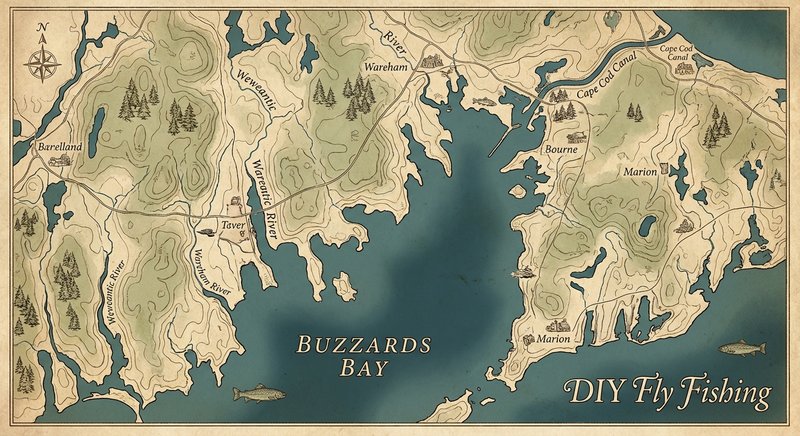
Buzzards Bay
Fly fishing in Massachusetts · Intermediate · Best seasons: Spring, Summer, Fall
Target Species
Striped Bass, Bluefish, Scup
About This Water
Excellent striped bass and bluefish. Diverse structure and flats.
Fishing Recommendations
Welcome to Buzzards Bay, Massachusetts, one of the most dynamic and productive saltwater fly fishing destinations on the East Coast. As your guide, I can tell you that this area is a "fish factory" due to its unique geography—nestled between the South Coast of Massachusetts and the Elizabeth Islands, it serves as the primary highway for migrating species heading toward the Cape Cod Canal and the Gulf of Maine.
🎣 Location Overview
Buzzards Bay is a large estuary approximately 28 miles long and 8 miles wide. What makes it special is the diversity of structure. You have everything here: shallow white-sand flats that mimic the Bahamas, jagged boulder fields reminiscent of Montauk, and deep, fast-moving "rips" near the Elizabeth Islands.
The bay warms up earlier in the spring than the open Atlantic, making it the first stop for the northern migration. The water is generally clear, allowing for exceptional sight-fishing opportunities on the flats in the upper bay and around the islands. Whether you are wading a quiet salt pond in Wareham or casting from a center console into the "washing machine" of Quicks Hole, Buzzards Bay offers world-class fly fishing.
🐟 Target Species & Behavior
Striped Bass (Stripers)
The undisputed king of the bay.
- Behavior: In May, "Schoolies" (12–24 inches) arrive first, followed by "Cows" (30+ lbs). They are structure-oriented. Early season bass hold in salt ponds and estuaries where water is warmest. By June, they move to the rocky points and reefs.
- Feeding: They focus on "Match the Hatch" scenarios—river herring in May, silversides and sand eels in June, and "Peanut" bunker (juvenile menhaden) in the fall.
Bluefish
Often called "Yellow-eyed Devils," these are the hardest-fighting fish pound-for-pound in the bay.
- Behavior: They move in aggressive packs. You will often see "blitzes" where the water turns white as they shred baitfish at the surface.
- Feeding: They aren't picky. If it moves and looks like a fish, they will eat it. They possess razor-sharp teeth that will bite through standard fluorocarbon in seconds.
Scup (Porgy)
A fantastic "light tackle" target that is often overlooked by fly anglers.
- Behavior: Scup congregate in massive schools over rock piles, oyster beds, and pier pilings.
- Feeding: They have small mouths and feed on tiny crustaceans, shrimp, and seaworms. On a 4-weight or 5-weight fly rod, a large Scup puts up a surprisingly soulful fight.
📅 Best Times to Fish
Optimal Seasons
- Spring (May - June): The "Spring Run." This is peak season. The arrival of the herring brings the largest bass of the year into shallow water.
- Summer (July - August): Fishing becomes a low-light game. Focus on "the graveyard shift" (night fishing) or the cracks of dawn/dusk for bass. Bluefish remain active all day in deeper water.
- Fall (September - October): The "Fall Blitz." Fish are fattening up for the southern migration. Expect explosive surface activity and massive schools of fish.
Prime Conditions
- The "Buzzards Bay Chop": A steady Southwest wind is common in the afternoons. While tough to cast in, a little chop masks your presence and "activates" the fish.
- Tides: The outgoing tide is generally preferred, especially near the mouths of harbors (like Marion or Mattapoisett) and the Elizabeth Island "Holes" (Robinson’s, Quicks, Canapitsit), as it flushes bait out to waiting predators.
🪰 Recommended Flies & Techniques
Top Fly Patterns
- Clouser Minnow (Chartreuse/White or Olive/White): The "don't leave home without it" fly. Mimics sand eels and silversides. Use size 1/0 to 2/0.
- Hollow Fleye / Bob's Banger: For large bass feeding on adult Menhaden.
- The Gurgler: An essential topwater fly. The "glub-glub" sound on a steady strip triggers violent strikes.
- Ray’s Fly: A classic New England flat-wing style that mimics small baitfish perfectly in clear water.
- Small Epoxy Shrimp (Size 6-8): Specifically for targeting Scup or picky Stripers on the flats.
Techniques
- Intermediate Lines: This is your workhorse. It gets the fly just below the surface wave action.
- Sinking Lines (300-400 grain): Necessary for fishing the deep rips of the Elizabeth Islands or the Cape Cod Canal entrance.
- The "Two-Handed Strip": When fishing for Bluefish, tuck the rod under your arm and strip with both hands as fast as possible. You cannot outswim a Bluefish.
💡 Pro Tips & Local Knowledge
- The Cinder Worm Hatch: In late May/early June, the salt ponds (like those in Falmouth or Dartmouth) experience a "hatch" of red/orange worms. Bass go crazy for them. You need specific small, red foam-headed flies to match this, and the fishing is very technical.
- The Elizabeth Islands: If you have access to a boat, the north side of the Elizabeths (Naushon, Pasque, Nashawena) offers some of the best boulder-field fishing in the world. Look for "white water" where waves break over rocks—bass hide right in the foam.
- Look for Birds: In Buzzards Bay, common terns and gulls are your best scouts. If you see birds hovering and dipping, there is bait, and there are almost certainly predators underneath.
⚠️ Important Information
Access
- Shore Access: Ned’s Point (Mattapoisett), Fort Phoenix (Fairhaven), and the Shining Sea Bikeway (Falmouth) offer great wading spots.
- Boat Ramps: State ramps are available in Wareham (Zecco Marina area) and Marion (Burr’s Bros).
Regulations
- Massachusetts Saltwater Fishing Permit: Required for all anglers 16 and older. It’s cheap and available online.
- Striper Regs: Rules change annually (currently a narrow "slot limit" for keepers). Always use circle hooks if you decide to use bait, though for fly fishing, ensure you are practicing "catch and release" ethics to preserve the fishery.
Special Considerations
- The "Buzzards Bay Chop": This bay can get dangerous quickly for small boats when a Southwester kicks up against an outgoing tide. Always check the marine forecast.
- Safety: If wading the boulder fields, Korkers (studded wading boots) are mandatory. The rocks are covered in "black snot" algae and are incredibly slippery.
Tight lines, and I'll see you out on the salt!
Bug Hatches & Matching Flies
| Hatch | Type | Peak months | Time of day | Hook sizes | Matching flies |
|---|---|---|---|---|---|
| Midges Chironomidae | midge | April, May, September, October | All Day | #18-24 | Zebra Midge #18-22, Griffith's Gnat #20-24, Palomino Midge #20-22 |
| March Brown Maccaffertium vicarium | mayfly | May, June | Afternoon | #10-14 | March Brown Dry #12-14, Gold Ribbed Hare's Ear #10-14 |
| Grannom Caddis Brachycentrus | caddis | April, May | Morning/Afternoon | #14-16 | Elk Hair Caddis (Olive) #14-16, LaFontaine's Deep Sparkle Pupa #14-16 |
| Sulphurs Ephemerella dorothea | mayfly | May, June, July | Evening | #16-20 | Sulphur Parachute #16-18, Sulphur Emerger #16-20, Pheasant Tail #16-20 |
| Light Cahill Stenacron interpunctatum | mayfly | June, July | Evening/Night | #12-14 | Light Cahill Dry #12-14, Light Cahill Wet Fly #12-14 |
| Cinnamon Caddis Hydropsyche | caddis | June, July, August | Evening | #14-18 | Tan Elk Hair Caddis #14-18, Pupa Sedge #16-18 |
| Flying Ants Formicidae | terrestrial | August, September | Afternoon | #16-22 | Black Flying Ant #16-20, Cinnamon Ant #18-22 |
| Trico Tricorythodes | mayfly | July, August, September | Early Morning | #22-26 | Trico Spinner #22-24, RS2 (Black) #22-24 |
| Beetles/Grasshoppers Coleoptera/Orthoptera | terrestrial | July, August | Afternoon | #10-16 | Foam Beetle #14-16, Dave's Hopper #10-12 |