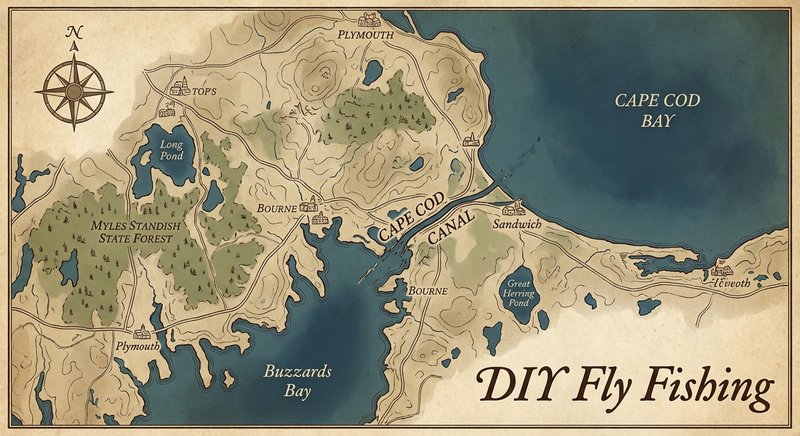
Cape Cod Canal
Fly fishing in Massachusetts · Intermediate · Best seasons: Spring, Summer, Fall
Target Species
Striped Bass, Bluefish, Tautog
About This Water
Famous striped bass fishery connecting Cape Cod Bay and Buzzards Bay. Strong currents.
Fishing Recommendations
Tighten your drag and check your knots. The Cape Cod Canal (the "Ditch") is one of the most challenging and rewarding saltwater fly fishing environments in the world. As a guide, I tell my clients: this isn't a typical "beach" experience. It is a man-made, high-velocity tidal river that acts as a highway for migrating sportfish.
Here is your comprehensive guide to fly fishing the Cape Cod Canal.
🎣 Location Overview
The Cape Cod Canal is a 7-mile long, 480-foot wide sea-level waterway connecting Buzzards Bay to the southwest and Cape Cod Bay to the northeast. What makes it special—and dangerous—is the current. Because of the difference in tide heights between the two bays, the water rushes through at speeds up to 6–7 knots.
For the fly angler, it is a place of extremes. You are fishing off a steep, rip-rap (large boulder) bank into deep, fast-moving water. It is world-renowned because it concentrates massive Striped Bass that are following bait through this shortcut to avoid the long trip around the Cape.
🐟 Target Species & Behavior
Striped Bass (The Main Event)
Stripers use the Canal as a feeding trough. They hold behind large underwater boulders (eddies) to ambush bait swept by the current. During "slacks" (when the tide changes), they may move higher in the water column.
- Behavior: They are opportunistic. They love the "breaking tides" where bait is trapped at the surface.
- Feed: Mackerel, Atlantic Menhaden (Punkerhunker/Pogy), Herring, Squid, and the "Canal Popcorn" (juvenile baitfish).
Bluefish
The "yellow-eyed devils" frequent the Canal in summer. They are often found in the faster, more turbulent water and will destroy any fly they touch.
- Behavior: Highly aggressive; they often blitz the surface during the turn of the tide.
Tautog (Blackfish)
Note: While primarily a bait/jig fishery, fly anglers can target them during slack tide near the rocks.
- Behavior: They hug the bottom structure.
- Feed: Crabs and crustaceans. You need heavy sinking lines and "crab" flies to get down to them.
📅 Best Times to Fish
Seasons
- Spring (May - June): The "Spring Run." This is the peak. Large migratory fish arrive, hungry and aggressive. This coincides with the herring run.
- Summer (July - August): Fishing becomes more nocturnal. Focus on the "Breaking Tides" (mornings where the tide turns west-to-east at sunrise).
- Fall (September - October): The "Fall Blitz." Fish are heading south and feeding heavily to prepare for winter.
Times of Day & Tides
- Low Light: Dawn and dusk are the "golden hours." Stripers are more likely to push bait to the surface.
- The "Turn": The 30 minutes before and after slack tide are the most productive for fly anglers, as the current is manageable enough to get your fly down to the fish.
🪰 Recommended Flies & Techniques
Top Fly Patterns
- Hollow Fleyes / Beast Fleyes: Large (8–12 inch) profiles that move water but are easy to cast. Use white/chartreuse or mackerel patterns.
- Bob’s Banger (Popper): For when fish are busting on the surface. The noise helps them find the fly in the turbulent water.
- Clouser Minnows: Weighted eyes are essential to get the fly down.
- Game Changers: Excellent for mimicking the swimming motion of a herring or mackerel in the eddies.
Techniques & Presentation
- The "Canal Swing": Cast up-current at a 45-degree angle. Use a heavy sinking line (350–500 grains). Let the fly sink as it drifts past you. Once it is "downstream," strip it back through the slack water near the rocks. Most hits occur at the "swing" when the fly begins to rise.
- Two-Handed Overhead Casting: Many Canal fly anglers use 11–12ft switch or beach rods to gain distance and clear the high embankment behind them.
💡 Pro Tips & Local Knowledge
- The Rip-Rap Dance: The rocks are covered in "weed" and are incredibly slippery. Korkers (studdded wading boots) are non-negotiable. Do not attempt to fish the Canal in standard rubber soles.
- Distance Matters: Sometimes the fish are right at your feet in the "wash," but often you need a 70+ foot cast to reach the seams where the big girls are holding.
- Watch the Birds: Tern and Gull activity is your best indicator of where the bait is being pushed up.
- The "West End" vs. "East End": The Buzzards Bay side (West) often warms up faster in the spring. The Cape Cod Bay side (East) can be better during the heat of summer as cooler water pulls in.
⚠️ Important Information
Access
- There are service roads on both sides of the Canal (North and South). These are paved and perfect for bicycles. Most serious Canal anglers use bikes with PVC pipe rod holders to cover ground quickly.
- Parking is available at designated lots (e.g., Scusset Beach, Bourne Scenic Park, Herring Run).
Regulations & Permits
- Massachusetts Saltwater Fishing Permit is required for all anglers 16 and older.
- Striped Bass Regulations: Very strict. Currently a 1-fish limit between 28" and 31" (check current MA DMF "Slot Limit" regulations as they change annually). Circle hooks are required when using bait, but not for flies.
Special Considerations
- Commercial Traffic: This is a shipping lane. Large tankers create massive wakes that can sweep you off the rocks. Stay alert.
- Etiquette: If a spot is crowded, don't "low-hole" someone. The Canal is a community; watch how the rotation works before jumping in.
Guide’s Final Word: The Canal is a "heartbreak" fishery. You might go three days without a hit, and on the fourth day, you'll hook a 40-pounder that tests every inch of your 10-weight rod. Stay persistent!
Bug Hatches & Matching Flies
| Hatch | Type | Peak months | Time of day | Hook sizes | Matching flies |
|---|---|---|---|---|---|
| Salt Marsh Midge Chironomidae | midge | May, June, September | Evening/Night | #18-22 | Zebra Midge #18-20, Griffith's Gnat #20-22 |
| Greenhead Fly Tabanus nigrovittatus | terrestrial | July | Daylight | #10-12 | Deer Hair Fly #10-12 |
| Sand Eel Ammodytes americanus | terrestrial | May, June, September, October | All Day | #2-2/0 | Surf Candy #2-1/0, Mushmouth #1/0-2/0 |
| Longfin Squid Doryteuthis pealeii | terrestrial | May, June | Night/Late Evening | #2/0-4/0 | Bob's Banger #2/0-4/0, Squidro #3/0 |
| Atlantic Menhaden (Bunker) Brevoortia tyrannus | terrestrial | June, September | Morning/Afternoon | #3/0-5/0 | Hollow Fleye #4/0-6/0, Bunker Spoon Fly #3/0 |
| Grass Shrimp Palaemonetes pugio | terrestrial | June, July, August | Evening/Night | #4-8 | Ultra Shrimp #6-8, Ray's Fly #4-6 |
| Atlantic Herring Clupea harengus | terrestrial | April, May | Morning | #1/0-3/0 | Blue/White Deceiver #2/0-3/0, Clouser Minnow #1/0 |
| Silversides Menidia menidia | terrestrial | September, October | Daylight | #4-6 | Gummy Minnow #6, Epoxy Silverside #4-6 |