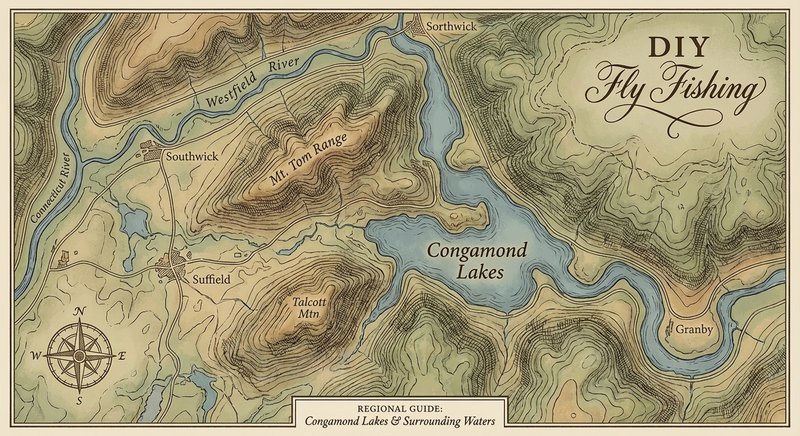
Congamond Lakes
Fly fishing in Massachusetts · Beginner · Best seasons: Spring, Summer, Fall
Target Species
Largemouth Bass, Calico Bass, Panfish
About This Water
Hampden County lakes with bass and panfish. Southwick area.
Fishing Recommendations
Welcome to the Congamond Lakes in Southwick, Massachusetts. As a guide, I can tell you that while many fly anglers head for the Swift or the Deerfield for trout, the Congamond chain offers some of the most exciting warm-water fly fishing in the Pioneer Valley.
The Congamond Lakes consist of three distinct basins—North, Middle, and South Ponds—connected by channels. It is a unique fishery that straddles the Massachusetts and Connecticut border, offering over 460 acres of prime bass and panfish water.
🎣 Location Overview
What makes the Congamond Lakes special is the diversity of structure.
- North Pond is the deepest (reaching 45 feet) and holds cooler water, making it a sanctuary during the heat of summer.
- Middle Pond is the hub of activity, featuring a mix of developed shorelines, docks, and drop-offs.
- South Pond is much shallower and heavily vegetated, creating a "bassy" paradise of lily pads and weed beds.
Anglers love the Congamond because it produces high-quality fish. It is widely considered one of the top bass tournament lakes in the state, which means the fish are smart, but the rewards are significant. For the fly angler, the transition zones between deep water and weed edges provide world-class opportunities.
🐟 Target Species & Behavior
Largemouth Bass
These are the kings of the Congamond. They hold tight to structure. In the spring, they move to the shallow sandy flats of the South and Middle ponds to spawn. During summer, they retreat to the shade of boat docks or the deep weed edges (10–15 feet). They feed primarily on golden shiners, sunfish, and crayfish.
Calico Bass (Black Crappie)
The Congamond has a massive population of "Calicos." They are school-oriented. In early spring, you’ll find them in the shallows near submerged brush. As the water warms, they move to the "vertical forest"—the edges of standing weed beds in 8–12 feet of water. They are aggressive predators of small minnows.
Panfish (Bluegill & Pumpkinseed)
The "bread and butter" of the lake. These fish are omnipresent but grow to impressive sizes here. They are found near any shoreline structure and are perfect for introducing newcomers to the sport or for a high-action afternoon.
📅 Best Times to Fish
- Spring (Late April – June): This is the prime window. As the water hits 55°F, the Crappie move shallow. When it hits 62°F, the Largemouths begin their pre-spawn feed.
- Summer (July – August): Low-light is your friend. The Congamond gets heavy boat traffic during the day. Fish the "edges of the day"—dawn and dusk—to avoid the wake and find fish moving into the shallows to hunt.
- Fall (September – October): As temperatures drop, bass become aggressive again, gorging on baitfish to prepare for winter. The weed lines begin to die back, making it easier to strip streamers without snagging "salad."
🪰 Recommended Flies & Techniques
For Largemouth Bass
- Patterns:
- Topwater: Dahlberg Divers, BoogleBugs (Poppers) in frog or white.
- Subsurface: Gamechangers (white/chartreuse), Woolly Buggers (Black/Olive, size 4), and Clouser Minnows.
- Technique: Use a 7-weight or 8-weight rod with a weight-forward floating line. For deep summer fish, use a sink-tip line to get a large streamer down to the 10-foot weed edge.
For Calico Bass (Crappie)
- Patterns:
- Small Bead-head Woolly Buggers (White or Pink, size 8-10).
- Crappie Jigs (tied on fly hooks) or Micro-Gamechangers.
- Technique: A "strip-and-pause" retrieve is vital. Crappie often strike on the pause as the fly sinks.
For Panfish
- Patterns: Foam Spiders, Rubber-legged poppers, and size 12 Prince Nymphs.
- Technique: Use a 3-weight or 4-weight rod for maximum fun. Fish a dry-dropper rig: a foam popper on top with a small nymph 18 inches below it.
💡 Pro Tips & Local Knowledge
- Work the Docks: The Middle Pond is lined with private docks. These provide the best "overhead cover" for big bass. Skip your flies as far under the docks as possible. If you aren't hitting the wood, you aren't deep enough.
- The Channels: The narrow channels connecting the ponds act as natural funnels for baitfish. During a light breeze, fish the downwind side of the channels where plankton and bait are pushed.
- Night Fishing: Because the Congamond is a popular recreational lake, the "big girls" (large bass) often become nocturnal in the summer. A black popper fished slowly on a calm July night can produce the fish of a lifetime.
- The "Drop": In the North Pond, look for where the shelf drops from 5 feet to 20 feet. Large bass will sit just off that edge waiting for perch to wander over the lip.
⚠️ Important Information
- Access: The primary public access is the State Boat Ramp on Berkshire Avenue (Middle Pond). There is a parking fee during the summer months. It is very kayak and belly-boat friendly.
- Regulations: Massachusetts fishing laws apply. A valid Massachusetts Fishing License is required. Even though the lake touches Connecticut, the majority is governed by MA; however, there is a reciprocal agreement for licenses—check the current MA/CT compendium for the latest boundary specifics.
- Safety: This lake allows high-horsepower engines. If you are in a kayak or float tube, stay close to the shoreline and use a safety flag. The "No Wake" zones in the channels and South Pond are your safest bets for peaceful fly fishing.
Guide’s Final Word: Don’t overlook the "slop." In South Pond, throw a weedless frog pattern right into the thickest lily pads. It’s heart-stopping when a 5-pound Largemouth explodes through the vegetation!
Bug Hatches & Matching Flies
| Hatch | Type | Peak months | Time of day | Hook sizes | Matching flies |
|---|---|---|---|---|---|
| Midges Chironomidae | midge | April, May, September, October | All Day | #18-24 | Zebra Midge #18-22, Griffith's Gnat #20-24, Palomino Midge #18-22 |
| Giant Michigan Mayfly (Hex) Hexagenia limbata | mayfly | June, July | Dusk/Night | #6-10 | Hexagenia Spinner #6-8, Hex Nymph #8-10, Paradun Hex #8 |
| Speckled Spinner / Callibaetis Callibaetis | mayfly | May, June, August | Morning/Afternoon | #12-16 | Callibaetis Spinner #14-16, Hare's Ear #14-16, Mercer's Pitted Callibaetis #14-16 |
| Damselflies Enallagma/Ischnura | terrestrial | June, July, August | Mid-day | #10-14 | Marabou Damselfly Nymph #10-12, Adult Blue Damselfly #12-14 |
| Traveling Sedge Phryganea | caddis | June, July | Evening/Late Night | #8-12 | Mikulak Sedge #8-10, Goddard Caddis #10-12 |
| Tricos Tricorythodes | mayfly | July, August, September | Early Morning | #22-26 | Trico Spinner #22-24, Trico Dun #22-24 |
| Scuds Gammarus | terrestrial | April, May, October | All Day | #14-18 | Ray Charles Scud #14-16, Olive Scud #14-18 |
| Black Carpenter Ants Camponotus | terrestrial | June, August | Afternoon | #12-16 | Chernobyl Ant #12, Black Foam Ant #14-16 |
| White Mayfly Ephoron leukon | mayfly | August | Evening | #12-14 | White Wulff #12-14, Ephoron Spinner #14 |