Concord River
Fly fishing in Massachusetts · Beginner · Best seasons: Spring, Summer, Fall
Target Species
Largemouth Bass, Pickerel, Panfish
About This Water
Historic Middlesex County river with bass and pickerel. Thoreau's fishing waters.
Fishing Recommendations
The Concord River is a historic, slow-moving "blackwater" gem in Eastern Massachusetts. Unlike the fast-moving trout streams of the Berkshires, the Concord is a stately, low-gradient river that meanders through marshes and woodlands. For the fly angler, it offers a classic warm-water experience characterized by lily pads, fallen timber, and aggressive ambush predators.
Here is your comprehensive guide to fly fishing the Concord River.
🎣 Location Overview
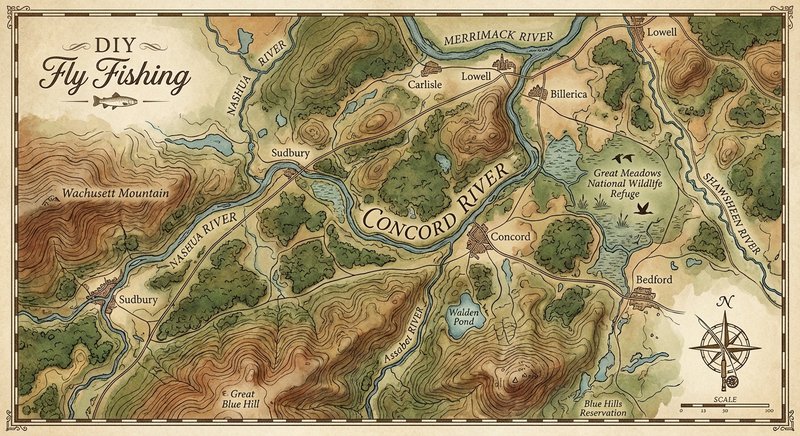
The Concord River is formed by the confluence of the Sudbury and Assabet rivers at Egg Rock in Concord. It flows north for about 15 miles before meeting the Merrimack in Lowell.
What makes it special is its low-gradient, sluggish character. Much of the river—especially the stretch through the Great Meadows National Wildlife Refuge—feels more like a long, narrow lake than a river. The water is often stained (the color of tea) due to tannins from the surrounding wetlands. This creates a perfect habitat for "sit-and-wait" predators. Anglers love it for its tranquility, historical significance (you can fish right past the Old North Bridge), and the explosive topwater strikes that occur along its weed-choked banks.
🐟 Target Species & Behavior
- Largemouth Bass: The undisputed king of the Concord. They hold tight to heavy structure: downed trees, lily pad edges, and undercut banks. They are opportunistic and will hammer large flies that imitate frogs, crayfish, or baitfish.
- Chain Pickerel: Often called "reedsnakes" or "water wolves," these fish are incredibly aggressive. They love the shallow, weedy bays. Be prepared for lightning-fast strikes and have a pair of long-nosed pliers ready—they have very sharp teeth.
- Panfish (Bluegill, Pumpkinseed, Crappie): Plentiful throughout the river. They provide non-stop action on light tackle. Look for them in the "pockets" of open water between weed beds.
- Bonus Species: You will also encounter Common Carp (which can reach massive sizes here and are a "freshwater bonefish" challenge on fly) and the occasional Smallmouth Bass as you move further north toward the swifter water in Billerica and Lowell.
📅 Best Times to Fish
- Spring (Late April – June): This is prime time. As the water warms into the 60s, bass move into the shallows to spawn. Pickerel are highly active during this period. The pre-spawn window in May offers the best chance at a trophy fish.
- Summer (July – August): Fishing is best at the "edges" of the day. Dawn and dusk are critical because the midday sun drives fish deep into the weed mats. This is peak topwater season.
- Fall (September – October): As the weeds begin to die back and the water cools, bass and pickerel go on a feeding binge to prepare for winter. The "Golden Hour" in the afternoon can be spectacular.
🪰 Recommended Flies & Techniques
Top Patterns
- Topwater: Hard-body Poppers (Size 2-6) in chartreuse, white, or frog patterns. Dahlberg Divers are excellent for a "swim and dive" action.
- Sub-surface: Woolly Buggers (Size 4-8) in black or olive. Clouser Minnows (chartreuse/white) to mimic the native shiners.
- Weedless Specials: The Johnson’s Silver Minnow (fly version) or any fly tied with a heavy monofilament weed guard is essential here.
- Panfish: Foam spiders, small "Sneaky Petes," and Bead-head Prince Nymphs.
Presentation & Techniques
- The "Twitch and Wait": When fishing poppers near lily pads, cast and let the fly sit until the rings disappear. Give it one subtle "pop," then wait. Bass often strike while the fly is stationary.
- Streamer Stripping: Use a floating line with a long leader (9ft 0X or 1X) or a slow-sinking tip. Strip streamers erratically along the edges of downed timber.
- Weedless is Mandatory: You will be frustrated if you don't use flies with weed guards. The Concord is "grabby" with its vegetation.
💡 Pro Tips & Local Knowledge
- Kayak/Canoe is King: While there is some bank access near bridges and the Old North Bridge, the Concord is best fished from a paddle craft. This allows you to reach the "far bank" structure that shore anglers can't touch.
- The Confluence: The area where the Assabet and Sudbury meet (Egg Rock) is a high-productivity zone. The mixing of currents often holds more active fish.
- Color Theory: In the stained, dark water of the Concord, black and purple flies often provide a better silhouette for the fish to track than natural colors. On bright days, use Chartreuse.
- Don't ignore the Carp: If you see large tails waving in the shallows near Great Meadows, put on a weighted crayfish or San Juan Worm. Be prepared for a 15-minute fight.
⚠️ Important Information
- Access Points:
- Lowell Road Bridge: Small launch area for canoes/kayaks.
- Route 225 (Bedford/Carlisle): A popular boat launch with ample parking.
- Old North Bridge (Minute Man National Historical Park): Good for foot access and history, but expect heavy tourist crowds.
- Regulations: A standard Massachusetts Freshwater Fishing License is required.
- Consumption Advisory: Like many historic rivers in New England, there are mercury advisories for the Concord River. Catch and release is highly recommended for all species.
- Conservation: The Concord is part of the National Wild and Scenic Rivers System. Please pack out all trash and monofilament line to protect the abundant bird life in the Great Meadows refuge.
Guide’s Final Word: The Concord River isn't about numbers; it's about the vibe. It's a slow, rhythmic style of fishing. Bring a 6-weight rod for the bass, some heavy tippet for the pickerel, and enjoy drifting through a piece of American history.
Bug Hatches & Matching Flies
| Hatch | Type | Peak months | Time of day | Hook sizes | Matching flies |
|---|---|---|---|---|---|
| Blue-Winged Olive Baetis | mayfly | April, May, September, October | Afternoon | #18-22 | RS2 #18-20, Parachute Adams #18-22 |
| White Miller Ephoron leukon | mayfly | August | Evening/Night | #12-14 | White Wulff #12-14, White Miller Soft Hackle #12-14 |
| Spotted Sedge Hydropsyche | caddis | May, June, July | Evening | #14-18 | Elk Hair Caddis (Tan) #14-16, LaFontaine's Deep Sparkle Pupa #14-16 |
| Trico Tricorythodes | mayfly | July, August, September | Morning | #20-24 | Trico Spinner #20-24, Zebra Midge #20-22 |
| Blue Dasher / Damselfly Enallagma | terrestrial | June, July, August | Daytime | #10-12 | Adult Damselfly #10-12, Marabou Damsel Nymph #12 |
| Light Cahill Stenacron candadense | mayfly | June, July | Evening | #12-14 | Light Cahill #12-14, Gold Ribbed Hare's Ear #12-14 |
| Common Midge Chironomidae | midge | March, April | Mid-day | #20-26 | Griffith's Gnat #20-24, Black Beauty #22-26 |
| Green Drake Ephemera guttulata | mayfly | June | Evening | #8-10 | Green Drake Parachute #8-10, Drake Nymph #8-10 |
| Common Grasshopper Melanoplus | terrestrial | August, September | Daytime | #8-12 | Dave's Hopper #8-12, Letort Hopper #10-12 |