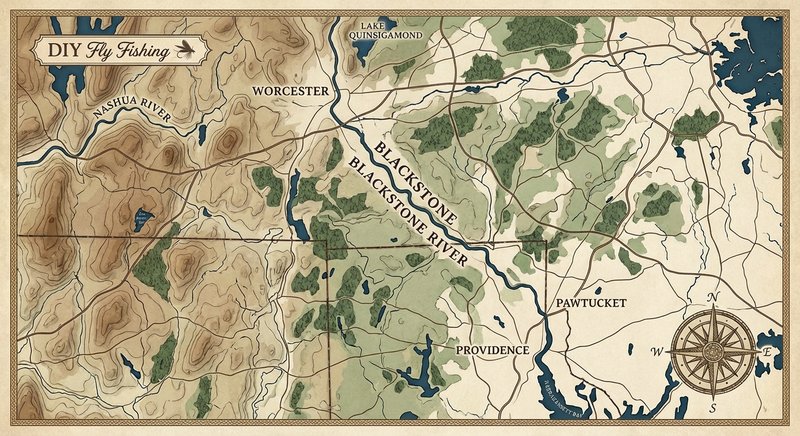
Blackstone River
Fly fishing in Massachusetts · Beginner · Best seasons: Spring, Summer, Fall
Target Species
Smallmouth Bass, Largemouth Bass, Trout
About This Water
Worcester County river with bass and trout. Industrial heritage corridor.
Fishing Recommendations
The Blackstone River in Massachusetts is one of the most storied waterways in New England. Known as the "Hardest Working River" during the Industrial Revolution, it has made a remarkable ecological comeback. Today, it offers some of the most underrated warm-water fly fishing in the Northeast, along with seasonal opportunities for trout.
As your guide, here is the comprehensive breakdown for fishing the Blackstone.
🎣 Location Overview
The Blackstone River flows from Worcester, MA, down through the Blackstone Valley into Rhode Island. What makes it special is its diversity of water. You’ll find everything from fast-moving pocket water and riffles to slow, deep "dead water" sections created by historic dams.
Anglers love the Blackstone because it feels like a "wild" experience hidden within a suburban/industrial corridor. It is a rugged river with a mix of gravel, boulders, and occasional urban debris, providing excellent structure for predatory fish. While it was once heavily polluted, massive cleanup efforts have turned it into a thriving corridor for Smallmouth Bass.
🐟 Target Species & Behavior
Smallmouth Bass (The Main Event)
The "bronzeback" is the king of the Blackstone. They are aggressive, hard-fighting, and plentiful.
- Behavior: They hold in the "seams" where fast water meets slow water, behind large boulders, and in the deep pools below dam spillways.
- Feeding: Their diet consists heavily of Crayfish and Hellgrammites (dobsonfly larvae), along with baitfish like dace and shiners.
Trout (Seasonal)
The Blackstone and its tributaries (like the Mumford and West Rivers) are stocked by MassWildlife in the spring.
- Behavior: Trout hold in the colder, oxygenated riffles and deeper runs near Uxbridge and Northbridge. They are less common in the main stem as water temperatures rise in July.
- Feeding: Typical opportunistic feeders—midge larvae, caddis, and mayflies.
Largemouth Bass
Found primarily in the impoundments (the "ponds" created by dams) and slower, weedier stretches.
- Behavior: They prefer "soft" water, lily pads, and fallen timber.
- Feeding: Large streamers, frogs, and dragonfly nymphs.
📅 Best Times to Fish
- Spring (April – June): This is the window for Trout. Focus on the upper sections and tributaries. By late May, the Smallmouth become active as they prepare to spawn.
- Summer (July – August): This is Prime Smallmouth Season. As water levels drop, the fish concentrate in the deeper runs and oxygenated pocket water. This is also the best time for heart-pounding topwater action.
- Fall (September – October): As temperatures cool, bass go on a feeding binge to bulk up for winter. This is the best time for trophy-sized Smallmouth using large streamers.
- Time of Day: In the heat of summer, the "magic hour" is the first two hours of light and the last two hours of evening. During the spring and fall, the midday sun often triggers the best hatches and activity.
🪰 Recommended Flies & Techniques
For Smallmouth & Largemouth Bass
- Streamers:
- Clouser Minnow (Chartreuse/White or Olive/White): The gold standard for the Blackstone.
- Woolly Bugger (Black or Olive, Size 4-8): Mimics hellgrammites and leeches.
- Near Nuff Crayfish: Must have. Bounce these along the bottom in rocky runs.
- Topwater:
- BoogleBug Poppers: Irresistible in the evening.
- Sneaky Pete: A subtler slider pattern for calmer water.
- Technique: Use a "strip-strip-pause" retrieve. For topwater, let the rings disappear after the fly hits the water before your first twitch.
For Trout
- Nymphs: Pheasant Tail (14-18), Gold-Ribbed Hare’s Ear, and Zebra Midges.
- Dry Flies: Elk Hair Caddis and Adams (12-16) for general searching.
- Technique: High-stick nymphing through the riffles or a classic dead-drift under an indicator.
💡 Pro Tips & Local Knowledge
- Focus on Uxbridge & Millville: The stretch near River Bend Farm (Uxbridge) and the Millville Rapid area offers some of the best wading access and most productive "trouty-looking" water for bass.
- The "Hellgrammite Factor": The Blackstone has a massive population of Hellgrammites. If the fishing is slow, tie on a large, weighted black stonefly nymph or a black woolly bugger and dead-drift it through the deepest part of the riffles.
- Reading the Water: Look for the "bubble line." In the Blackstone, bass love to sit right under the foam lines created by small drops and rocks, waiting for the current to bring food.
- Wade With Care: The bottom can be slippery and contains "industrial artifacts" (bricks, metal). Studded wading boots and a staff are highly recommended.
⚠️ Important Information
- Access: Use the Blackstone River Greenway and various canoe launches (e.g., Rice City Pond, Blackstone Gorge). Most of the river bank is accessible through the National Historical Park lands.
- Regulations: A valid Massachusetts Freshwater Fishing License is required.
- Consumption: While the water is much cleaner than in decades past, Catch and Release is strongly recommended for all species due to legacy pollutants in the river sediment (check the latest MA DPH fish consumption advisories).
- Stay Dry: Always check the USGS Gauge at Northbridge or Uxbridge before heading out. If the flow is spiking after a heavy rain, the river becomes dangerous to wade and the visibility turns to chocolate milk.
Tight lines on the Blackstone! It's a rugged, beautiful piece of New England history that fishes much better than it looks on a map.
Bug Hatches & Matching Flies
| Hatch | Type | Peak months | Time of day | Hook sizes | Matching flies |
|---|---|---|---|---|---|
| Blue Winged Olive Baetis | mayfly | April, May, September, October | Midday | #18-22 | BWO Sparkle Dun #18-20, Pheasant Tail #18-22, RS2 #20-22 |
| Hendrickson Ephemerella subvaria | mayfly | April, May | Afternoon | #12-14 | Hendrickson Pink Lady #12-14, Red Quill #14, Hendrickson Wet Fly #12-14 |
| Tan Caddis Hydropsyche | caddis | May, June | Evening | #14-18 | Elk Hair Caddis #14-16, LaFontaine's Deep Sparkle Pupa #14-16, Holy Grail #16 |
| Sulfur Ephemerella invaria/dorothea | mayfly | June, July | Late Afternoon/Evening | #14-18 | Sulfur Parachute #16-18, Sulfur Cripple #14-16, Pheasant Tail Sulfur #16-18 |
| March Brown Maccaffertium vicarium | mayfly | May | Midday | #10-12 | March Brown Western #10-12, Hare's Ear #10-12, March Brown Spider #12 |
| Light Cahill Stenacron | mayfly | June, July | Evening | #12-14 | Light Cahill #12-14, Gold Ribbed Hare's Ear #14, Cream Usual #14 |
| Slate Drake Isonychia | mayfly | June, September | Late Afternoon | #10-12 | Iso Parachute #10-12, Zug Bug #10-12, Prince Nymph #12 |
| Trico Tricorythodes | mayfly | July, August, September | Morning | #22-26 | Trico Spinner #22-24, Black Zebra Midge #22, Trico Parachute #22-26 |
| Cinnamon Ant Formicidae | terrestrial | July, August, September | All Day | #14-18 | Cinnamon Ant #16-18, Chernobyl Ant #12-14, Flying Ant #16 |
| Zebra Midge Chironomidae | midge | January, February, March, December | Midday | #18-24 | Zebra Midge #18-22, Griffith's Gnat #20-22, Black Fly Larva #20 |