Charles River
Fly fishing in Massachusetts · Beginner · Best seasons: Spring, Summer, Fall
Target Species
Largemouth Bass, Carp, Pickerel
About This Water
Greater Boston river with bass and carp. Urban fishing opportunity.
Fishing Recommendations
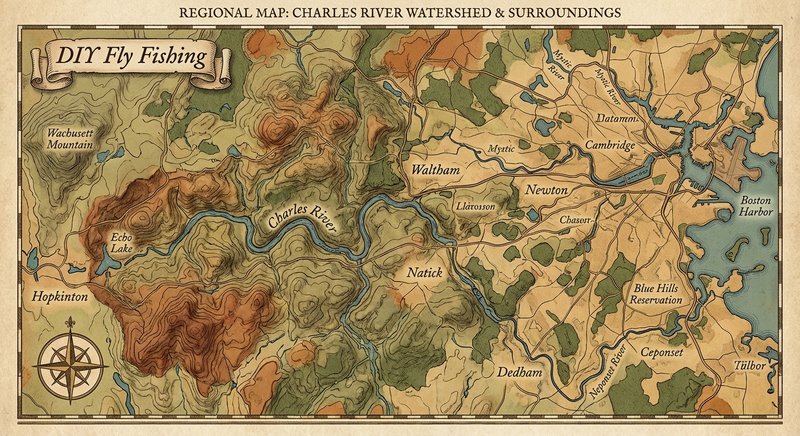
Welcome to the "Old Muddy." As an expert guide, I can tell you that the Charles River is one of the most underrated fly fishing resources in the Northeast. Stretching 80 miles from Hopkinton to Boston Harbor, it transforms from a narrow, wading stream to a sprawling urban basin. For the fly angler, it offers a "warm-water safari" right in the shadows of the Boston skyline.
🎣 Location Overview
The Charles River is a slow-moving, low-gradient river characterized by tea-colored (tannic) water, abundant lily pads, and submerged timber. What makes it special is the juxtaposition of nature and industry; you might be casting to a 20lb carp while a rowing crew pulses past.
Anglers love it because of its accessibility and the sheer size of its inhabitants. It is not a "numbers" river for trout, but it is a "trophy" river for warm-water species. The middle stretches (Natick to Dedham) offer a classic wilderness feel, while the lower basin (Cambridge/Boston) offers world-class urban carp fishing.
🐟 Target Species & Behavior
Largemouth Bass
- Behavior: The kings of the river. They are structure-dependent, holding tight to downed trees, bridge pilings, and the edges of lily pad fields.
- Feeding: They focus on "Bluegill" (sunfish), crayfish, and frogs. In the evening, they become aggressive surface hunters.
Common Carp
- Behavior: Known as the "Freshwater Bonefish." These are highly intelligent, spooky fish that can reach over 30 pounds. They "tail" in the shallows just like saltwater species.
- Feeding: They vacuum the bottom for nymphs and crayfish, but in June/July, they famously key in on falling mulberries.
Chain Pickerel
- Behavior: The "Water Wolves" of the Charles. They are ambush predators that sit motionless in thick vegetation.
- Feeding: Extremely aggressive. They will hit anything that flashes or moves erratically. They have sharp teeth, so a bite-guard is essential.
📅 Best Times to Fish
- Spring (Late April – June): This is prime time. Bass move into the shallows to spawn (please fish responsibly and avoid visible beds). Carp begin to congregate in the flats, making them easier to spot.
- Summer (July – August): Best for early morning and late evening. The "Mulberry Hatch" occurs when trees overhanging the river drop fruit, sending carp into a feeding frenzy. Low light is best for topwater bass action.
- Fall (September – October): As water temps drop, fish feed heavily to prepare for winter. Bass and pickerel become more active throughout the day, often moving to rocky points and deeper weed edges.
Prime Window: 6:00 AM – 9:00 AM and the "Golden Hour" before sunset.
🪰 Recommended Flies & Techniques
For Largemouth Bass & Pickerel
- Flies:
- Topwater: Dahlberg Divers (Chartreuse/White), BoogleBugs (Poppers), and Foam Frogs.
- Subsurface: Gamechangers (White/Yellow), Woolly Buggers (Olive/Black, Size 4), and Clouser Minnows.
- Technique: Cast as tight to the structure as possible. For poppers, use a "pop and pause" cadence—the strike usually happens during the pause. Use a 6wt to 8wt rod with a weight-forward floating line.
For Carp
- Flies:
- Nymphs: Carp Bitter, Backstabber (Rust color), or a heavy San Juan Worm.
- Surface: Foam Mulberry (Purple/Dark Red) during the summer drop.
- Technique: Sight fishing is mandatory. Locate a feeding fish (look for "mudding" or tailing), cast 2 feet in front of its nose, and let the fly sink. Give it the tiniest twitch. If the fish’s tail shakes or its mouth moves, strip set—do not trout set!
💡 Pro Tips & Local Knowledge
- The "Lakes" Section: The area between Newton Lower Falls and Waltham (often called the Lakes) is a maze of islands and channels. This is the best kayak-fishing stretch for bass and pickerel.
- The Mulberry Strategy: Look for overhanging trees with purple stains on the pavement or mud below. If you find one over the water, there will be carp underneath. Use a purple foam fly and "splat" it on the water to mimic falling fruit.
- The "Cutter" Trick: Pickerel will slice through standard 10lb fluorocarbon like butter. Use a 6-inch section of 20lb–30lb wire tippet or heavy fluorocarbon (25lb+) if you are specifically targeting the "gators."
- Stealth in the Basin: In the Boston/Cambridge basin, the water is clearer than you think. Stay low and avoid wearing bright colors, as the carp here are "educated" and will spook at the sight of a fly rod waving.
⚠️ Important Information
- Access:
- Wandering: Excellent access via the Charles River Esplanade (Boston) and Herter Park (Allston).
- Boating: Many anglers launch kayaks/canoes at Nahanton Park (Newton) or the Moody Street Dam (Waltham).
- Regulations: A valid Massachusetts Freshwater Fishing License is required for anyone 15 or older.
- Health Advisory: While the river is much cleaner than in decades past, it is still an urban waterway. Catch and release is highly recommended. If you do handle fish, wash your hands afterward.
- Gear Protection: The Charles is notorious for "snags." Bring a hook hone and check your hook points frequently after hitting rocks or bridge pilings.
Tight lines on the Charles—it’s a wild ride in the heart of the city!
Bug Hatches & Matching Flies
| Hatch | Type | Peak months | Time of day | Hook sizes | Matching flies |
|---|---|---|---|---|---|
| White Miller Caddis Nectopsyche | caddis | June, July, August | Evening/Night | #12-16 | White Miller #14, White Elk Hair Caddis #14-16 |
| Trico Tricorythodes | mayfly | July, August, September | Early Morning | #20-24 | Trico Spinner #22-24, RS2 #20-22 |
| Light Cahill Stenacron interpunctatum | mayfly | May, June | Evening | #12-14 | Light Cahill #14, Gold Ribbed Hare's Ear #12-14 |
| Common Midges Chironomidae | midge | March, April, October, November | All Day | #18-24 | Zebra Midge #18-22, Griffith's Gnat #20-22 |
| Blue-Winged Olive Baetis | mayfly | April, May, September, October | Afternoon | #16-20 | BWO Sparkle Dun #18-20, Pheasant Tail #16-18 |
| Blue Damselfly Enallagma | terrestrial | June, July, August | Afternoon | #10-14 | Marabou Damselfly Nymph #10-12, Adult Damselfly #12 |
| Sulfur Ephemerella invaria | mayfly | May, June | Evening | #14-16 | Sulfur Parachute #14-16, Sulfur Emerger #16 |
| Japanese Beetle Popillia japonica | terrestrial | July, August | Afternoon | #12-14 | Japanese Beetle (Foam) #12-14 |