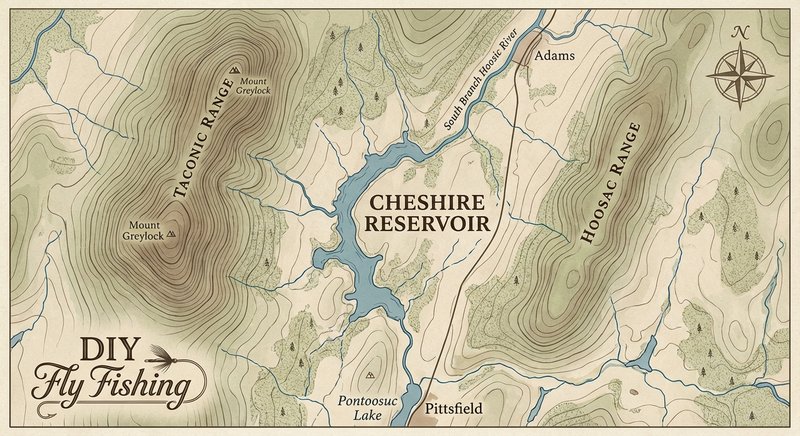
Cheshire Reservoir
Fly fishing in Massachusetts · Beginner · Best seasons: Spring, Summer, Fall
Target Species
Brown Trout, Largemouth Bass, Pickerel
About This Water
Berkshire County reservoir with bass and trout. Scenic mountain setting.
Fishing Recommendations
As an expert guide familiar with the Berkshire region of Massachusetts, I can tell you that Cheshire Reservoir (locally often referred to as the Hoosac Reservoir) is one of the most scenic and productive warm-water fisheries in the Commonwealth.
While it is famous for its Northern Pike, it offers exceptional opportunities for fly anglers targeting Bass and Pickerel. Regarding the Brown Trout, it is important to note that while the reservoir itself is shallow and warm, the Hoosic River—which feeds and drains the reservoir—is a noted trout fishery.
🎣 Location Overview
Cheshire Reservoir is a 418-acre impoundment divided into three distinct basins (First, Second, and Third Lakes) separated by causeways. Located at the foot of Mount Greylock, the scenery is unmatched.
What makes this water special for the fly fisher is its structure. It is a shallow, "weedy" lake with an average depth of only 4 feet and a maximum depth of about 10 feet. This creates a massive "flats" style environment where fish are often looking up. The Ashuwillticook Rail Trail runs directly along the eastern shore, providing some of the best bank-access fly fishing in the state, though a kayak or canoe is the preferred tool for reaching the honeycomb of weed channels.
🐟 Target Species & Behavior
Largemouth Bass
The "king" of the reservoir. Because the water is shallow, these bass stay active in the weeds. They are highly opportunistic and will hold in the "pockets" of open water within the lily pads and milfoil. They feed on golden shiners, frogs, and dragonfly larvae.
Chain Pickerel
These are the "water wolves" of Cheshire. They are ubiquitous here and grow to impressive sizes (20"+). They love flashy movement and will strike aggressively at anything that crosses their lateral line. They hold in the shallower, muckier edges of the south basin.
Brown Trout
While not a "lake trout" fishery due to summer water temperatures, the Hoosic River inlet and outlet are stocked with Browns. In the early Spring and late Fall, these trout will move into the reservoir's north end where the water is moving and oxygenated. They feed on caddis, mayflies, and small dace.
📅 Best Times to Fish
- Spring (April – June): This is the prime window for Trout near the inlets and Bass in the shallows. As the water warms to 55°F, the Bass move to the sandy patches for spawning.
- Summer (July – August): Focus on the early morning (5 AM - 9 AM) and dusk. The midday sun warms this shallow water quickly, driving fish deep into the thickest weed mats. This is peak topwater season.
- Fall (September – October): As the weeds begin to die back, the Pickerel and Northern Pike become extremely aggressive. This is the best time for "big fly" fishing.
- Optimal Conditions: Overcast, "fishy" days are best here. Because the water is shallow, bright sun can make the fish "spooky."
🪰 Recommended Flies & Techniques
For Bass & Pickerel
- Topwater: Dahlberg Divers or Deer Hair Poppers (Chartreuse or White). Work these along the edges of the lily pads.
- Subsurface: Gamechangers or Woolly Buggers (Size 2-6) in olive or black.
- Technique: Use a "strip-strip-pause" retrieve. The pause is usually when the Bass will inhale the fly. For Pickerel, keep the fly moving fast to trigger their predatory instinct.
For Brown Trout (Inlets/Outlets)
- Dry Flies: Adams or Elk Hair Caddis (Size 14-16) during the evening hatches.
- Nymphs: Pheasant Tail or Prince Nymphs drifted under an indicator in the moving water sections.
- Streamers: Black Ghost or Muddler Minnows to mimic the small baitfish moving out of the reservoir.
Equipment Note
I recommend an 8-weight rod for the reservoir. Even though you are targeting Bass, the chance of hooking a 30-inch Northern Pike is very high, and you need the backbone to pull fish out of heavy vegetation. Use a bite guard or heavy fluorocarbon tippet (20lb+) because the Pickerel will bite through standard trout leaders instantly.
💡 Pro Tips & Local Knowledge
- The "Middle Basin" Secret: The middle section (between the two causeways) often holds the largest Bass but gets the least pressure. Look for the old river channel—there is a slight depth change there that holds fish when the sun is high.
- Kayaking the Reeds: If you have a kayak, move into the extreme southern end. It is a labyrinth of reeds. Use a weedless "Texas-rigged" fly (hooks tied with wire guards) to get into the tightest spots.
- The Rail Trail Advantage: If you are on foot, walk the Ashuwillticook Rail Trail. Look for "points" where the wind is blowing baitfish against the shore. These are natural ambush points for Pickerel.
- Trout Transitions: For the Browns, focus on the North Basin near the dam. The water stays slightly cooler here, and the transition into the Hoosic River provides the oxygen they crave.
⚠️ Important Information
- Access: There is a public boat ramp on Route 8 in Cheshire for trailers, and several smaller put-ins along the Rail Trail for kayaks.
- Regulations: Massachusetts fishing license is required. Cheshire Reservoir follows standard "General Inland Fishing" regulations, but be aware that Northern Pike have specific size and creel limits.
- Safety: The reservoir has a very soft, "mucky" bottom. I do not recommend wading far from the shore; you can easily sink to your waist in silt. Stick to the banks or a boat.
- Boating: It is a "no-wake" lake in many sections due to the shallow depths and vegetation. Watch your prop!
Guide’s Final Word: Cheshire is a "visual" fishery. Bring high-quality polarized glasses. Watching a 24-inch Pickerel wake behind your fly in two feet of water is one of the greatest thrills in Berkshire fly fishing.
Bug Hatches & Matching Flies
| Hatch | Type | Peak months | Time of day | Hook sizes | Matching flies |
|---|---|---|---|---|---|
| Giant Michigan Mayfly (Hex) Hexagenia limbata | mayfly | June, July | Late Evening/Night | #6-10 | Hexagenia Dry #6-8, Hex Nymph #8-10, Wiggle Nymph #8 |
| Speckled Dun Callibaetis | mayfly | May, June, September | Late Morning | #12-16 | Callibaetis Spinner #14-16, Hare's Ear Nymph #12-16, Callibaetis Cripple #14 |
| Blue-Winged Olive Baetis | mayfly | April, May, September, October | Afternoon | #18-22 | BWO Parachute #18-22, RS2 #20-22, Pheasant Tail #18-20 |
| Damselfly Enallagma | terrestrial | June, July, August | Afternoon | #10-14 | Marabou Damselfly Nymph #10-12, Adult Damselfly #12, Blue Foam Damsel #12 |
| Chironomid (Midges) Chironomidae | midge | March, April, October, November | All Day | #18-24 | Zebra Midge #18-22, Griffith's Gnat #20-24, Snowshoe Midge #20-22 |
| White Miller Nectopsyche | caddis | July, August | Evening | #12-14 | White Elk Hair Caddis #12-14, LaFontaine's Sparkle Pupa #14, White Wulff #12 |
| Trico Tricorythodes | mayfly | July, August, September | Morning | #20-24 | Trico Spinner #22-24, Sunken Trico #22, Trico CDC Emerger #22 |
| Black Carpenter Ant Camponotus pensylvanicus | terrestrial | June, July, August | Afternoon | #10-16 | Black Foam Ant #12-16, Chernobyl Ant #8-10, Flying Ant #14-16 |