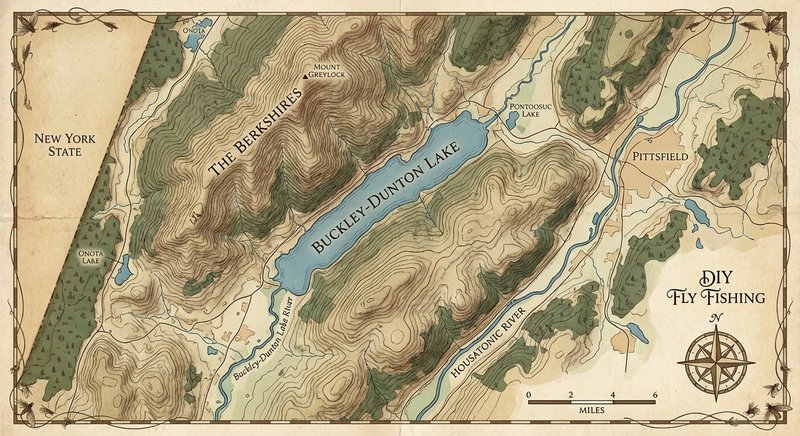
Buckley-Dunton Lake
Fly fishing in Massachusetts · Beginner · Best seasons: Spring, Summer, Fall
Target Species
Brown Trout, Rainbow Trout
About This Water
Berkshire County reservoir with trout. Becket area.
Fishing Recommendations
Welcome to one of the Berkshires’ hidden gems. As your guide, I’m excited to walk you through Buckley-Dunton Lake. Located within the sprawling October Mountain State Forest in Becket, Massachusetts, this is not your typical "park and cast" pond. It is a high-elevation, stump-filled reservoir that offers a wilder, more remote feel than most stocked waters in the Commonwealth.
🎣 Location Overview
Buckley-Dunton Lake is a roughly 160-acre body of water sitting at an elevation of nearly 1,900 feet. What makes this water special is its character: it’s essentially a flooded forest. The lake is shallow (averaging 5–10 feet) and punctuated by thousands of submerged and semi-submerged tree stumps.
Anglers love Buckley-Dunton because it feels like a piece of the Adirondacks dropped into Western Massachusetts. It is quiet, scenic, and lacks the heavy boat traffic found on larger lakes. Because of the heavy timber, it is a technical stillwater fishery that rewards accuracy and stealth rather than long, booming casts.
🐟 Target Species & Behavior
The primary draws for the fly angler are the Rainbow and Brown Trout, which are stocked heavily by MassWildlife in both the spring and fall.
- Rainbow Trout: These are your primary targets in the spring. They tend to cruise the upper water column and are often found in the more "open" pockets of water between the stump fields.
- Brown Trout: The Browns here are a bit more secretive. They love the overhead cover provided by the stumps and the old stream channel that runs through the center of the lake. They are more likely to stay deep during the bright parts of the day.
- Secondary Species: Be prepared to catch "Berkshire Mixed Bag" items, including Largemouth Bass, Chain Pickerel, and Yellow Perch, all of which will readily take a fly.
📅 Best Times to Fish
- Spring (Late April – June): This is the prime window. The water is cool, the trout are fresh from the hatchery, and the insect life is waking up. May is arguably the best month for consistent action.
- Summer (July – August): Because the lake is shallow, it warms up quickly. During mid-summer, trout fishing becomes difficult as the fish retreat to the deepest pockets or near cold-spring seeps. If you fish now, go at first light or dusk.
- Fall (September – October): As the high-elevation air cools, the water temperature drops rapidly. The state often does a secondary stocking in the fall. The foliage on October Mountain is world-class, making this the most scenic time to be on the water.
🪰 Recommended Flies & Techniques
Top Fly Patterns
- Streamers:
- Woolly Bugger (Size 8-12): Black, Olive, or White. This is the "meat and potatoes" fly for this lake.
- Muddler Minnow: Great for mimicking the small baitfish hiding in the stumps.
- Nymphs/Wets:
- Chironomids (Size 16-20): Midges are the most consistent hatch here. Suspend them under a small indicator.
- Pheasant Tail Nymph (Size 14-16): A classic that mimics various mayfly nymphs.
- Soft Hackles: Swinging a Partridge and Orange in the evening can be deadly.
- Dry Flies:
- Elk Hair Caddis (Size 14-16): For the evening rise.
- Adams (Size 14-18): The perfect generalist for high-mountain lakes.
- Terrestrials (Summer): Foam Ants and Beetles dropped right against the stumps.
Presentation & Techniques
- The "Slow Strip": When using streamers, use a very slow, erratic retrieve. The trout here are often holding tight to wood; you want the fly to look like a confused minnow darting between the stumps.
- Indicator Fishing: In the spring, hanging a midge or a small Hare's Ear 3–5 feet under a strike indicator is often the most productive method when fish aren't rising.
- The "Dink and Drop": If you see a fish rise near a stump, cast a dry fly (the "dink") with a small nymph dropper about 18 inches below it.
💡 Pro Tips & Local Knowledge
- Bring a Vessel: Shore access is extremely limited due to the marshy perimeter and dense forest. To fish Buckley-Dunton effectively, you must have a kayak, canoe, or float tube.
- Find the Channel: Look for the "cleaner" water where there are fewer stumps—this usually indicates the old brook channel. This is often where the trout congregate when the sun is high, as it is slightly deeper and cooler.
- Avoid the "Snag-Nosis": You will get hung up on wood. Use a slightly heavier tippet than usual (4X instead of 6X) to allow you to pull your flies off the stumps without snapping off every time.
- Stealth is Key: Because the water is shallow and clear, a heavy-handed approach will spook the fish. Avoid splashing your oars or paddles, and try to keep a low profile in your boat.
⚠️ Important Information
- Access: Access is via York Lake Road in Becket. The road is gravel/dirt and can be rough in early spring after the mud season.
- Regulations: Massachusetts fishing regulations apply. A valid MA freshwater fishing license is required. There are no special "fly fishing only" restrictions here, so you may share the water with spin anglers.
- Motors: Only electric trolling motors are permitted. Gasoline engines are prohibited to preserve the peace and water quality of the state forest.
- Safety: Be careful navigating the stump fields. If you are in a fiberglass boat, go slow—those stumps can be unforgiving. Also, cell service is spotty at best on October Mountain; let someone know your plan before you head up.
Guide’s Final Word: Buckley-Dunton is for the angler who values the experience as much as the catch. It’s quiet, rugged, and requires a bit of "hunting" to find the fish. Tight lines!
Bug Hatches & Matching Flies
| Hatch | Type | Peak months | Time of day | Hook sizes | Matching flies |
|---|---|---|---|---|---|
| Chironomids (Midges) Chironomidae | midge | April, May, September | All Day | #18-24 | Zebra Midge #18-22, Griffith's Gnat #20-24, Brooks Sprout Midge #20-22 |
| Speckled Duns (Callibaetis) Callibaetis | mayfly | June, July, August | Late Morning/Afternoon | #14-16 | Callibaetis Spinner #14-16, Hare's Ear Nymph #14-16, Parachute Adams #14-18 |
| Blue-Winged Damselfly Enallagma | terrestrial | June, July | Afternoon | #10-14 | Marabou Damselfly Nymph #10-12, Braided Butt Damsel #12-14 |
| Hex (Giant Mayfly) Hexagenia limbata | mayfly | June, July | Dusk/Dark | #6-10 | Hexagenia Paradox #6-8, Hex Nymph #6-10 |
| Cinnamon Caddis Hydropsyche | caddis | July, August | Evening | #14-18 | Elk Hair Caddis (Tan) #14-16, LaFontaine's Emerger #14-18 |
| Black Ants & Beetles Formicidae / Coleoptera | terrestrial | July, August, September | All Day | #12-18 | Black Foam Ant #14-18, Chernobyl Ant #10-14, Fat Albert #10-14 |
| Dragonflies Anisoptera | terrestrial | June, July, August | Daylight | #4-10 | Dragonfly Nymph #6-10, Woolly Bugger (Olive) #6-10 |
| White Miller Caddis Nectopsyche | caddis | August | Morning/Evening | #12-14 | White Elk Hair Caddis #12-14, White Stimulator #12-14 |