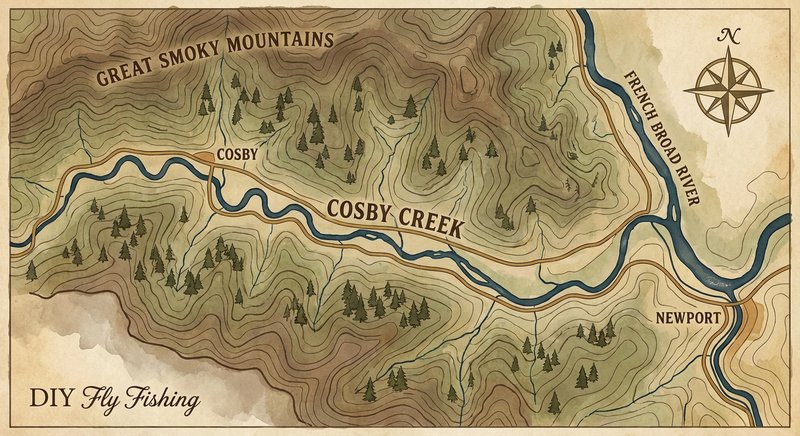
Cosby Creek
Fly fishing in Tennessee · Intermediate · Best seasons: Spring, Summer, Fall
Target Species
Rainbow Trout, Brown Trout
About This Water
Eastern Smokies stream with wild rainbow trout. Less pressured fishing.
Fishing Recommendations
Cosby Creek is one of the "hidden gems" of the Great Smoky Mountains National Park (GSMNP). While tourists flock to the Little River near Townsend or the Oconaluftee in Cherokee, Cosby offers a more secluded, quintessential Appalachian fly fishing experience. As your guide, I’m excited to break down this technical but rewarding freestone stream.
🎣 Location Overview
Cosby Creek is located on the northeastern edge of the Great Smoky Mountains National Park, near the town of Cosby, Tennessee. It is a high-gradient, freestone mountain stream characterized by crystal-clear water, moss-covered boulders, and dense rhododendron canopies.
What makes Cosby special is its solitude. It doesn’t receive half the pressure of the streams near Gatlinburg. The water is divided into two distinct personalities: the lower section near the park boundary, which features slightly larger pools and easier casting, and the upper section, which becomes a "blue-line" adventure requiring stealth, short rods, and creative casting.
🐟 Target Species & Behavior
The creek is home to wild, self-sustaining populations of Rainbow and Brown Trout.
- Rainbow Trout: These are the primary residents. They are opportunistic feeders but very "spooky." They typically hold in the "bubble line" at the head of pools or in the pocket water behind large boulders.
- Brown Trout: While less numerous than rainbows, the browns in Cosby can reach surprising sizes for such a small stream. They are nocturnal and predatory, usually holding in deep undercut banks or under submerged logs during the bright part of the day.
- Behavior: Because these are wild fish in low-nutrient water, they aren't usually "selective" about fly patterns, but they are extremely sensitive to vibration and shadow. If they see you, the fishing in that pool is over.
📅 Best Times to Fish
Spring (March – May) – The Golden Window
This is the peak. Water temperatures rise into the 50s, triggering major hatches.
- Prime Window: Late March through April.
- Conditions: Look for overcast days for the best dry fly action.
Summer (June – August) – The Terrestrial Season
The water stays cooler here than in the valley streams due to the elevation and canopy.
- Best Time: Early morning (daybreak to 10:00 AM) and late evening.
- Conditions: Low, clear water requires 6x or 7x tippet and a very stealthy approach.
Fall (September – November) – The Brown Trout Run
As temperatures drop, the fish become aggressive again ahead of the winter.
- Prime Window: October, when the leaves change.
- Conditions: Focus on the deeper pools. The Brown Trout become more active during the day as they prepare to spawn.
🪰 Recommended Flies & Techniques
Top Fly Patterns
- Dry Flies:
- Yellow Sally (Size 14-16) - A staple in the Smokies.
- Parachute Adams (Size 16-20) - The ultimate searcher pattern.
- Elk Hair Caddis (Size 14-16) - Great for the riffles.
- Stimulators (Yellow or Orange, Size 12-14) - Perfect for high-floating in pocket water.
- Nymphs:
- Pheasant Tail (Size 16-18) - Classic dropper.
- Prince Nymph (Size 14-16) - Good for the deeper, darker holes.
- Frenchie (Size 16) - High visibility in fast water.
- Terrestrials:
- Black Foam Ants or Beetles (Size 16-18) - Deadly in mid-summer.
Effective Techniques
- Dry-Dropper Rig: This is the "bread and butter" on Cosby. Use a buoyant dry fly (like a Stimulator) with 18-24 inches of 6x tippet tied to the bend of the hook, trailing a small bead-head nymph.
- High-Sticking: Due to the complex currents and boulders, keeping your fly line off the water is crucial to avoid drag. Use a short, accurate cast and lead the fly through the pocket with your rod tip.
- The Bow-and-Arrow Cast: You will need this. The rhododendrons are thick; often, you won't have room for a backcast.
💡 Pro Tips & Local Knowledge
- The "Cosby Crawl": Experienced guides know to stay low. Don't stand tall on top of a boulder looking into a pool. Kneel on the rocks and cast from a low profile.
- Move Fast, Fish Slow: Don't spend 30 minutes in one pool. Give it 5-10 good drifts; if you don't get a strike, move upstream. The best fishing is often found by those willing to hike 2+ miles away from the campground.
- The Gabes Mountain Trail: Follow this trail to access sections of the creek that rarely see a fly. The further you get from the Cosby Campground, the less "educated" the fish are.
- Gear Recommendation: Use a 7’6” to 8’6” 3-weight or 4-weight rod. Anything longer will get tangled in the trees; anything heavier will over-power these delicate fish.
⚠️ Important Information
Access
- Access is primarily through the Cosby Campground entrance of the Great Smoky Mountains National Park. There is ample parking near the trailhead and picnic areas.
Regulations & Permits
- License: You need a valid Tennessee OR North Carolina fishing license. A special trout stamp is not required inside the National Park, but a standard fishing license is.
- Artificial Only: You may only use single-hook artificial lures or flies. No bait (corn, bread, worms) is allowed.
- Droppers: You are allowed to fish up to two flies at once (e.g., a dry-dropper rig).
- Parking Pass: As of 2023, the GSMNP requires a "Park it Forward" parking tag for any vehicle parking for more than 15 minutes. You can buy these online or at local kiosks.
Special Considerations
- Bears: This is active black bear country. Keep all food in your vehicle and carry bear spray if you are hiking deep into the backcountry.
- Slippery Rocks: The rocks in Cosby Creek are notoriously "greasy." Felt-soled wading boots or boots with carbide studs are highly recommended to avoid injury.
Bug Hatches & Matching Flies
| Hatch | Type | Peak months | Time of day | Hook sizes | Matching flies |
|---|---|---|---|---|---|
| Quill Gordon Epeorus pleuralis | mayfly | March, April | Midday | #12-14 | Quill Gordon Dry #12-14, Quill Gordon Wet #12-14 |
| Blue Quill Paraleptophlebia | mayfly | March, April | Late Morning/Afternoon | #16-18 | Blue Quill #16-18, Pheasant Tail #16-20 |
| March Brown Maccaffertium vicarium | mayfly | April, May | Afternoon | #10-14 | March Brown Dry #10-12, Hare's Ear #10-14 |
| Yellow Sally Isoperla | stonefly | May, June, July | Late Afternoon/Evening | #14-16 | Yellow Sally Stone #14-16, Little Yellow Sloan #14-16 |
| Green Sedge Rhyacophila | caddis | April, May, June | All Day/Evening | #14-16 | Green Weenie #14-16, Elk Hair Caddis (Olive) #14-16 |
| Light Cahill Stenacron / Stenonema | mayfly | June, July | Evening | #12-16 | Light Cahill #12-16, Cream Variant #14-16 |
| Golden Stonefly Acroneuria | stonefly | June, July | Afternoon/Evening | #8-12 | Golden Stone Nymph #8-12, Stimulator (Yellow/Orange) #8-12 |
| Blue Winged Olive Baetis | mayfly | February, March, October, November | Midday/Overcast | #18-22 | BWO Sparkle Dun #18-22, RS2 #20-22 |
| Terrestrials (Ants/Beetles) Formicidae / Coleoptera | terrestrial | July, August, September | All Day | #12-18 | Black Foam Beetle #14-16, Cinnamon Ant #16-18 |