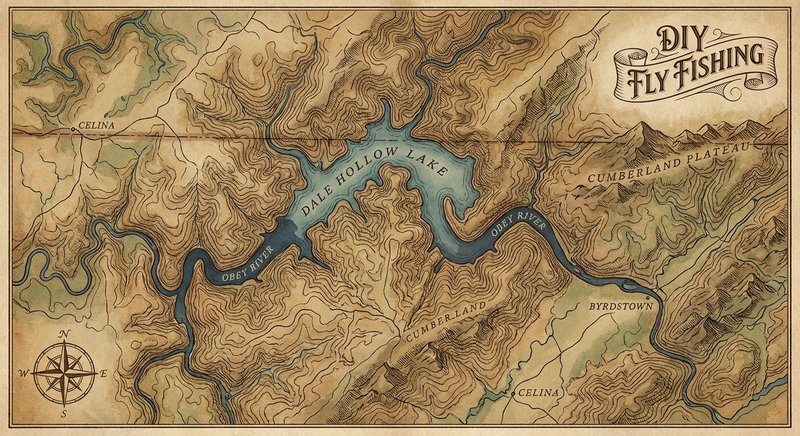
Dale Hollow Lake
Fly fishing in Tennessee · Beginner · Best seasons: Spring, Summer, Fall
Target Species
Smallmouth Bass, Largemouth Bass, Walleye
About This Water
Clear highland reservoir famous for smallmouth bass. World record smallmouth caught here.
Fishing Recommendations
Welcome to Dale Hollow Lake, arguably the crown jewel of Highland Reservoirs in the United States. As an expert guide, I can tell you that Dale Hollow is a bucket-list destination for any fly angler seeking trophy Smallmouth Bass. It is a massive, deep, and incredibly clear body of water that straddles the Tennessee-Kentucky border.
Here is your comprehensive guide to fly fishing Dale Hollow.
🎣 Location Overview
Dale Hollow is world-renowned as the home of the world-record Smallmouth Bass (11 lbs, 15 oz). What makes this lake special is its incredible clarity (visibility can exceed 20 feet) and its lack of residential development along the shoreline, thanks to the Corps of Engineers' management.
The lake is characterized by massive limestone bluffs, deep channels, sunken islands (humps), and vast grass beds. Because the water is so clear, the fish tend to be spookier and hold deeper than in other Southern lakes, making it a "thinking man's" fishery where stealth and technique are paramount.
🐟 Target Species & Behavior
Smallmouth Bass (The Main Attraction)
- Behavior: These are "open water" hunters. They relate heavily to transitions—where a bluff wall turns into a gravel shelf or where a point drops into the old river channel.
- Diet: Their primary forage consists of Crayfish and Threadfin Shad.
Largemouth Bass
- Behavior: While Smallmouth dominate the main lake, Largemouth are found in the backs of the many "hollows" (creeks) and around standing timber and weed beds.
- Diet: Bluegill, frogs, and larger shad.
Walleye
- Behavior: A challenging target on a fly, but very rewarding. They are light-sensitive. During the day, they hold deep (20–40 feet). In the spring, they migrate into the Obey River and Wolf River arms to spawn.
- Diet: Exclusively small baitfish and crayfish.
📅 Best Times to Fish
Spring (March – May): Prime Time
This is the best window for fly anglers. As water temperatures hit the 55°F–62°F range, Smallmouth move onto the shallow gravel shelves to spawn.
- Window: April is the "Golden Month."
- Condition: Overcast days are your best friend here due to water clarity.
Summer (June – August): The Night Game
Daytime fly fishing can be brutal in the summer as fish go deep (30+ feet).
- Window: The "Night Bite" is legendary. Fish the "dark of the moon" (New Moon) using surface flies along the bluff walls.
- Condition: Calm, humid nights.
Fall (September – November): The Shad Bust
As temperatures drop, shad school up and move toward the surface.
- Window: October.
- Condition: Look for "the jump." When you see seagulls diving, Smallmouth are pushing shad to the surface. It is fast and furious action.
🪰 Recommended Flies & Techniques
For Smallmouth (The "Brown Bass")
- Clouser Minnows: Size 2-4. Use Chartreuse/White or Grey/White to mimic shad. This is the most versatile fly on the lake.
- Game Changers: In white or silver. The erratic movement triggers big Smallmouth in clear water.
- Near Nuff Craw: Smallmouth on Dale Hollow love crayfish. Fish these on a sinking tip line along gravel points.
- Technique: Use an Intermediate or Type 3 Sinking Line. You must get the fly down to the 10–15 foot zone even when fish are "shallow."
For Largemouth
- Dahlberg Divers: Work these around standing timber in the backs of creeks.
- BoogleBugs: High-quality foam poppers. The "Electric Blue" or "Frog" patterns work well in the evening.
For Walleye
- Heavy Leech Patterns: Use black or purple with plenty of flash.
- Technique: Use a heavy Full Sinking Line (Type 5 or 7). You need to "dredge" the bottom in the river arms during the spring run.
💡 Pro Tips & Local Knowledge
- The "Float and Fly" (Fly Rod Version): Locals use a spinning rod with a jig under a buoy. Fly anglers can mimic this with a Balanced Leech or a Wooly Bugger suspended 10–12 feet under a large slip-indicator. This is deadly in the winter and early spring.
- Watch the Wind: Because the lake is so deep, the wind creates "current" against the points. Always fish the windward side of a point; the plankton drifts there, the shad follow, and the bass follow the shad.
- The Long Leader: Due to the extreme clarity, use longer leaders than usual. A 9-foot to 12-foot fluorocarbon leader (8lb - 10lb test) is necessary to avoid spooking trophy Smallmouth.
- The Bluff Wall Drop: Cast your fly directly against a limestone bluff and let it sink vertically. Smallmouth often suspend against these walls and will hit the fly on the initial fall.
⚠️ Important Information
Reciprocal License Agreement
Dale Hollow lies in both Tennessee and Kentucky. Fortunately, there is a reciprocal agreement: you can fish most of the main body of the lake with a license from either state. However, this does not apply to the tributary rivers (like the Wolf River), so check the map carefully.
Regulations
- Smallmouth Bass: There is a strict "Slot Limit." Generally, you are only allowed to keep one fish under 16 inches and one fish over 21 inches (check current TN Wildlife Resources Agency - TWRA - regs for yearly updates). This is why the lake produces such massive fish.
- Boating Safety: This is a large lake with heavy houseboat traffic. If you are in a kayak or small boat, be extremely cautious of large wakes.
Access Points
- Willow Grove Marina: Excellent central access to some of the best Smallmouth flats.
- Horse Creek Marina: Great for accessing the famous "lower end" near the dam.
- Donaldson Park: The best access for those wanting to fish the tailwaters of the Obey River below the dam (Trout water!).
Guide’s Final Word: Dale Hollow is not a numbers lake; it is a trophy lake. Bring your 6-weight or 7-weight rod, be patient, and stay late. That one "tug" might just be the fish of a lifetime.
Bug Hatches & Matching Flies
| Hatch | Type | Peak months | Time of day | Hook sizes | Matching flies |
|---|---|---|---|---|---|
| Giant Mayfly (Hex) Hexagenia limbata | mayfly | June, July | Dusk/Night | #6-10 | Hexagenia Dry #6-8, Burrowing Mayfly Nymph #8-10 |
| Zebra Midge / Chironomids Chironomidae | midge | March, April, October, November | All Day | #18-24 | Zebra Midge #18-22, Griffith's Gnat #20-24 |
| Sulfur Mayfly Ephemerella invaria | mayfly | May, June | Afternoon/Evening | #14-18 | Sparkle Dun #16-18, Pheasant Tail Nymph #14-16 |
| Cinnamon Caddis Hydropsyche | caddis | May, August, September | Evening | #14-16 | Elk Hair Caddis #14-16, Holy Grail Caddis #14-16 |
| Blue Winged Olives (BWO) Baetis | mayfly | March, April, October, November | Midday | #18-22 | RS2 #20-22, Parachute Adams #18-22 |
| Annual Cicada Neotibicen | terrestrial | July, August | Late Morning/Afternoon | #4-8 | Project Cicada #6-8, Fat Albert #6-10 |
| Damselfly Enallagma | terrestrial | June, July, August | All Day | #10-14 | Marabou Damselfly Nymph #10-12, Blue Foam Damsel #12-14 |
| Carpenter Ants / Terrestrials Camponotus | terrestrial | August, September | Afternoon | #12-16 | Chernobyl Ant #10-14, Black Foam Ant #14-16 |