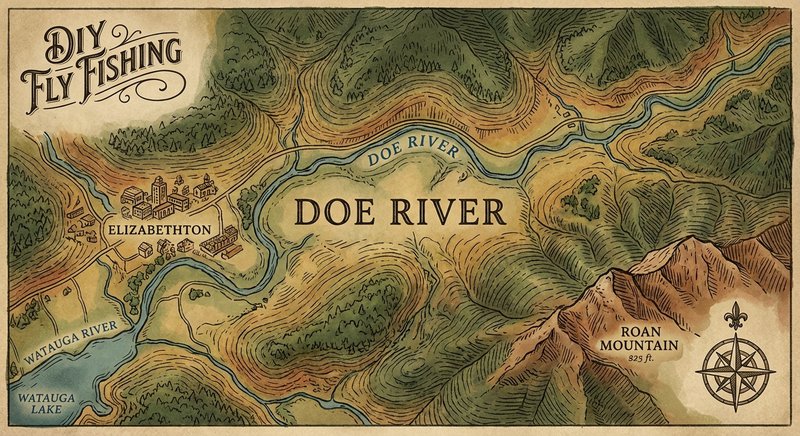
Doe River
Fly fishing in Tennessee · Beginner · Best seasons: Spring, Summer, Fall
Target Species
Rainbow Trout, Brown Trout
About This Water
Northeast Tennessee mountain stream. Wild trout fishing near Roan Mountain.
Fishing Recommendations
The Doe River in Northeast Tennessee is one of the state’s most beautiful and underrated freestone gems. While many anglers flock to the nearby tailwaters of the Watauga and South Holston, the Doe offers a classic mountain stream experience characterized by plunges, pocket water, and stunning scenery as it descends from the slopes of Roan Mountain.
🎣 Location Overview
The Doe River originates in the high elevations of the Unaka Mountains and flows through the town of Roan Mountain and the city of Elizabethton before joining the Watauga River.
What makes the Doe special is its freestone character. Unlike the regulated tailwaters nearby, the Doe is subject to the whims of nature—its flows and temperatures fluctuate with the weather. It is divided into two distinct personalities:
- The Upper Doe: High-gradient, rocky, and forested, mostly within or near Roan Mountain State Park.
- The Lower Doe: Broader, slower, and more fertile as it moves toward the Watauga, flowing through the historic "Doe River Gorge" and into the city of Elizabethton.
Anglers love the Doe for its solitude and the ability to "escape the crowds" of the bigger rivers. It provides a technical but rewarding challenge in a pristine Appalachian setting.
🐟 Target Species & Behavior
The Doe is home to both Rainbow Trout and Brown Trout.
- Rainbow Trout: In the upper reaches (Roan Mountain State Park), you will find smaller, vibrant wild rainbows. In the lower sections, the state stocks catchable-sized rainbows. They are typically opportunistic, holding in the "bubble line" at the head of pools or in the pocket water behind boulders.
- Brown Trout: The Doe holds some surprisingly large wild Brown Trout, particularly in the deep holes of the Doe River Gorge and the lower stretches near Elizabethton. Browns are more elusive, often hiding under undercut banks or in the shadows of overhanging rhododendrons during the day, becoming active during low-light periods or after a light rain.
📅 Best Times to Fish
The Doe is a seasonal river, and timing is everything due to its freestone nature.
- Spring (March – May): Prime Time. This is when the best hatches occur. Water levels are usually good, and the fish are hungry after winter. Look for the Quill Gordon and March Brown hatches in early spring, followed by Sulphurs in late May.
- Summer (June – August): Focus on the Upper Doe and the State Park. The high elevation keeps these waters cooler. In the lower sections, water temperatures can get too high for trout health by mid-afternoon, so stick to early morning or late evening.
- Fall (September – November): A spectacular time to be on the water. The Brown Trout become aggressive as they prepare to spawn. Blue Winged Olives (BWO) hatch on overcast days, and the water is typically very clear.
- Best Time of Day: During Spring/Fall, mid-day is excellent. In Summer, "First Light" and "Last Light" are the only windows worth fishing in the lower stretches.
🪰 Recommended Flies & Techniques
Dry Flies
- Spring: Parachute Adams (#12-16), Quill Gordon (#12-14), Elk Hair Caddis (Tan/Olive, #14-16).
- Summer: Stimulators (Yellow/Orange, #12-14), Parachute Hopper (#10-12), Ant and Beetle patterns (#16-18).
- Fall: Blue Winged Olives (#18-22), Parachute Adams (#18-20).
Nymphs
- Year-Round: Bead-head Pheasant Tails (#14-18), Gold Ribbed Hare’s Ear (#14-16), Prince Nymphs (#12-16).
- Specialty: Pat’s Rubber Legs (Stonefly imitation) is lethal in the higher gradient sections after a rain.
Techniques
- Tight-Line/Euro Nymphing: Because the Doe is full of pocket water and varying current speeds, a tight-line approach is often more effective than an indicator, as it reduces drag in the complex currents.
- Dry-Dropper: A high-visibility dry fly (like a Stimulator) with a small Pheasant Tail dropped 18-24 inches below is the "standard" rig for the Doe.
- Stealth: The water is often crystal clear. Long, fine leaders (9ft 5X or 6X) and a stealthy approach (avoiding wading splashes) are mandatory.
💡 Pro Tips & Local Knowledge
- The "Gorge" Factor: The Doe River Gorge is spectacular but difficult to access. If you are willing to hike, you will find fish that rarely see a fly. Be prepared for rugged terrain and slick rocks.
- Watch the Gauge: The Doe rises and muddies quickly after rain. Check the USGS gauge at Elizabethton. If it’s spiking, the river might be unfishable; however, as it begins to drop and clear ("the tea-colored stage"), streamer fishing for big Browns can be epic.
- Match the Gradient: If you aren't seeing fish in the flat water, move to the "broken water." In the summer, trout move into the riffles and highly oxygenated chutes to breathe and feed.
- Roan Mountain State Park: This is the best place for beginners. The access is easy, the river is well-stocked, and the scenery is world-class.
⚠️ Important Information
- Access:
- Roan Mountain State Park: Ample public access with parking lots and trails.
- Hampton/Valley Forge: Several bridge crossings and pull-offs along Highway 19E.
- Elizabethton: Linear Park offers great walking access to the lower river.
- Regulations: A Tennessee fishing license with a Trout Stamp is required. The Doe is generally under "General Trout Regulations," but always check the current TWRA (Tennessee Wildlife Resources Agency) guide for specific creel limits and bait restrictions.
- Safety: The rocks in the Doe are notoriously slippery (covered in "didymo" or rock snot in some areas). Studded wading boots and a wading staff are highly recommended.
- Etiquette: Much of the middle Doe flows through private property. Respect "Posted" signs and stay in the riverbed.
The Doe River is a "soul" river—it requires a bit more effort than the tailwaters, but the reward of a wild rainbow in a mountain setting is incomparable. Tight lines!
Bug Hatches & Matching Flies
| Hatch | Type | Peak months | Time of day | Hook sizes | Matching flies |
|---|---|---|---|---|---|
| Blue-Winged Olive Baetis | mayfly | March, April, October, November | Late Morning/Afternoon | #18-22 | Parachute BWO #18-22, RS2 #20-22, Pheasant Tail #18-20 |
| Quill Gordon Epeorus pleuralis | mayfly | March, April | Mid-day | #12-14 | Quill Gordon Dry #12-14, Quill Gordon Wet Fly #12-14 |
| Blue Quill Paraleptophlebia | mayfly | April | Late Morning | #16-18 | Blue Quill Dry #16-18, Hares Ear Nymph #16-18 |
| March Brown Maccaffertium vicarium | mayfly | May | Afternoon | #10-14 | March Brown Dry #12-14, Gold Ribbed Hare's Ear #10-12 |
| Sulphur Ephemerella invaria | mayfly | May, June | Evening | #14-18 | Parachute Sulphur #14-18, Sulphur Spinner #16-18, Split Case Sulphur #16 |
| Cinnamon Caddis Hydropsyche | caddis | May, June, September | Evening | #14-18 | Elk Hair Caddis (Tan) #14-18, Holy Grail #16, Frenchie #14-18 |
| Yellow Sally Isoperla | stonefly | June, July | Late Afternoon/Evening | #14-16 | Yellow Sally Dry #14-16, Iron Lotus (Yellow) #16 |
| Terrestrials Formicidae/Coleoptera | terrestrial | July, August, September | All Day | #12-18 | Black Foam Ant #16-18, Grape Foam Beetle #14-16 |
| Common Midge Chironomidae | midge | January, February, December | Late Morning/Afternoon | #18-24 | Griffith's Gnat #20-22, Zebra Midge #18-22 |