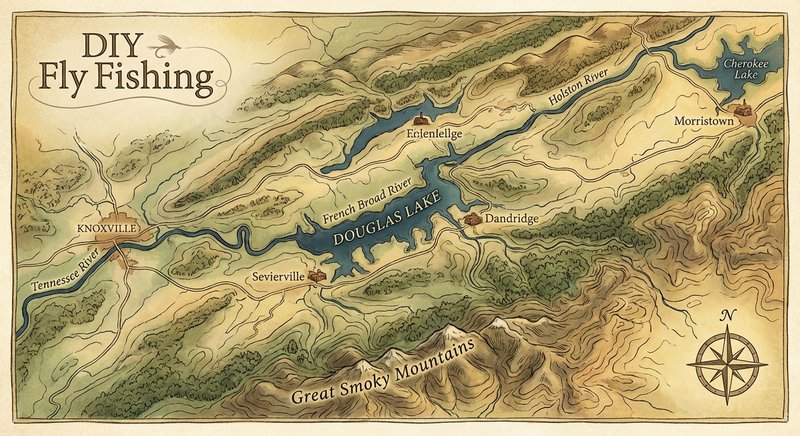
Douglas Lake
Fly fishing in Tennessee · Beginner · Best seasons: Spring, Summer, Fall
Target Species
Largemouth Bass, Crappie, Catfish
About This Water
Near Sevierville with excellent bass and crappie. Good family fishing destination.
Fishing Recommendations
Welcome to the foothills of the Great Smoky Mountains. As a guide in East Tennessee, I can tell you that Douglas Lake (a TVA reservoir on the French Broad River) is a different beast than our cold-water trout streams. It is a high-productivity, "fertile" fishery known for its impressive biomass.
While most people think of conventional gear here, Douglas is a sleeping giant for the fly angler who understands lake transitions and baitfish migrations.
🎣 Location Overview
Douglas Lake is a sprawling 28,000-acre reservoir with over 500 miles of shoreline. What makes it special is its topography and fertility. Unlike the deep, clear "dead" lakes further north, Douglas is relatively shallow with stained-to-murky water, which creates an explosion of forage (primarily Gizzard and Threadfin Shad).
Anglers love it because it is a "numbers" lake. You aren't just looking for one bite; you are often fishing over massive schools of fish. The landscape is a mix of rolling farmland and steep rocky bluffs, providing a diverse array of structure including submerged timber, points, and flats.
🐟 Target Species & Behavior
Largemouth Bass
- Behavior: These are the kings of the shoreline. In the spring, they move into the "hollows" and shallow flats to spawn. In summer, they retreat to deeper ledges and submerged points.
- Feeding: They are opportunistic but primarily focus on shad and bluegill. Large crayfish are a staple near the rocky points of the Dandridge area.
Crappie
- Behavior: Douglas is arguably the best crappie lake in Tennessee. They are highly school-oriented. They hold tight to submerged "brush piles" and old timber.
- Feeding: They are "visual" hunters looking for small minnows. On a fly rod, they offer incredible sport on 3-weight or 4-weight gear.
Catfish (Channel & Flathead)
- Behavior: While rarely targeted on fly, it is a thrill when you hook one. They hold in the river-channel bends and deep holes during the day, moving onto shallow flats at night to feed.
- Feeding: They scavenge, but they also hunt. They respond to vibration and scent.
📅 Best Times to Fish
- Spring (Late March – May): Prime Time. This is when all three species move shallow. Look for water temperatures hitting 55°F for Crappie and 62°F for Bass.
- Summer (June – August): Focus on the "Golden Hour" (first and last light). Bass will bust shad on the surface at dawn. For catfish and larger bass, night fishing is highly productive.
- Fall (September – November): As the water cools, shad migrate into the backs of creeks. The bass follow them. This is the best time for "blitz" fishing where you see schools of fish breaking the surface.
🪰 Recommended Flies & Techniques
For Largemouth Bass
- Flies:
- Topwater: Game Changers (mini), BoogleBugs (Poppers) in white or chartreuse.
- Subsurface: Clouser Minnows (Chartreuse/White), Murdich Minnows, and Crawdad patterns (rubber legs are a must).
- Technique: Use an intermediate sinking line to keep your fly in the "strike zone" (3–6 feet deep) along rocky points.
For Crappie
- Flies:
- Micro-Clousers, Wooly Buggers (Size 8-12 in Pink, White, or Chartreuse), and "Crappie Candy" (bead-head streamers).
- Technique: Use a "Vertical Jigging" fly approach. Drop the fly near submerged brush and use a slow, rhythmic "strip-pause" to mimic a dying minnow.
For Catfish
- Flies:
- Heavy Lead-Eyed Leeches or large Bunny Strips in dark colors (Black/Purple).
- Technique: You must get the fly to the bottom. Use a fast-sinking tip and "crawl" the fly along the substrate near the mouth of the French Broad River.
💡 Pro Tips & Local Knowledge
- The "Drawdown" Factor: Douglas is a flood-control lake. In winter/late fall, the water level can drop 40+ feet. This concentrates fish but makes boat ramps tricky. Always check the TVA Lake Info App for current water levels and discharge rates.
- Focus on the "Mud Line": After a rain, the upper end of the lake (near Newport) gets muddy. Fish the "mud line" where the dirty water meets the clear water—bass use this as an ambush point.
- Bridge Pilings: The bridges (like the Hwy 139 bridge) create humongous shadows and current breaks. Crappie often stack up 10–15 feet deep against these pilings.
- Find the Birds: If you see gulls diving in the Fall, get there immediately. They are feeding on shad pushed to the surface by schools of White Bass and Largemouth.
⚠️ Important Information
- Access: The Dandridge Public Dock and Swann’s Marina are excellent starting points for boaters. For wade anglers, access is limited, but the area near Douglas Dam (tailwaters) offers great wading for bass and even some trout further down.
- Regulations: A valid Tennessee Fishing License is required. There are specific length and creel limits, especially for Crappie (10-inch minimum) and Bass. Check the TWRA website for the current year's guide.
- Safety: Douglas can get very choppy with wind. Also, watch for heavy boat traffic during summer weekends; bass boats move fast here.
Guide’s Final Word: If you want the most fun, take a 4-weight rod and a box of white streamers to the brush piles in May. You’ll catch Crappie until your arm gets tired, and the occasional 3lb Largemouth will keep you on your toes!
Bug Hatches & Matching Flies
| Hatch | Type | Peak months | Time of day | Hook sizes | Matching flies |
|---|---|---|---|---|---|
| Midges Chironomidae | midge | January, February, March, December | All day | #18-24 | Zebra Midge #18-22, Griffith's Gnat #20-22, Palomino Midge #20-24 |
| Hex Hexagenia limbata | mayfly | June, July | Late Evening/Night | #6-10 | Hexagenia Spinner #6-8, Hare's Ear Nymph #8-10, Burrowing Mayfly Nymph #6-10 |
| Cinnamon Caddis Hydropsyche | caddis | May, June, September | Evening | #14-18 | Elk Hair Caddis #14-16, Pupa Sells #16-18, Hydropsyche Larva #14-16 |
| Blue Winged Olives Baetis | mayfly | March, April, October, November | Afternoon | #18-22 | Parachute Adams #18-22, RS2 #20-22, Pheasant Tail Nymph #18-20 |
| White Fly Ephoron leukon | mayfly | August, September | Evening/Dusk | #12-14 | White Wulff #12-14, Snowshoe Emerger #12-14 |
| Damselfly Enallagma | other | June, July, August | Morning/Afternoon | #10-14 | Marabou Damsel Nymph #12-14, Adult Damsel #10-12 |
| Terrestrial Ants and Beetles Formicidae/Coleoptera | terrestrial | July, August, September | All day | #12-18 | Black Foam Ant #14-18, Chernobyl Ant #8-12, Foam Beetle #12-16 |
| Sulphurs Ephemerella invaria | mayfly | May, June | Late Afternoon/Evening | #14-16 | Sulphur Parachute #14-16, Split Case Sulphur #14-16, Sulphur Cripple #14-16 |