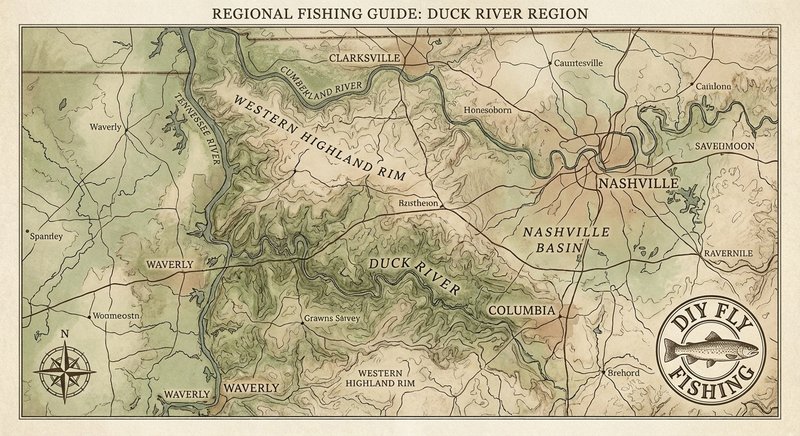
Duck River
Fly fishing in Tennessee · Beginner · Best seasons: Spring, Summer, Fall
Target Species
Smallmouth Bass, Largemouth Bass, Rock Bass
About This Water
One of the most biodiverse rivers in North America. Excellent smallmouth bass fishing.
Fishing Recommendations
The Duck River in Middle Tennessee is a crown jewel of Southern fly fishing. Often cited by the Nature Conservancy as one of the most biologically diverse rivers in North America, it boasts more species of fish and freshwater mussels than all the rivers of Europe combined. For the fly angler, it is a paradise of limestone ledges, scenic bluffs, and aggressive river bass.
Here is your comprehensive guide to fly fishing the Duck River.
🎣 Location Overview
The Duck River winds over 280 miles through the heart of Tennessee, but the prime fly fishing water is generally found between Normandy Dam and Columbia.
What makes the Duck special is its limestone geology. The riverbed is a labyrinth of shelves, undercut banks, and gravel bars. This alkaline environment creates a rich food chain, leading to healthy, thick-shouldered bass. The water is generally clear to stained, characterized by long, slow pools separated by oxygen-rich riffles. It is a "big" feeling river that remains intimate enough to wade in many sections during summer flows.
🐟 Target Species & Behavior
Smallmouth Bass (The Bronze Back)
The undisputed king of the Duck. These fish are lean, mean, and use the current to their advantage.
- Behavior: They hold in the "push water" just above a riffle or in the "tailout" just below. During mid-day, they retreat to the shadows of limestone ledges.
- Feeding: They are opportunistic but have a particular affinity for crayfish and hellgrammites.
Largemouth Bass
Found primarily in the slower, deeper reaches and the "sloughs" of the river.
- Behavior: Look for woody debris, downed trees, and lily pad edges. They prefer the slack water where they can ambush prey without fighting the current.
- Feeding: They focus on larger profiles—frogs, baitfish (shad/shiners), and even dragonflies.
Rock Bass (Goggle-eye)
The unsung hero of the Duck. They are ubiquitous and strike with surprising aggression.
- Behavior: They hide in the tightest crevices of rocks and submerged root balls.
- Feeding: If it fits in their oversized mouths, they will eat it. Great for kids or beginners to practice hook sets.
📅 Best Times to Fish
Spring (April – May)
As the water warms into the 55–65°F range, the fish become highly active. This is the time for trophy Smallmouth. They move out of winter holes and into the shallows to spawn and feed.
- Note: Be mindful of spawning beds (redds); if you see a bass on a pale circular patch of gravel, let it be.
Summer (June – August)
The Topwater Season. This is the most exciting time to fish the Duck. Low, stable water levels make the river easy to read.
- Prime Window: The first two hours of daylight and the "golden hour" before sunset.
Fall (September – October)
As temperatures drop, bass go on a feeding binge to prepare for winter. The river is often at its clearest, requiring stealthy approaches.
- Prime Window: Mid-day as the sun warms the rocks and activates the baitfish.
🪰 Recommended Flies & Techniques
Topwater Patterns
- BoogleBug Poppers (Size 4-6): The gold standard for the Duck. Yellow and Chartreuse are local favorites.
- Stealth Bomber: Excellent for "splatting" against rock bluffs.
- Murdich Minnow: A "suspending" fly that works wonders just under the surface.
Subsurface Patterns (Streamers/Nymphs)
- Near Nuff Craw: A crayfish imitation that should be bounced along the bottom.
- Gamechanger (Small): For mimicking the abundant shiners and shad.
- Pat’s Rubber Legs (Size 6-8): To mimic the massive hellgrammites found under the river's rocks.
- Clouser Minnow: Chartreuse/White or Olive/White. A staple for every Tennessee river.
Techniques
- The "Pop and Pause": When using poppers, the pause is more important than the pop. Let the rings disappear before moving it again.
- Swing and Strip: Cast streamers 45 degrees downstream into riffles, let them swing into the soft water, and strip back erratically.
- The Crawl: For crayfish patterns, use a slow, "heavy" retrieve to keep the fly ticking against the limestone ledges.
💡 Pro Tips & Local Knowledge
- Watch the Gauges: The Duck is highly sensitive to rain. Check the USGS gauge at Shelbyville or Columbia. If the flow is spiking or the water is "chocolate milk," stay home. Ideally, you want a stable or falling discharge.
- Focus on the Ledges: Duck River Smallmouth love verticality. A ledge that drops from 2 feet to 6 feet is a biological skyscraper. Cast your fly right against the rock face and let it sink down the "stairs."
- The "Duck River Twitch": When fishing a popper, try one violent pop followed by 10 seconds of total stillness. Often, the biggest bass watch the fly and only strike when they think it's dying.
- Wading Safety: The limestone on the Duck is notoriously slick. Studded wading boots are not optional—they are a necessity. A wading staff is also highly recommended.
⚠️ Important Information
Access Points
- Henry Horton State Park: Great for wade anglers with easy river access and groomed trails.
- Yanahli Park (Columbia): Offers thousands of acres and multiple access points for both wading and kayak launching.
- Normandy Tailwaters: The section immediately below the dam stays cooler and can hold trout in the early spring, but transitions quickly to a world-class Smallmouth fishery.
Regulations
- A Tennessee Fishing License (Type 001) is required.
- Certain sections of the Duck have Smallmouth Bass Length Limits (usually a 13-17 inch protected slot limit). Always check the current TWRA (Tennessee Wildlife Resources Agency) guide before heading out.
- Leave No Trace: Because of the river's high biodiversity and endangered mussel species, please be careful not to disturb the riverbed excessively and always pack out your trash.
Guide’s Final Word: The Duck River doesn't give up its secrets easily, but if you master the art of the "slow strip" and learn to read the limestone ledges, it will provide some of the best Smallmouth action in the United States.
Bug Hatches & Matching Flies
| Hatch | Type | Peak months | Time of day | Hook sizes | Matching flies |
|---|---|---|---|---|---|
| Blue Winged Olive Baetis | mayfly | March, April, October, November | Late Morning/Afternoon | #18-22 | RS2 #20-22, Parachute Adams #18-22, Pheasant Tail Nymph #18-20 |
| Sulphur Ephemerella invaria | mayfly | May, June | Late Afternoon/Evening | #14-18 | Sulphur Parachute #16-18, Sulphur Cripple #16, Gold Ribbed Hare's Ear #14-16 |
| Tan Caddis Hydropsyche | caddis | April, May, September | Evening | #14-18 | Elk Hair Caddis #14-16, Holy Grail Caddis #16, LaFontaine's Deep Sparkle Pupa #14-18 |
| White Fly Ephoron leukon | mayfly | August, September | Late Evening/Night | #12-14 | White Wulff #12-14, Snowshoe Mayfly #14, White Sparkle Dun #12-14 |
| Zebra Midge Chironomidae | midge | January, February, March, December | All Day | #18-24 | Zebra Midge (Black/Silver) #18-22, Griffith's Gnat #20-22, Mercury Midge #20-24 |
| Cranefly Tipulidae | other | May, September | Morning/Evening | #8-12 | Crane Fly Larva #8-12, Daddy Long Legs #10-12, Killer Bug #10-12 |
| Sowbug Asellidae | crustacean | January, February, March, April, May, June, July, August, September, October, November, December | All Day | #14-18 | Ray Charles #14-18, Sow-Bug (Grey/Tan) #14-16, Scud #16-18 |
| Terrestrials (Ants/Beetles) Formicidae/Coleoptera | terrestrial | July, August, September | Afternoon | #12-18 | Black Foam Ant #16-18, Cricket #12-14, Chernobyl Ant #10-14 |