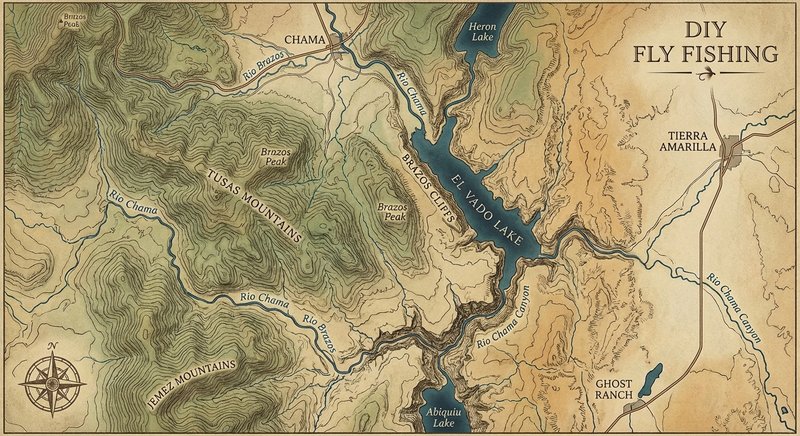
El Vado Lake
Fly fishing in New Mexico · Beginner · Best seasons: Spring, Summer, Fall
Target Species
Rainbow Trout, Brown Trout, Kokanee Salmon
About This Water
Reservoir on the Chama River with good trout fishing. Connected to Heron Lake by Rio Chama.
Fishing Recommendations
Greetings, angler. As a guide who has spent years navigating the high-desert waters of Northern New Mexico, I can tell you that El Vado Lake is a unique and rugged destination. It is part of the legendary Rio Chama system, sitting at about 6,900 feet of elevation.
⚠️ CRITICAL UPDATE FOR ANGLERS: Before we dive in, you must know that as of 2023–2024, El Vado Lake is undergoing major dam repairs. Water levels are being kept extremely low, often reduced to the original Rio Chama river channel snaking through the lake bed. This has shifted the fishing from a "big water boat" experience to more of a "river-inlet and pool" experience.
Here is the comprehensive guide to fly fishing El Vado Lake.
🎣 Location Overview
El Vado Lake is a reservoir on the Rio Chama, located near Tierra Amarilla. What makes it special is its transitionary nature; it sits between the high alpine peaks of the San Juans and the red rock canyons of the lower Chama.
When full, it offers miles of rocky shoreline and steep drop-offs. When low (as it is currently), it exposes the old riverbed, creating "micro-environments" where trout congregate in the deeper pools of the original channel. It is less crowded than its neighbor, Heron Lake, and offers a more "wild" feel. The scenery is quintessential New Mexico—sagebrush, ponderosa pines, and dramatic mesas.
🐟 Target Species & Behavior
Rainbow Trout
- Behavior: These are largely stocked by NM Department of Game and Fish. They tend to cruise the shorelines in spring and congregate near the Rio Chama inlet.
- Feeding: They are opportunistic, feeding on midges, callibaetis, and terrestrial insects blown off the sagebrush.
Brown Trout
- Behavior: These are the "kings" of El Vado. Many are wild or long-term holdovers. They are highly predatory and prefer structure—submerged boulders, old logs, and the steep walls of the river channel.
- Feeding: Large Browns here are "piscivorous" (fish-eaters). They hunt crayfish and smaller trout or minnows.
Kokanee Salmon
- Behavior: A landlocked sockeye salmon. They spend most of the year in deep water schooling and feeding on zooplankton.
- The Run: In late Fall (October–November), they become aggressive and "color up" (turn bright red) as they attempt to spawn near the rocky banks or move toward the inlet.
📅 Best Times to Fish
- Spring (April – June): This is prime time for Rainbows. As the ice melts, fish move into the shallows to warm up and feed. The Rio Chama inlet is firing during this window, though runoff can make the water murky.
- Summer (July – August): Best for early morning and late evening. Mid-day heat pushes fish deep. This is "hopper season"—fishing large terrestrial patterns near the banks can result in explosive strikes.
- Fall (September – November): The trophy window. Brown trout move toward the inlets to spawn and become aggressive. This is also when the Kokanee Salmon "snagging" season (and fly fishing for them) occurs.
🪰 Recommended Flies & Techniques
The Streamer Game (Best for Big Browns)
Since El Vado is a predatory environment, stripping streamers is often the most productive way to find a wall-hanger.
- Patterns: White or Olive Sculpzilla, Woolly Buggers (Size 6-10) in black or peacock, and the Sparkle Minnow.
- Technique: Use a sink-tip line. Cast toward the old river channel edges and use a "strip-strip-pause" retrieval to mimic a wounded minnow.
Nymphing the Channel
With the current low water, the fish are concentrated in the moving water of the Rio Chama as it enters the lake bed.
- Patterns: Zebra Midges (Size 18-22) in red or black, RS2s, and Pheasant Tails.
- Technique: Use an indicator rig. Set your depth so your fly is bouncing just off the bottom of the channel.
Dry Fly/Terrestrials
- Patterns: Amy’s Ant, Chubby Chernobyl (Tan or Orange), and Parachute Adams.
- Technique: In late summer, wind blows grasshoppers from the surrounding meadows onto the water. "Splat" your hopper pattern near the bank and give it a slight twitch.
💡 Pro Tips & Local Knowledge
- Follow the Inlet: The spot where the Rio Chama enters the lake is the most consistent producer. Because the lake is low, you may have to hike further than usual to find where the moving water meets the standing water.
- The "Chama Craw": The Rio Chama system is loaded with crayfish. If the streamers aren't working, fish a weighted crayfish pattern (like a Near Nuff Craw) slowly along the bottom.
- Wind is Your Friend: A "Chama Chop" (light wind) breaks up the surface of the water, making the fish less spooky. If the lake is glass-calm, your presentation must be incredibly delicate.
- Low Water Stealth: Because the water is currently confined to a smaller channel, the fish are more skittish. Wear earth-toned clothing and avoid "lining" the fish with your fly line.
⚠️ Important Information
- Access: El Vado Lake State Park access can be restricted due to the dam construction. Check the New Mexico State Parks website for the latest closure updates.
- Regulations: A valid New Mexico fishing license is required. You also need a Gila/Chama Habitat Stamp.
- Kokanee Rules: Note that there are specific dates for "snagging" season versus "angling" season for Kokanee. Always check the current NMDGF Ribbon Press for bag limits.
- Weather: This is high-country desert. A sunny 70-degree morning can turn into a 40-degree lightning storm in 30 minutes. Always carry a rain shell and extra layers.
Guide’s Final Word: El Vado is a "grind" lake. You might go two hours without a hit, but the next strike could be a 24-inch Brown Trout that will make your entire season. Stay patient, watch the birds (to find baitfish), and focus on the channel edges. Tight lines!
Bug Hatches & Matching Flies
| Hatch | Type | Peak months | Time of day | Hook sizes | Matching flies |
|---|---|---|---|---|---|
| Midges Chironomidae | midge | March, April, October, November | All Day | #18-24 | Zebra Midge #18-22, Griffith's Gnat #20-22, Palomino Midge #20-24 |
| Callibaetis (Speckled Duns) Callibaetis nigritus | mayfly | June, July, August | Late Morning/Afternoon | #12-16 | Callibaetis Spinner #14-16, Hares Ear Nymph #12-16, Trigger Finger Callibaetis #14-16 |
| Damselflies Enallagma | terrestrial | June, July | Morning/Afternoon | #10-12 | Marabou Damsel Nymph #10-12, Adult Damsel #12, Braided Butt Damsel #12 |
| Blue Winged Olive (BWO) Baetis | mayfly | April, May, September, October | Mid-Day | #18-22 | RS2 #18-22, Parachute Adams #18-22, Pheasant Tail Nymph #18-20 |
| Caddisflies Hydropsychidae | caddis | May, June, July | Evening | #14-18 | Elk Hair Caddis #14-18, LaFontaine's Deep Sparkle Pupa #14-16, Godzilla Caddis #14-16 |
| Grasshoppers Acrididae | terrestrial | August, September | Afternoon | #8-12 | Hopper Juan #10-12, Dave's Hopper #8-12, Amy's Ant #10-12 |
| Scuds Gammarus | terrestrial | March, April, May | All Day | #12-16 | Ray Charles #14-16, UV Scud #12-16, Pink Scud #14-18 |
| Water Boatmen Corixidae | terrestrial | September, October | Afternoon | #14-16 | Water Boatman #14-16, Prince Nymph #14-16 |