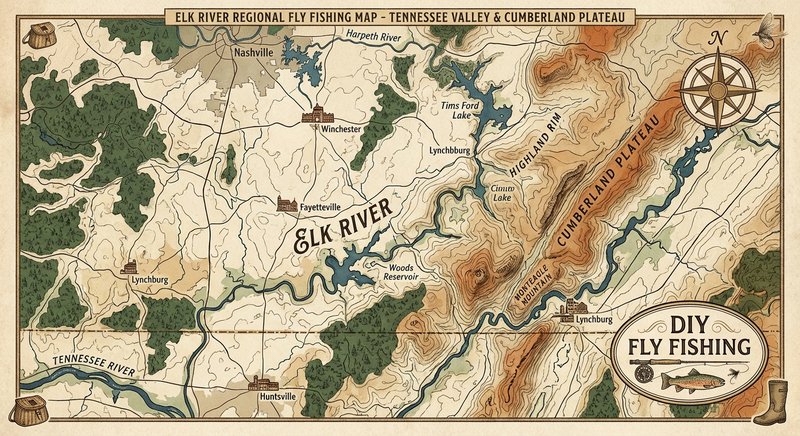
Elk River
Fly fishing in Tennessee · Beginner · Best seasons: Spring, Summer, Fall
Target Species
Smallmouth Bass, Rock Bass
About This Water
Middle Tennessee stream with smallmouth bass and some trout. Scenic float fishing.
Fishing Recommendations
As an expert guide who has spent years poling drift boats and wading the limestone-rich waters of Middle Tennessee, I can tell you that the Elk River is one of the region's most underrated gems for Smallmouth Bass.
While many anglers flock to the Elk for its trout tailwater near Tims Ford Dam, the lower sections of the river transform into a premier warm-water fishery. The "Elk River Bronze" is known for its incredible strength, fueled by the river’s high dissolved oxygen and rich forage base.
🎣 Location Overview
The Elk River is a classic Highland-style stream that flows through the rolling hills of Middle Tennessee. What makes it special is its limestone bedrock. This limestone buffers the water chemistry, creating a highly productive ecosystem teeming with crawfish and hellgrammites—the "steak and potatoes" for Smallmouth Bass.
The river transitions from a cold-water trout fishery below Tims Ford Dam into a warm-water paradise as you move downstream toward Fayetteville. The water is characterized by long, deep pools separated by shallow, rocky riffles and magnificent limestone bluffs. It is a scenic, intimate river that feels much more remote than it actually is.
🐟 Target Species & Behavior
Smallmouth Bass ("Bronzebacks")
The Smallmouth here are lean and powerful. Unlike lake-dwelling fish, Elk River Smallies are "river strong," meaning they spend their lives fighting current.
- Holding Patterns: Look for them behind "current breaks"—large boulders, submerged logs, or the seams where fast water meets slow water. In the heat of summer, they move into the "heads" of pools where the water is most oxygenated.
- Feeding: They are opportunistic but lean heavily on crawfish. If you see a gravel bar, there are crawfish there, and the Smallmouth won't be far away.
Rock Bass ("Goggle-eyes")
Often overlooked but a blast on a light fly rod, the Rock Bass in the Elk are exceptionally large.
- Holding Patterns: They are highly structure-oriented. You will find them tucked tight against limestone ledges, root wads, and bridge pilings.
- Feeding: They love smaller silhouettes. If you find a submerged tree, you can often pull a half-dozen Rock Bass out of it before the Smallmouth move in.
📅 Best Times to Fish
- Spring (April – June): This is the prime window for trophy fish. As the water hits 55-60°F, the fish become aggressive. Pre-spawn Smallmouth will hold in the deeper eddies near spawning flats.
- Summer (July – August): The "topwater window." Early mornings and late evenings are magical. During the day, fish move into faster, "bubbly" water to stay cool and find oxygen.
- Fall (September – November): As temperatures drop, the bass go on a feeding binge to prepare for winter. This is the best time for streamers, as the fish are looking for high-calorie meals like shiners and smaller sunfish.
Prime Window: Low-light periods (dawn and dusk) are always best for topwater, but on the Elk, the "mid-day hopper" bite can be surprisingly productive in late summer.
🪰 Recommended Flies & Techniques
Top Patterns
- Streamers:
- Game Changers (White or Chartreuse) - Mimics the local shad and shiners.
- Clouser Minnows (Olive/White) - The gold standard for bouncing off the bottom.
- Near Nuff Crayfish - Because the Elk is a crawfish factory.
- Topwater:
- Boogle Bugs (Poppers) - Yellow or "Frog" patterns.
- Murdich Minnow - Fished on a sink-tip, this dances just below the surface.
- Nymphs/Sub-surface:
- Hellgrammite patterns (Black Pat’s Rubber Legs) - Fish these under a strike indicator in the riffles.
Presentation Tips
- The "Swing and Strip": Cast 45 degrees downstream across a riffle, let the fly swing into the eddy, and then give it short, erratic strips.
- Tight to the Wood: When fishing for Rock Bass, your fly needs to be within inches of the timber. If you aren't snagging occasionally, you aren't fishing where they live.
💡 Pro Tips & Local Knowledge
- The Fayetteville Stretch: The water around the city of Fayetteville is legendary. Focus on the areas where smaller creeks (like Norris Creek) enter the river; these "confluences" bring in fresh nutrients and cooler water.
- Watch the Flow: The Elk is a tailwater. Check the TVA Lake Info app for Tims Ford Dam release schedules. If they are pulling two generators, the river becomes dangerous for wading and the fish often "shut down" due to the sudden temperature drop. Look for "Low Flow" or "One Generator" windows.
- The "Limestone Slide": Smallmouth love to sit right against the underwater limestone ledges that run parallel to the current. Instead of casting to the middle, cast your streamer right against the rock wall and let it sink before your first strip.
⚠️ Important Information
Access Information
- Public Access: There are several TWRA (Tennessee Wildlife Resources Agency) access points. The Farris Creek Bridge and the Fayetteville City Park offer good entry points for waders and kayakers.
- Float Fishing: The Elk is best experienced via kayak or canoe. A popular float is from the Old Dam (near Kelso) down to Fayetteville.
Regulations & Permits
- A valid Tennessee Fishing License is required.
- If you are fishing above the Hwy 64 bridge, be aware of trout-specific regulations, but for Smallmouth, standard state limits apply. Always check the current TWRA Fishing Guide for seasonal changes.
Special Considerations
- Stay Hydrated: Middle Tennessee summers are humid and punishing.
- Wading Safety: The Elk has "slick" limestone. Felt-soled boots or studs are highly recommended to avoid a spill.
- Private Property: While the water is public, the land on either side is often private. Stay in the river or on the gravel bars below the high-water mark.
Tight lines, and enjoy the pull of an Elk River Smallmouth!
Bug Hatches & Matching Flies
| Hatch | Type | Peak months | Time of day | Hook sizes | Matching flies |
|---|---|---|---|---|---|
| Midges Chironomidae | midge | January, February, March, December | All day | #18-24 | Zebra Midge #18-22, Griffith's Gnat #20-22, Morgan's Midge #20-24 |
| Blue Winged Olive Baetis | mayfly | February, March, October, November | Mid-day | #16-20 | RS2 #18-20, Parachute BWO #16-20, Pheasant Tail Nymph #18-20 |
| Sulphurs Ephemerella invaria | mayfly | May, June, July | Late Afternoon/Evening | #14-18 | Parachute Sulphur #14-16, Sulphur Emerger #16-18, Split Case Sulphur #16 |
| Sowbugs Isopoda | terrestrial | Year-round | All day | #14-18 | Ray Charles #14-18, Tailwater Sowbug #16-18, Soft Hackle Sowbug #16 |
| Cinnamon Caddis Hydropsyche | caddis | April, May, June | Evening | #14-16 | Elk Hair Caddis (Tan) #14-16, LaFontaine's Deep Sparkle Pupa #14-16, Holy Grail #14-16 |
| Crane Fly Tipulidae | stonefly | August, September, October | Morning/Evening | #8-12 | Daddy Long Legs #10-12, Crane Fly Larva #8-10 |
| Terrestrials (Ants and Beetles) Formicidae/Coleoptera | terrestrial | July, August, September | Afternoon | #12-18 | Black Foam Beetle #14-16, Cinnamon Ant #16-18, Chernobyl Ant #10-12 |
| March Brown Maccaffertium vicarium | mayfly | March, April | Afternoon | #12-14 | March Brown Western #12-14, Hare's Ear Nymph #12-14, March Brown Wet Fly #14 |