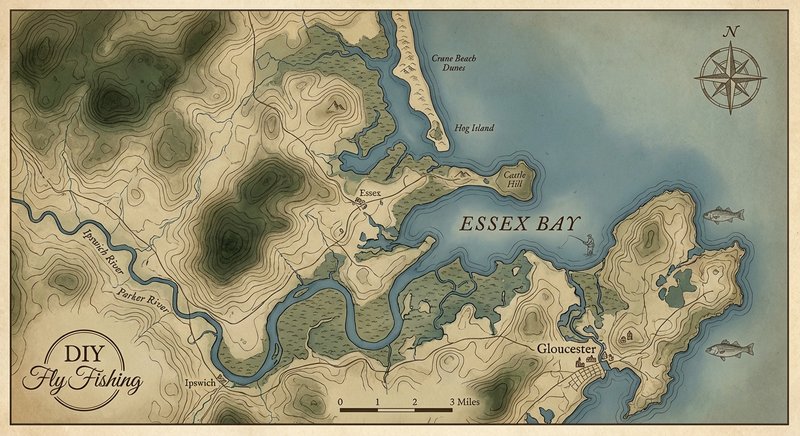
Essex Bay
Fly fishing in Massachusetts · Intermediate · Best seasons: Summer, Fall
Target Species
Striped Bass, Bluefish
About This Water
Essex County estuary with striped bass. Fly fishing the flats.
Fishing Recommendations
Welcome to one of the most picturesque and productive saltwater fly fishing destinations in New England. As your guide, I’m excited to break down Essex Bay, a massive salt marsh system that serves as a vital nursery and hunting ground for Atlantic Striped Bass.
🎣 Location Overview
Essex Bay is a sprawling, shallow estuary located behind Crane Beach and the Castle Neck dunes. It is fed by the Essex River and several smaller tidal creeks. What makes this area special is its dynamic ecosystem: it consists of vast cordgrass marshes, winding tidal channels, expansive sand flats, and the rocky "front side" of the islands.
Anglers love Essex Bay because it offers a "sight fishing" experience that is rare in the Northeast. When the sun is high and the tide is right, you can pole a skiff or wade the white sand flats and target cruising Striped Bass in water less than two feet deep. It feels more like the Bahamas than Massachusetts.
🐟 Target Species & Behavior
Striped Bass (Morone saxatilis)
The star of the show. In Essex Bay, you’ll find everything from "schoolies" (12–22 inches) to "cows" (30+ inches).
- Behavior: They are highly tide-dependent. They move into the marsh on the flood tide to hunt crabs and silversides in the grass and retreat to deeper channels on the ebb.
- Feeding: Their diet here consists of sand eels, silversides, green crabs, mummichogs (mudsuckers), and the occasional "tinker" mackerel near the mouth of the bay.
Bluefish (Pomatomus saltatrix)
The "yellow-eyed devils" usually show up when the water warms in July and August.
- Behavior: They are aggressive, surface-oriented, and often travel in schools. They are less likely to be found deep in the marsh and more likely to be found in the main Essex River channel or crashing bait at the mouth of the bay near the "Bar."
📅 Best Times to Fish
Optimal Seasons
- Summer (June – August): This is the prime time for flats fishing. The water is warm, the fish are settled into a routine, and sight fishing is at its peak.
- Fall (September – October): The "Fall Run." As temperatures drop, fish begin their migration south. This is when you’ll see massive "blitzes" where bass and blues push bait to the surface.
Best Times of Day & Tides
- The "Magic Hour": Low light conditions (dawn and dusk) are always best for surface activity.
- The Tide Factor: In Essex Bay, tide is everything.
- The Flood: Fish move up onto the flats and into the grass. Focus on the edges where the water is first creeping over the sand.
- The Ebb: As water drains, fish stage at the "mouths" of small feeder creeks to intercept bait being flushed out.
- Dead Low: Focus on the main Essex River channel where fish are forced to congregate in deeper water.
🪰 Recommended Flies & Techniques
Top Fly Patterns
- Sand Eel Clouser Minnow: (Chartreuse/White or Olive/White). The gold standard for Essex. Use sizes #2 to 2/0.
- Ray’s Fly: A classic local pattern that mimics silversides perfectly.
- Gurglers & Poppers: For explosive topwater action, especially during the fall or at dawn.
- Mushmouths: Great for mimicking small, translucent baitfish.
- Crab Patterns: (Epoxy or Merkin style) for targeting bass tailing in the grass on high tides.
Techniques & Presentation
- The Strip-Set: Never "trout set" (lift the rod). When a bass eats, pull the line tight with your hauling hand to set the hook in their hard mouths.
- Flats Stealth: If wading the sand flats, move slowly. Striped Bass have excellent vision in clear water; long leaders (9–12 feet) and fluorocarbon tippet (15–20lb) are essential.
- The "Dead Drift": In the tidal creeks, cast upstream and let your fly drift naturally with the current, occasionally twitching it. This mimics a wounded baitfish being swept out.
💡 Pro Tips & Local Knowledge
- The Crane Beach "Front Side": If the bay is quiet, head to the ocean side of Crane Beach. Walking the surf line with an intermediate line can produce larger "migrator" fish.
- The "Drain" Strategy: Find a small creek mouth as the tide is dropping. Position yourself downstream and cast into the outflow. Bass will sit right in the seam waiting for a meal.
- Color Matching: In bright sun over white sand, use light-colored flies (white, tan). In the tea-colored water deep in the marsh or on cloudy days, switch to darker profiles (black/purple or olive).
- Polarized Sunglasses: Non-negotiable. You cannot sight fish the flats without high-quality amber or copper polarized lenses.
⚠️ Important Information
Access
- Boat Ramps: The town of Essex has a public ramp, but parking is extremely limited and often restricted to residents. Most non-residents use the Conomo Point area for launching kayaks or small skiffs (check local signage for permit requirements).
- Wading: You can access the flats via Crane Beach (managed by The Trustees of Reservations), but be prepared for a long hike and a parking fee.
Regulations & Permits
- MA Saltwater Fishing Permit: Required for all anglers 16 and older. It is inexpensive and available online via the MassFishHunt website.
- Striped Bass Limits: Regulations change annually. Currently, there is a strict "slot limit" (usually 1 fish between 28" and less than 31"). Most fly anglers practice 100% catch and release to protect the fishery.
Special Considerations
- Greenhead Flies: From mid-July to early August, the salt marsh is home to aggressive biting greenhead flies. Bring heavy-duty repellent or avoid the deep marsh during this window.
- Tidal Range: The tide in Essex Bay can swing 9–11 feet. Be extremely careful when wading; a flat that is dry can be under four feet of water in a very short time. Never get trapped behind a rising channel.
Bug Hatches & Matching Flies
| Hatch | Type | Peak months | Time of day | Hook sizes | Matching flies |
|---|---|---|---|---|---|
| Cinder Worm Nereis limbata | midge | May, June | Evening | #10-14 | Red-Hump Cinder Worm #12, Gurgler Worm #10-12, Floating Poly-Worm #14 |
| Greenhead Fly Tabanus nigrovittatus | terrestrial | July | Morning/Afternoon | #8-12 | Deer Hair Greenhead #10, Foam Horsefly #8-10 |
| Salt Marsh Mosquito Aedes sollicitans | midge | July, August, September | Evening/Morning | #18-22 | Griffith's Gnat #20, Zebra Midge #18-22 |
| Marsh Ant Formicidae | terrestrial | August, September | Afternoon | #16-20 | Black Foam Ant #16-18, Flying Ant #16 |
| Brackish Chironomid Chironomidae | midge | April, May, October | Morning/Evening | #16-20 | Brassie #18, Black Gnat #16 |
| Grass Shrimp (Larval) Palaemonetes pugio | midge | June, July | Evening | #14-18 | Glass Shrimp #16, Ray's Fly (Sparse) #14 |
| Marsh Beetle Coleoptera | terrestrial | June, July, August | Afternoon | #12-16 | Foam Beetle #14, Coffee's Sparkle Beetle #12 |
| Crab Megalops Carcinus maenas | midge | August, September | Evening | #12-16 | Megalops Midge #14, Micro Crab #16 |