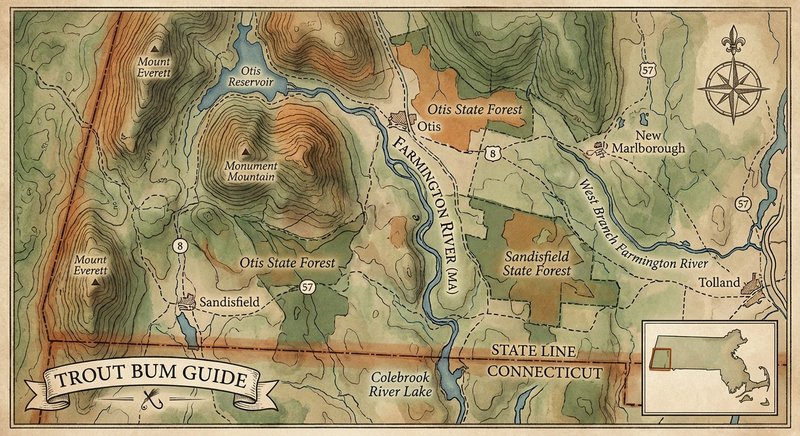
Farmington River (MA)
Fly fishing in Massachusetts · Intermediate · Best seasons: Spring, Summer, Fall
Target Species
Brown Trout, Brook Trout
About This Water
Massachusetts section near Otis with wild trout. Scenic mountain stream.
Fishing Recommendations
Welcome to the Farmington River in Massachusetts. While most anglers immediately think of the famous tailwater section in Connecticut, the Massachusetts portion (the West Branch) offers a completely different, more "wild" experience. It is a classic New England freestone stream characterized by boulder-strewn pocket water, cold mountain flows, and beautiful scenery.
🎣 Location Overview
The Massachusetts section of the Farmington River flows through the rugged hills of Sandisfield, Tolland, and Otis. Unlike the deep, slow-moving pools found further downstream in Connecticut, the MA section is a high-gradient, freestone environment.
What makes this stretch special is its "wildness." It is heavily forested, lined with hemlocks and laurel, and offers a sense of solitude that is hard to find on the lower river. The water is exceptionally clean and stays cold longer than many other Massachusetts freestones thanks to its high elevation and forest canopy. Anglers love it for the technical pocket-water fishing and the chance to catch vibrant, wild-born fish.
🐟 Target Species & Behavior
- Brown Trout: The primary resident. These are a mix of wild-born fish and high-quality holdovers. They are wary and prefer deep undercut banks, the "cushion" in front of large boulders, and the dark water at the tail-outs of pools during low light.
- Brook Trout: You will find beautiful native brook trout, particularly in the upper reaches near Sandisfield and around the confluences of small mountain tributaries. They are opportunistic but require stealthy approaches.
- Behavior: Because this is a freestone river, the fish are highly dependent on water temperature and flow. In the spring, they are aggressive. In the heat of summer, they retreat to the oxygenated "white water" or stay tight to cold-water springs.
📅 Best Times to Fish
- Spring (Late April – June): This is the "Golden Age" of the Farmington. As the water warms to 50°F, insect activity explodes. You’ll see Hendricksons in late April/May, followed by various Caddis and March Browns in June.
- Summer (July – August): While other rivers get too warm, the Farmington MA section often remains fishable in the early mornings. Focus on the pocket water where oxygen levels are highest.
- Fall (September – October): This is a favorite for many guides. The Brown Trout become aggressive as they prepare for the spawn. Isonychia hatches are common, and the foliage makes for a world-class backdrop.
- Prime Windows: During the summer, fish the "trico" window at dawn or the "caddis" window at dusk. On overcast days, the dry fly fishing can be excellent all day long.
🪰 Recommended Flies & Techniques
Top Fly Patterns
- Dry Flies:
- Ausable Wulff: High visibility and buoyancy, perfect for the rough pocket water.
- Elk Hair Caddis (Tan/Olive): Sizes 14–18. A staple on this river.
- Stimulators: Great for searching the water or imitating large stoneflies.
- Parachute Adams: The ultimate "match-all" for various mayflies.
- Nymphs:
- Pat’s Rubber Legs: In coffee or black; the river has a large population of Golden and Black Stoneflies.
- Pheasant Tail (Flashback): Sizes 16–20 to imitate various mayfly nymphs.
- Perdigons: Heavy, slim nymphs that sink quickly in the fast current.
- Streamers:
- Woolly Buggers: Black or Olive (Size 8–10).
- Muddler Minnow: Effective when fished on a swing to imitate sculpins.
Techniques
- Pocket Water Nymphing: This is the most effective way to stack numbers. Use a Euro-nymphing rig or a very short-leash indicator setup. You need to get your flies down fast in small "buckets" behind rocks.
- Dry-Dropper: In the summer, a size 12 Stimulator with a small beaded nymph (like a Zebra Midge) dropped 18 inches below is deadly.
- The "High-Stick" Presentation: Because the current is complex, keep as much fly line off the water as possible to prevent drag.
💡 Pro Tips & Local Knowledge
- Focus on the "West Branch": The stretch along Route 8 through Sandisfield offers some of the most consistent fishing. Look for areas where the river pulls away from the road—these spots see significantly less pressure.
- Stealth is Mandatory: The water can be crystal clear. Wear drab clothing (greens and browns) and avoid wading deep unless necessary. Often, the fish are sitting right against the bank you are standing on.
- The "Cold Water" Secret: If the main stem feels warm in August, hike up any small tributary brook. You will likely find a "thermal refuge" where brook trout congregate.
- Watch the Flows: Freestone rivers rise and fall quickly with rain. Always check the USGS gauge for the Farmington River (the Sandisfield or Unionville gauges) before driving out.
⚠️ Important Information
- Access: Much of the river follows Route 8. There are several dirt pull-offs and small bridges with public access. Be respectful of any "Posted" signs, though much of the river corridor is part of State Forest land.
- Regulations:
- A Massachusetts Freshwater Fishing License is required.
- Note that regulations change as you cross the border into Connecticut. In MA, ensure you are following MassWildlife seasons and creel limits.
- Some sections may be designated "Catch and Release" or "Artificial Lures Only"—always check the current year's abstracts.
- Safety: The rocks in the Farmington are notoriously slippery (often covered in "didymo" or rock snot). Studded wading boots and a wading staff are highly recommended. Cell service is very spotty in the Farmington River Valley; let someone know where you are going.
Bug Hatches & Matching Flies
| Hatch | Type | Peak months | Time of day | Hook sizes | Matching flies |
|---|---|---|---|---|---|
| Blue-Winged Olive (BWO) Baetis / Acerpenna | mayfly | April, May, September, October | Afternoon | #18-24 | RS2 #20-22, Parachute Adams #18-22, Pheasant Tail Nymph #18-20 |
| Hendrickson Ephemerella subvaria | mayfly | April, May | Afternoon | #12-14 | Red Quill #12-14, Hendrickson Emerger #12-14, Hendrickson Nymph #12-14 |
| Grannom Caddis Brachycentrus | caddis | April, May | Morning/Afternoon | #14-16 | Elk Hair Caddis (Dark) #14-16, LaFontaine's Deep Sparkle Pupa #14-16, Pupa with Green Egg Sac #16 |
| Sulfur Ephemerella invaria / dorothea | mayfly | June, July | Evening | #14-18 | Sulfur Parachute #16-18, Sulfur Emerger #16-18, Sulfur Spinner #14-18 |
| Slate Drake Isonychia bicolor | mayfly | June, July, September | Afternoon/Evening | #10-12 | Isonychia Nymph #10-12, Isonychia Parachute #10-12, Zug Bug #10-14 |
| Trico Tricorythodes | mayfly | July, August, September | Morning | #22-26 | Trico Spinner #22-26, Trico Dun #24, Sunken Trico Spinner #22-24 |
| Giant Golden Stonefly Acroneuria | stonefly | June, July | Evening/Night | #6-10 | Golden Stone Nymph #8-10, Stimulator #8-12, Pat's Rubber Legs #8-10 |
| Winter Midge Chironomidae | midge | January, February, March, December | All day | #18-28 | Zebra Midge #18-22, Griffith's Gnat #20-24, Top Secret Midge #20-24 |