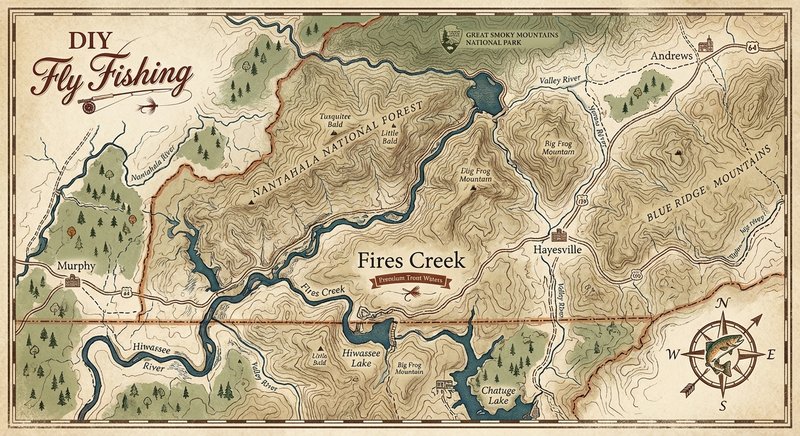
Fires Creek
Fly fishing in North Carolina · Intermediate · Best seasons: Spring, Summer, Fall
Target Species
Brown Trout, Rainbow Trout
About This Water
Scenic stream in Nantahala National Forest. Wild trout and beautiful waterfalls.
Fishing Recommendations
Fires Creek is one of Western North Carolina’s best-kept secrets. Tucked away in the Nantahala National Forest near Hayesville, this "Wild Trout" designated water offers a rugged, backcountry experience that feels worlds away from the more crowded streams near Asheville or Bryson City.
As your guide, here is everything you need to know to find success on the emerald waters of Fires Creek.
🎣 Location Overview
Fires Creek is a pristine freestone stream characterized by its exceptionally clear water, moss-covered boulders, and a "stair-step" gradient that creates endless plunge pools and riffles. It is surrounded by the "Rim Trail," a horseshoe of high ridges that keeps the valley cool and shaded.
What makes Fires Creek special is its remoteness and purity. It is managed by the NC Wildlife Resources Commission as a "Wild Trout Water," meaning you are targeting fish born and bred in this stream. The canopy is tight, the wading can be slick, and the scenery is quintessential Southern Appalachian wilderness. It’s a "technical" stream—not because the fish are picky eaters, but because the approach and casting require stealth and precision.
🐟 Target Species & Behavior
The creek is home to Wild Rainbow Trout and Wild Brown Trout.
- Wild Rainbows: These are the primary residents. They are opportunistic, aggressive, and incredibly vibrant in color. They tend to hold in the faster oxygenated water at the heads of pools and in "pockets" behind boulders.
- Wild Browns: The "ghosts" of Fires Creek. They are more reclusive, often found in the deeper, darker undercut banks or beneath heavy rhododendron overhangs. They are most active during low-light conditions or after a light rain.
- Behavior: Because the water is nutrient-poor (typical of high-elevation freestones), these fish are competitive. If you don't spook them, they will usually strike a well-presented fly. However, their "spook distance" is high—if they see your shadow or feel your wading vibrations, the pool is finished.
📅 Best Times to Fish
Spring (March – May) - The Prime Window
This is the golden era for Fires Creek. As water temperatures hit the 50s, the insects wake up. You’ll see Quill Gordons, March Browns, and various Caddis.
- Prime Window: 10:00 AM – 4:00 PM (as the sun warms the water).
Summer (June – August) - The Dry Fly Delight
While other NC rivers get too warm, Fires Creek stays cool due to its elevation and canopy. This is the time for terrestrial patterns (ants, beetles).
- Prime Window: Early morning and the last two hours of daylight.
Fall (September – November) - The Brown Trout Movement
As the leaves turn, the Brown trout become aggressive and territorial ahead of the spawn. The water levels are often lower, requiring extra stealth.
- Prime Window: All day, but mid-afternoon is most productive.
🪰 Recommended Flies & Techniques
Top Fly Patterns
- Dry Flies: Yellow Stimulator (#12-16), Royal Wulff (#14-16), Elk Hair Caddis (Tan or Olive, #14-18), and the local favorite: The Neversink Caddis.
- Nymphs: Pheasant Tail (#16-20), Frenchie (#14-18), and Bead-head Prince Nymphs.
- Terrestrials: Black Foam Ants (#16-18) and Green Weenies.
Effective Techniques
- Dry-Dropper: This is the "bread and butter" of Fires Creek. Use a high-visibility dry fly (like a Stimulator) and hang a small Pheasant Tail nymph 18-24 inches below it.
- Tight-Line Nymphing: In the deeper plunge pools, skipping a weighted nymph through the "bubbles" at the head of the pool is deadly.
- Bow-and-Arrow Cast: You will need this. The rhododendrons are thick; often, a traditional backcast is impossible.
💡 Pro Tips & Local Knowledge
- Work Upstream: Always fish upstream. Because the water is so clear, if you fish downstream, the trout will see you long before you see them.
- The "One Cast" Rule: In these small pools, your first cast is your best chance. Accuracy is more important than distance.
- Stealth is Key: Wear drab colors (earth tones). Avoid bright shirts. If you can stay low and use boulders as cover, your catch rate will double.
- Where to Focus: Focus on the "leather"—the slick, dark water just before the lip of a waterfall or the soft seams right next to heavy current.
- Higher is Wilder: The further you drive up the Forest Service road (past the Leatherwood Falls picnic area), the smaller the water gets and the more "wild" the fish behave.
⚠️ Important Information
Access
- Access is via Fires Creek Road (FS 340). It is a well-maintained gravel road that parallels the creek for several miles, offering numerous pull-offs.
- The Leatherwood Falls area is a great starting point for beginners, but the best fishing is usually found by hiking a half-mile away from the main parking lots.
Regulations
- Designation: Much of Fires Creek is designated as Wild Trout Waters.
- Lures/Bait: Only single-hook artificial lures/flies are permitted. No bait of any kind.
- Size/Creel: Check current NCWRC regulations, but most anglers here practice 100% Catch and Release to preserve the wild genetics of the stream.
- License: You must have a valid North Carolina Fishing License with a Trout privilege.
Special Considerations
- Cell Service: Expect zero cell service once you enter the North Forest boundary. Download your maps offline.
- Wildlife: This is bear country. While they generally avoid humans, keep your food secured.
- Slippery Rocks: The rocks in Fires Creek are notoriously "greasy." Felt-soled boots or studs are highly recommended for safety.
Guide’s Final Thought: Fires Creek isn't about trophy-sized fish; it's about the beauty of a 7-inch wild rainbow that looks like it was painted by an artist. Bring a 3-weight or 4-weight rod, leave the phone in the truck, and enjoy one of the purest fly fishing experiences in the South.
Bug Hatches & Matching Flies
| Hatch | Type | Peak months | Time of day | Hook sizes | Matching flies |
|---|---|---|---|---|---|
| Quill Gordon Epeorus pleuralis | mayfly | February, March | Midday to Afternoon | #12-14 | Quill Gordon Dry #12-14, Quill Gordon Wet Fly #12-14 |
| Blue Winged Olive Baetis | mayfly | March, April, October, November | Overcast Afternoons | #18-22 | RS2 #20-22, Parachute Adams #18-22, Pheasant Tail Nymph #18-20 |
| March Brown Maccaffertium vicarium | mayfly | April, May | Afternoon | #10-14 | American March Brown #12-14, Hare's Ear Nymph #10-12 |
| Yellow Sally Isoperla | stonefly | May, June, July | Late Afternoon/Evening | #14-16 | Yellow Sally Stimulator #14-16, Little Yellow Stone Nymph #14-16 |
| Green Sedge Rhyacophila | caddis | April, May, June | All Day/Evening | #12-16 | Green Weenie #12-16, Elk Hair Caddis (Olive) #14-16 |
| Light Cahill Stenacron interpunctatum | mayfly | May, June, July | Evening | #12-16 | Light Cahill Dry #12-16 |
| Golden Stonefly Acroneuria | stonefly | June, July | Evening/Night | #6-10 | Golden Stone Nymph #8-10, Kaufmanns Stone #6-10 |
| Terrestrials (Ants/Beetles) Formicidae / Coleoptera | terrestrial | July, August, September | All Day | #12-18 | Cinnamon Ant #14-18, Black Foam Beetle #12-16 |