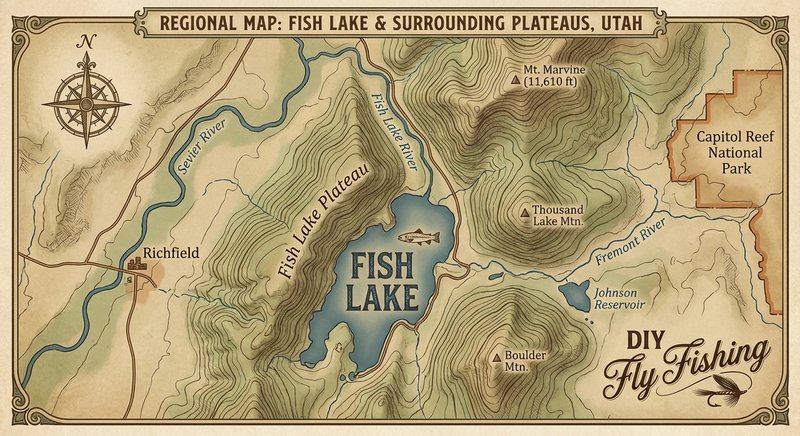
Fish Lake
Fly fishing in Utah · Beginner · Best seasons: Summer, Fall
Target Species
Splake, Lake Trout, Rainbow Trout
About This Water
Natural high mountain lake with large splake and lake trout. Beautiful setting.
Fishing Recommendations
Welcome to Fish Lake, Utah—the "Gem of the High Plateaus." As an expert guide, I can tell you that this isn't just another mountain lake; it is a high-altitude natural wonder sitting at 8,843 feet. Known for its crystal-clear water and massive glacial boulders, it offers some of the most unique fly fishing opportunities in the Intermountain West, specifically for those hunting trophy-sized char and aggressive hybrids.
🎣 Location Overview
Fish Lake is a natural lake (not a reservoir) roughly six miles long and one mile wide. It is cradled between the Mytoge Mountains and the Fish Lake Plateau. What makes it special is its oligotrophic nature: the water is cold, deep (up to 175 feet), and incredibly clear.
Anglers love it because it offers a "big game" feel. Unlike many high-altitude lakes that produce stunted fish, Fish Lake is an incredibly productive ecosystem. It is famous for its massive Lake Trout (Mackinaw) and a thriving population of Splake (a Brook Trout/Lake Trout hybrid). The lake is bordered by the famous Pando Aspen Grove, the largest living organism on earth, which creates a stunning backdrop during the fall season.
🐟 Target Species & Behavior
Splake (The Main Attraction)
Fish Lake is arguably the best Splake fishery in the world. They behave like a mix of their parents: they have the aggressive appetite of a Lake Trout but often hold in shallower water like a Brook Trout.
- Behavior: They are highly piscivorous (fish-eaters), primarily targeting Yellow Perch fry.
- Holding Zones: Look for them along the "drop-off" where the shallow weed beds transition into the deep blue water (usually 15–25 feet deep).
Lake Trout (Mackinaw)
These are the kings of the lake, reaching weights over 30 pounds.
- Behavior: They prefer the coldest water. In summer, they are deep (60+ feet), but in the fall, they move into the shallows (10–20 feet) to spawn.
- Feeding: They focus on Yellow Perch and smaller Rainbow Trout.
Rainbow Trout
These are frequently stocked and provide consistent action.
- Behavior: They cruise the shorelines and weed edges.
- Feeding: They are more opportunistic, feeding on scuds, chironomids, and occasional terrestrial insects blown off the trees.
📅 Best Times to Fish
Summer (July – August)
- Window: Best from dawn until 10:00 AM. Once the sun hits the water, the fish move deep.
- Conditions: Look for "glassy" mornings. The wind often picks up in the afternoon, making fly casting from a boat or float tube difficult.
Fall (Late September – Early November) — Prime Season
- Window: All day.
- Conditions: This is the magic window. As water temperatures drop, the Lake Trout and Splake move into the shallows (5–15 feet) to spawn along the rocky shorelines. This is your best chance to hook a 10lb+ fish on a fly rod.
🪰 Recommended Flies & Techniques
The "Deep Strip" (Streamer Technique)
This is the most effective way to target Splake and Lake Trout. Use a Type 5 or Type 7 full-sinking line.
- Patterns:
- Perch Imitations: Sex Dungeon (Yellow/Olive), Game Changers, and Baby Gonga.
- Classic Streamers: White or Olive Zonkers, Wooly Buggers (Size 4-8) with tungsten beads.
- Technique: Cast toward the shore from a boat, let the line sink for 15–20 seconds, and use a "strip-strip-pause" retrieve to mimic a wounded perch.
The "Scud & Midge" (Nymphing)
Because of the massive weed beds, the lake is crawling with scuds (freshwater shrimp).
- Patterns:
- Scuds: Olive or Orange Sparkle Scuds (Size 12-16).
- Chironomids: Ice Midge or Zebra Midge (Black/Silver) under an indicator.
- Technique: Fish these along the edges of the weed beds on a long leader (12–15 feet) or with a slow-sinking intermediate line.
Dry Fly Action
- Patterns: Large terrestrial patterns like Fat Alberts or Chernobyl Ants in late summer.
- Technique: Fish the "Pando" side of the lake where the wind blows insects off the aspen trees into the water.
💡 Pro Tips & Local Knowledge
- The "Drop-Off" is Key: If you look at the water, there is a visible line where the light green (shallow weeds) meets the dark navy blue (deep water). Most fish cruise exactly on that transition line. Position your boat in the blue and cast into the green.
- Focus on Twin Creeks: The area around the Twin Creeks inlet is a magnet for fish, especially in the spring and fall when fish are looking for moving water or gravel for spawning.
- The "Perch Pulse": Yellow Perch are the engine of this lake. If you find schools of small perch near the weed docks, the predators are nearby. Match your fly color to the perch (olive backs, yellowish bellies, vertical dark bars).
- Float Tube Safety: This is a high-altitude lake. Storms roll in fast over the mountains. If you see whitecaps or dark clouds over the plateau, get off the water immediately.
⚠️ Important Information
- Access: There are several marinas (Lakeside and Fish Lake Lodge) with boat rentals. For shore access, the "Doctor Creek" area and the boardwalks near the lodge are popular.
- Regulations:
- Check the current Utah Fishing Guidebook, as regulations on Lake Trout can change to manage the population.
- There is often a limit on Lake Trout (e.g., only one over a certain size), but they encourage the harvest of smaller ones to protect the trophy fishery.
- Invasive Species: Ensure your boat/float tube is "Clean, Drain, and Dry." Utah is very strict about Quagga Mussels.
- Gear Recommendation: For Splake and Rainbows, a 5-weight or 6-weight rod is fine. If you are specifically targeting the "Big Mac" Lake Trout in the fall, bring an 8-weight rod with a stout reel—you’re going to need the backbone.
Final Guide Advice: Dress in layers. Even in August, the mornings can be 35 degrees Fahrenheit, warming up to 75 by noon. Tight lines!
Bug Hatches & Matching Flies
| Hatch | Type | Peak months | Time of day | Hook sizes | Matching flies |
|---|---|---|---|---|---|
| Midges Chironomidae | midge | May, June, September | All Day | #12-22 | Zebra Midge #16-20, Chironobone #12-16, Griffith's Gnat #18-22 |
| Callibaetis Callibaetis spp. | mayfly | July, August | Late Morning/Afternoon | #12-16 | Parachute Adams #14-16, Callibaetis Spinner #14-16, Hare's Ear Nymph #12-16 |
| Damselflies Enallagma spp. | other | June, July | Morning/Afternoon | #10-14 | Marabou Damsel #10-12, Adult Damsel #12-14, Braided Butt Damsel #12 |
| Traveling Sedge Hesperophylax | caddis | July, August | Evening | #8-12 | Goddard Caddis #8-12, Mikulak Sedge #10, Soft Hackle Cary Special #10-12 |
| Scuds Gammarus lacustris | other | April, May, October | All Day | #12-16 | Ray Charles #14-16, Olive Scud #12-16, Orange UV Scud #14 |
| Water Boatmen Corixidae | other | September, October | Afternoon | #14-18 | Prince Nymph #14-16, Water Boatman #14-18, Backswimmer #12-14 |
| Terrestrials (Ants and Beetles) Formicidae / Coleoptera | terrestrial | August, September | Afternoon | #12-18 | Chernobyl Ant #10-14, Black Foam Ant #16-18, Juicy Beetle #12-14 |
| Dragonflies Anisoptera | other | July, August | All Day | #4-10 | Dragonfly Nymph #6-10, Woolly Bugger (Olive) #4-8, Dredge Damsel/Dragon #8 |