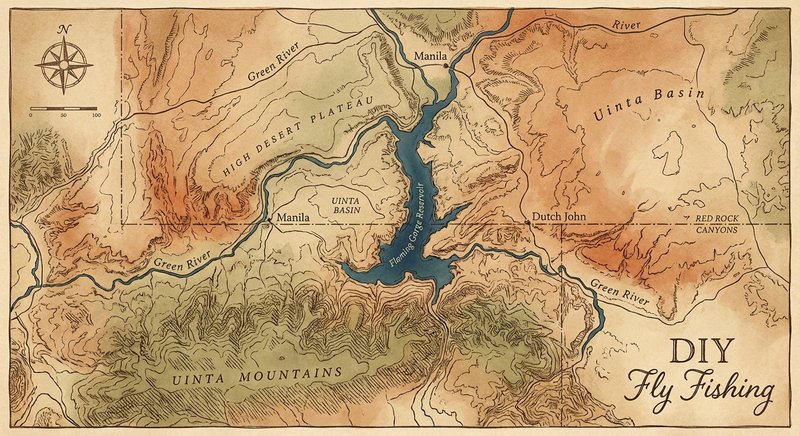
Flaming Gorge Reservoir
Fly fishing in Utah · Beginner · Best seasons: Spring, Summer, Fall
Target Species
Lake Trout, Rainbow Trout, Kokanee Salmon
About This Water
Large reservoir with trophy lake trout and kokanee. Dramatic red rock scenery.
Fishing Recommendations
Welcome to the "Gorge." As a guide, I can tell you that Flaming Gorge Reservoir is one of the most spectacular, yet challenging, stillwater fisheries in the American West. Straddling the border of Northeastern Utah and Southwestern Wyoming, this 91-mile-long reservoir is carved through red rock canyons and high desert plateaus.
While it is famous for gear trollers chasing world-record Lake Trout, the fly angler who understands the seasonal movements of these fish can have a career-defining day here.
🎣 Location Overview
Flaming Gorge is a high-altitude impoundment of the Green River. It is characterized by its staggering depth (over 400 feet in places), crystal-clear visibility, and dramatic "flaming" red sandstone cliffs.
What makes it special for fly fishing is the diversity of habitat. You have shallow, productive flats and bays in the northern Wyoming end (near Buckboard) and deep, sheer-walled canyon environments in the southern Utah end (near the Dam). It is a "trophy" destination where you aren't just fishing for numbers; you are fishing for size.
🐟 Target Species & Behavior
Lake Trout (Mackinaw)
These are the kings of the Gorge. They are apex predators that primarily feed on Kokanee Salmon and Utah Chubs.
- Behavior: Most of the year they stay deep (60–100+ feet). However, when water temperatures are below 55°F (Spring and Fall), they move into the shallows (10–40 feet) to hunt, putting them within reach of a sinking fly line.
Rainbow Trout
The "bread and butter" for the fly angler. These fish are active, hard-fighting, and grow large on a diet of midges, scuds, and terrestrial insects.
- Behavior: They cruise the rocky shorelines and drop-offs. In the spring, they congregate near inlet areas and gravel shorelines to spawn.
Kokanee Salmon
Landlocked Sockeye that are famous for their silver flash and delicious meat.
- Behavior: They are pelagic, meaning they roam the open water following plankton blooms. For the fly fisher, the best window is during their fall spawning run when they turn bright red and become highly aggressive toward "nuisance" flies.
📅 Best Times to Fish
- Spring (Ice-out through May): The Prime Window. As the ice recedes, the water is uniform in temperature. Giant Lake Trout move into 10–20 feet of water to sun themselves and hunt. Rainbow fishing is at its peak in the bays.
- Summer (June – August): Excellent for Rainbows at dawn and dusk. For Lake Trout and Kokanee, you must use heavy sinking lines or fish very early before the sun hits the water and pushes fish deep.
- Fall (September – November): The "Second Season." Lake Trout move onto rocky points to spawn in October. Kokanee Salmon school up near Sheep Creek and the Green River inlet, providing a unique sight-fishing opportunity.
Time of Day: Morning is king. The "Gorge Winds" typically kick up by 11:00 AM, making fly casting difficult and the water choppy.
🪰 Recommended Flies & Techniques
For Lake Trout (The "Big Game" Setup)
You need an 8-weight or 9-weight rod with a fast-sinking integrated tip (Type 5 or 7).
- Flies: Large articulated streamers (6–9 inches). Game Changers, Kelly Galloup’s Sex Dungeon, and Big T-Bone Snakes.
- Colors: White/Silver (mimicking Kokanee) or Olive/Orange (mimicking Chubs).
- Technique: "Stair-stepping" streamers down underwater points. Cast toward the shore, let the line sink, and strip back aggressively toward deep water.
For Rainbow Trout
A 5-weight or 6-weight rod with a floating line or a clear intermediate sink tip.
- Flies: Balanced Leeches (Olive or Black), Zebra Midges (size 16-20), and Scuds (Orange or Pink). In late summer, use Chubby Chernobyls against the canyon walls.
- Technique: Indicator nymphing along weed lines or slow-stripping leeches near submerged timber.
For Kokanee Salmon
- Flies: Small, flashy streamers like the Comet or Woolly Buggers in neon pink, red, or orange.
- Technique: When they are staging to spawn, a "swing and strip" technique works well. They aren't feeding, they are defending territory, so movement and flash are key.
💡 Pro Tips & Local Knowledge
- Focus on the "Shelf": Use your electronics or a topo map to find where a flat bench drops off into 80+ feet of water. Large Lake Trout patrol these edges like lions in tall grass.
- The "Linwood Bay" Secret: This area in the Utah portion is a massive nursery. It warms up faster in the spring and holds a huge concentration of Rainbows and smaller "pup" Lake Trout.
- Watch the Gulls: If you see seagulls diving in open water, they are likely hovering over a school of Kokanee that have been pushed to the surface by predatory Lake Trout. Get there fast and throw a big white streamer into the mix.
- Vertical Fly Fishing: If you have a boat and good electronics, don't be afraid to "jig" a heavy fly vertically over marks in 40–50 feet of water. It’s unconventional for fly gear but incredibly effective.
⚠️ Important Information
- Regulations: Flaming Gorge has a Reciprocal Fishing Stamp. If you have a Utah license, you need a small fee stamp to fish the Wyoming side, and vice versa. Always check the current "Special Rules" regarding Lake Trout limits (the states often encourage keeping smaller "pups" to protect the Kokanee population).
- Invasive Species: You must certify your boat/float tube as "AIS Free." Both states are very strict about Quagga Mussels.
- Safety: This is a high-desert reservoir. Weather moves in fast, and the wind can create 3–4 foot swells in minutes. If you are in a float tube or kayak, stay close to the shore and have a life jacket on at all times.
- Access: Key boat ramps for fly anglers include Sheep Creek, Cedar Springs, and Lucerne Valley.
Guide’s Final Word: Bring your heavy gear and your patience. Flaming Gorge is a game of "quality over quantity." When that 30-pound Mackinaw finally hits your fly in 15 feet of water, you’ll understand why we call this place the "Great Lakes of the West."
Bug Hatches & Matching Flies
| Hatch | Type | Peak months | Time of day | Hook sizes | Matching flies |
|---|---|---|---|---|---|
| Chironomids Chironomidae | midge | April, May, October | All Day | #12-22 | Ice Cream Cone #12-18, Zebra Midge #16-22, Griffith's Gnat #18-22 |
| Callibaetis Callibaetis | mayfly | June, July, August | Morning/Early Afternoon | #12-16 | Callibaetis Spinner #14-16, Hare's Ear Nymph #14-16, Quigley Cripple #14-16 |
| Cicada Magicicada/Okanagana | terrestrial | May, June | Afternoon | #4-10 | Black Foam Cicada #6-10, Mormon Cricket #4-8 |
| Damselfly Enallagma | other | June, July | Morning/Afternoon | #10-14 | Marabou Damsel #10-12, Adult Damsel #12-14 |
| Grasshoppers Acrididae | terrestrial | August, September | Afternoon | #8-14 | Parachute Hopper #8-12, Morrish Hopper #10-14 |
| Scud Gammarus | other | March, April, November | All Day | #12-18 | Ray Charles #14-18, Orange Scud #12-16 |
| Water Boatman Corixidae | other | September, October | Afternoon | #14-16 | Water Boatman #14-16, Prince Nymph #14-18 |
| Caddis Trichoptera | caddis | July, August | Evening | #14-18 | Elk Hair Caddis #14-18, LaFontaine's Sparkle Pupa #16-18 |