Forney Creek
Fly fishing in North Carolina · Advanced · Best seasons: Spring, Summer, Fall
Target Species
Rainbow Trout, Brown Trout, Brook Trout
About This Water
Backcountry stream in Great Smoky Mountains. Excellent wild trout and remote camping.
Fishing Recommendations
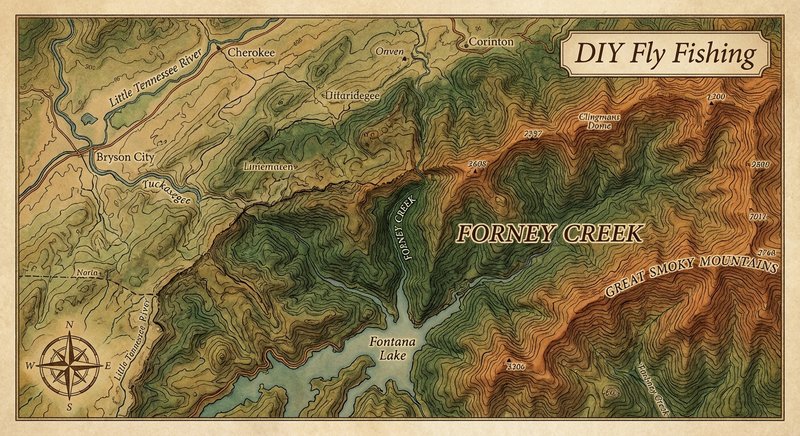
Forney Creek is one of the "crown jewels" of the Great Smoky Mountains National Park (GSMNP). Located on the remote North Shore of Fontana Lake, it offers a true wilderness experience. As a guide, I consider Forney to be one of the best representations of Southern Appalachian fly fishing because it offers everything from big-water brown trout to high-altitude "specs" (wild brook trout).
🎣 Location Overview
Forney Creek is a rugged, medium-to-large freestone stream that drains off the high ridges of Clingmans Dome. What makes Forney special is its remoteness. Because there are no roads leading directly to the heart of the creek, it receives significantly less pressure than "roadside" streams like the Oconaluftee or the Davidson.
The water is crystal clear and characterized by classic Southern Appalachian "pocket water": a chaotic mix of plunge pools, runs, riffles, and massive boulders. The lower sections near Fontana Lake are wide and powerful, while the headwaters are tight, rhododendron-choked, and steep.
🐟 Target Species & Behavior
Forney Creek is a rare "Grand Slam" water where you can catch all three species in a single day.
- Rainbow Trout: The primary residents of the middle and lower sections. They are opportunistic and usually hold in the "fast glass"—the bubbly water at the head of a pool or in riffles.
- Brown Trout: Forney is famous for its wild brown trout, especially in the lower reaches. They are wary and nocturnal. Look for them in deep, dark undercut banks or at the very tail-out of large pools during low-light hours.
- Brook Trout (Southern Appalachian Strain): Found in the high-elevation headwaters (generally above 3,500 feet). They are small, vibrant, and highly aggressive. They hold in the smallest of pockets behind rocks.
- Feeding Behavior: These fish are in a "nutrient-poor" environment. They don't have the luxury of being overly picky; if a meal passes by without looking suspicious, they will usually strike.
📅 Best Times to Fish
- Spring (Late March – May): The Golden Era. This is when the major hatches occur (Quill Gordons, March Browns, and Yellow Sallies). Water temperatures hit the 50–55°F "sweet spot."
- Summer (June – August): Excellent for the high-country brookies. While lower elevation streams get too warm, Forney stays cool. Focus on morning and evening. This is prime "dry-dropper" season.
- Fall (Late September – early November): The most beautiful time to be on the water. Brown trout become aggressive as they prepare to spawn. Blue Winged Olives (BWOs) provide great dry fly action on drizzly days.
🪰 Recommended Flies & Techniques
Top Fly Patterns
- Dry Flies:
- Yellow Stimulator (Size 12-16) – Mimics stoneflies and is highly visible.
- Parachute Adams (Size 14-18) – The ultimate generalist.
- Yellow Sallie (Size 14-16) – A staple in the Smokies.
- Elk Hair Caddis (Size 14-16) – Tan or Olive.
- Nymphs:
- Pheasant Tail (Size 14-18) – Bead-head or unweighted.
- Prince Nymph (Size 12-16) – Great for attracting attention in fast water.
- Girdle Bug/Pat’s Rubber Legs (Size 8-12) – Effective in the deeper pools for big browns.
- Terrestrials (Summer):
- Green Weenie – A local legend.
- Foam Beetle or Ant (Size 16-18).
Techniques & Presentation
- The Dry-Dropper: This is the bread and butter of Forney Creek. Use a buoyant Stimulator or Elk Hair Caddis on top and hang a Pheasant Tail or Green Weenie 18–24 inches below it.
- Stealth is Mandatory: The water is gin-clear. If you can see the fish, they have already seen you. Always fish upstream, wear natural colors, and keep a low profile.
- Short Line Fishing: Most casts will be under 20 feet. High-sticking (keeping your fly line off the water to avoid drag) is essential in the complex currents of pocket water.
💡 Pro Tips & Local Knowledge
- The "Boat Shuttle" Strategy: The smartest way to fish Forney is to take a boat shuttle from Bryson City or Fontana Village across Fontana Lake to the mouth of the creek. This saves you a grueling 10+ mile hike through the "Road to Nowhere" tunnel.
- Backcountry Camping: To truly fish Forney, stay overnight. Backcountry sites #68, #69, and #70 are right on the water. Site #71 puts you in the heart of brook trout territory.
- The "Big Water" Secret: The very lowest section of Forney, where it meets Fontana Lake, often holds "Lake-Run" Browns. If the lake levels are right, you can find some of the largest trout in the park in this transition zone.
- Watch the Gauge: Forney doesn't have a USGS gauge, but you can look at the Noland Creek or Oconaluftee gauges. If they are spiking after a rain, Forney will likely be blown out and dangerous.
⚠️ Important Information
- Regulations: Great Smoky Mountains National Park regulations apply.
- Artificial Lures Only: Single hook only. No bait.
- License: You need a valid North Carolina OR Tennessee freshwater fishing license. Either is recognized anywhere in the Park.
- Size Limits: 7-inch minimum for all trout. (Check current park maps for any specific tributary closures).
- Access: Access via the Forney Creek Trail. Most anglers enter via the "Road to Nowhere" (Lakeview Drive) in Bryson City and hike through the tunnel, or via boat shuttle.
- Safety:
- Bears: This is high-density Black Bear country. Use bear cables at campsites and carry bear spray.
- Cell Service: There is zero cell service once you leave Bryson City. Carry a satellite messenger (InReach/Zoleo) for emergencies.
- Flash Floods: These mountain streams rise incredibly fast during summer thunderstorms. If the water turns murky, get to high ground immediately.
Bug Hatches & Matching Flies
| Hatch | Type | Peak months | Time of day | Hook sizes | Matching flies |
|---|---|---|---|---|---|
| Quill Gordon Epeorus pleuralis | mayfly | March, April | Mid-day | #12-14 | Quill Gordon Dry #12-14, Quill Gordon Wet #12-14 |
| Blue Quill Paraleptophlebia adoptiva | mayfly | March, April | Late morning to Afternoon | #16-18 | Blue Quill Dry #16-18, Pheasant Tail Nymph #16-18 |
| Yellow Sally Isoperla spp. | stonefly | May, June, July | Late afternoon to Evening | #14-16 | Yellow Stimulator #14-16, Yellow Sally Nymph #14-16 |
| Light Cahill Stenacron interpunctatum | mayfly | May, June | Evening | #12-14 | Light Cahill #12-14, Gold Ribbed Hare's Ear #12-14 |
| Golden Stonefly Acroneuria lycorias | stonefly | May, June | Morning/Evening | #6-10 | Golden Stone Nymph #8-10, Kaufmann's Stimulator #8-12 |
| Cinnamon Caddis Hydropsyche spp. | caddis | May, June, September | Evening | #14-16 | Elk Hair Caddis (Tan/Cinnamon) #14-16, LaFontaine's Emerger #14-16 |
| Terrestrials (Ants and Beetles) Formicidae / Coleoptera | terrestrial | June, July, August, September | All Day | #12-18 | Black Foam Beetle #14-16, Parachute Ant #16-18 |
| Blue Winged Olive Baetis spp. | mayfly | March, October, November | Mid-day/Afternoon | #18-22 | BWO Sparkle Dun #18-20, RS2 #20-22 |