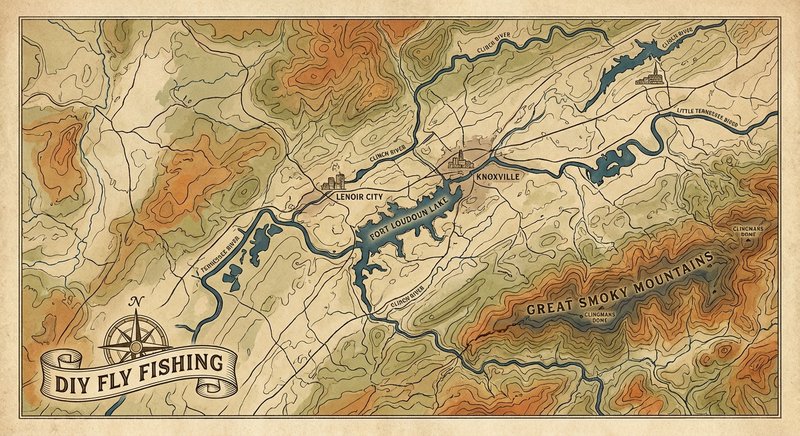
Fort Loudoun Lake
Fly fishing in Tennessee · Beginner · Best seasons: Spring, Summer, Fall
Target Species
Largemouth Bass, Striped Bass, Catfish
About This Water
Knoxville area reservoir with excellent bass and striper fishing. Good access.
Fishing Recommendations
Welcome to the "Headwaters of the Tennessee." As a guide, I can tell you that Fort Loudoun Lake is a unique beast. Located right in the backyard of Knoxville, it is the uppermost reservoir in the Tennessee River chain. While many fly anglers head to the nearby Smoky Mountains for trout, those in the know stay on the big water for some of the most heart-pounding warm-water fly fishing in the Southeast.
🎣 Location Overview
Fort Loudoun Lake is a 14,600-acre reservoir formed by the Fort Loudoun Dam. It begins at the confluence of the Holston and French Broad Rivers. This is a "river-run" reservoir, meaning it retains a significant amount of current, especially when the TVA (Tennessee Valley Authority) is generating power.
What makes it special is the diversity of habitat: you’ll find deep river channels, expansive shallow flats, rocky bluffs, and thousands of private docks. For the fly angler, it offers a "big game" experience. You aren't casting for 10-inch brookies here; you are hunting for 5-pound Largemouth and 20-pound Stripers that will test your backing and your 8-weight rods.
🐟 Target Species & Behavior
Largemouth Bass
- Behavior: They are structure-oriented. In the spring, they move into the "flats" and backwater sloughs to spawn. In the summer, they retreat to the shade of deep docks or offshore ledges.
- Feed: Primarily Gizzard and Threadfin Shad, but they have a major weakness for crawfish and bluegill.
Striped Bass (Stripers)
- Behavior: These are the ghosts of the river. They are highly migratory and current-dependent. They love the highly oxygenated water near the confluence (the "Forks of the River") and the tailwaters below the dams.
- Feed: They are nomadic hunters that follow massive schools of shad. When they find them, it’s a "blitz" scenario.
Catfish (Channel and Blue)
- Behavior: Yes, you can catch them on a fly! On Fort Loudoun, they often move into the shallows during the evening or during a "midge hatch" or "mayfly spin" to gulp insects off the surface.
- Feed: While they are scavengers, they are also predatory. They will take a well-presented fly that mimics a dying baitfish or a large nymph/crawfish moving slowly along the bottom.
📅 Best Times to Fish
- Spring (March – May): Prime Time. As water temps hit 55-60°F, Largemouth move into the shallows of the creeks (like Poland Creek or Ish Creek). This is your best chance for a trophy on a fly.
- Summer (June – August): Focus on the "Low Light Windows." Fish from 5:00 AM to 9:00 AM or the last two hours of daylight. Night fishing with black surface flies is a local secret.
- Fall (September – November): The "Shad Kill" and Migration. As temps drop, shad move into the backs of creeks, and the Bass and Stripers follow them. Look for birds diving; that’s where the fish are.
- The "Current" Window: Always check the TVA Lake Info app. When they are "pulling water" (generating), the fish activate. If the water is stagnant, the fishing is much tougher.
🪰 Recommended Flies & Techniques
For Largemouth Bass
- Flies:
- BoogleBugs (Poppers): Size 2-4 in "Frog" or "Pearl."
- Gamechangers: 3-4 inch white/clear patterns to mimic shad.
- Clouser Minnows: Chartreuse/White is the gold standard here.
- Technique: "Dock Skipping." Use a heavy 8-weight line to skip poppers or unweighted streamers deep under the shadows of private boat docks.
For Striped Bass
- Flies:
- EP Fiber Minnows: 5-7 inches long in grey/white.
- Hollow Fleyes: For maximum water displacement.
- Technique: Use an Intermediate or Sink-Tip line. Stripers rarely sit on the surface during the day. You need to get the fly down 5-10 feet in the current and use a fast, erratic "strip-strip-pause" retrieve.
For Catfish
- Flies:
- Heavy Lead-Eyed Wooly Buggers: Black or Olive.
- Backstabber Carp/Catfish Flies: Patterns that ride hook-point up.
- Technique: "Dredging." Cast upstream into the current near rocky points, let the fly sink to the absolute bottom, and "bounce" it back slowly.
💡 Pro Tips & Local Knowledge
- The "Forks of the River": The area where the Holston and French Broad meet to form the Tennessee is legendary. The mixing of different water temperatures and clarity levels creates a "seam" that Stripers love to patrol.
- Follow the Birds: If you see Blue Herons lined up on a bank or Gulls diving in open water, stop the boat. On Fort Loudoun, the birds are better than any sonar for finding active baitfish.
- The "Mud Line": After a heavy rain, the main channel gets muddy. Look for where clear water from a smaller creek flows into the muddy main lake. Large predators sit right on that "mud line" to ambush prey.
- Gear Up: Do not bring a 5-weight. Use a 7-weight or 8-weight with a powerful weight-forward taper (like a Rio Smallmouth or Bass Bug taper) to turn over large, wind-resistant flies.
⚠️ Important Information
- Access:
- Louisville Point Park: Great for launching a kayak or boat to access mid-lake flats.
- Concord Park: Excellent central access with lots of shoreline and dock structure.
- The Tailwaters: Access via the boat ramp below Melton Hill Dam or Fort Loudoun Dam (be extremely careful of high water/current).
- Regulations: A valid Tennessee Fishing License is required. Fort Loudoun has specific length and creel limits for Bass and Stripers—always check the current TWRA (Tennessee Wildlife Resources Agency) guide before heading out.
- Safety: This is a commercial waterway. Watch out for large barges in the main channel; they cannot stop quickly and create massive wakes that can swamping a small boat or kayak.
Guide’s Final Word: Fort Loudoun requires patience. It’s not a "fish a minute" destination, but it is a "quality over quantity" fishery. When that line goes tight and starts peeling off into your backing, you'll understand why we love these waters. Tight lines!
Bug Hatches & Matching Flies
| Hatch | Type | Peak months | Time of day | Hook sizes | Matching flies |
|---|---|---|---|---|---|
| Hexagenia (Giant Mayfly) Hexagenia limbata | mayfly | June, July | Evening/Night | #6-10 | Hexagenia Dry #6-8, Burrowing Mayfly Nymph #8-10, Hex Emerger #8 |
| Chironomids (Midges) Chironomidae | midge | March, April, October, November | All day | #18-24 | Zebra Midge #18-22, Griffith's Gnat #20-24, Snowshoe Midge #20-22 |
| White Miller Nectopsyche | caddis | July, August | Evening | #12-16 | White Elk Hair Caddis #12-14, White LaFontaine Sparkle Pupa #14-16 |
| Damselfly Enallagma | terrestrial | June, July, August | Afternoon | #10-14 | Adult Damsel #10-12, Marabou Damsel Nymph #12-14 |
| Light Cahill Stenonema femoratum | mayfly | May, June | Late Afternoon/Evening | #12-14 | Light Cahill Dry #12-14, Gold Ribbed Hare's Ear #14 |
| Trico Tricorythodes | mayfly | August, September | Morning | #20-24 | Trico Spinner #22-24, Trico Nymph #22 |
| Terrestrial Ants Formicidae | terrestrial | July, August, September | All day | #14-18 | Black Foam Ant #14-16, Cinnamon Ant #16-18 |
| Caenis (Angler's Curse) Caenis | mayfly | June, July, August | Dawn/Dusk | #22-26 | Caenis Spinner #24-26, Micro-Midge Larva #24 |