Fremont River
Fly fishing in Utah · Intermediate · Best seasons: Spring, Fall
Target Species
Brown Trout, Rainbow Trout
About This Water
Desert canyon stream with wild brown trout. Unique fishing near Capitol Reef National Park.
Fishing Recommendations
The Fremont River is one of Utah’s best-kept secrets. While the Green and Provo Rivers garner the national headlines, the Fremont offers a diverse, technical, and visually stunning experience that transitions from high-alpine meadows to dramatic red-rock canyons.
As your guide, here is the comprehensive breakdown for fishing the Fremont.
🎣 Location Overview
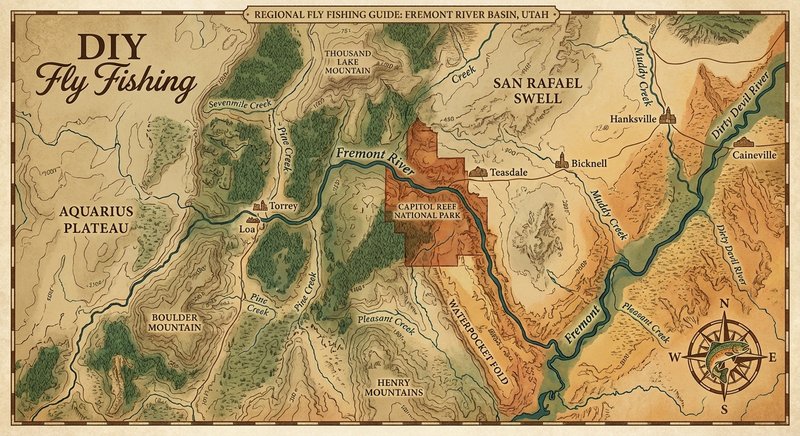
The Fremont River originates in the high plateaus near Fish Lake and flows eastward through the towns of Loa, Bicknell, and Torrey before carving through Capitol Reef National Park.
What makes the Fremont special is its diversity of character. In the upper reaches (near Johnson Valley Reservoir), it behaves like a classic tailwater. Through the Loa and Bicknell meadows, it becomes a slow-moving, meandering "spring creek" style fishery with deep undercuts. As it enters the Fremont Canyon and Capitol Reef, it transforms into a rugged, bouldery pocket-water stream. It is a "technical" river that rewards stealth and precision rather than brute force.
🐟 Target Species & Behavior
- Brown Trout: The undisputed kings of the Fremont. These are wild, buttery fish that can grow surprisingly large for a river of this size. They are structure-oriented, hugging undercut banks and hiding beneath overhanging willows.
- Rainbow Trout: Found primarily in the faster riffles and aerated pocket water. Many are wild, though some stocking occurs near public access points and bridge crossings.
Behavior: These fish are notoriously "spooky." In the meadow sections, the water is often glassy; a heavy footfall on the bank or a poor shadow cast will send fish scurrying. They feed heavily on sub-surface crustaceans (scuds and sowbugs) but will rise confidently during a hatch.
📅 Best Times to Fish
While the river can be fished year-round, the "shoulder seasons" are the gold standard.
- Spring (Late March – Early June): This is the window for the Blue Winged Olive (BWO) hatches. If you can catch the river after the ice thaws but before the heavy mountain runoff (usually mid-May), the fishing is world-class.
- Fall (September – November): This is the Prime Window. The Brown Trout become aggressive as they prepare for the spawn. The crowds (which are already thin) disappear, and the cottonwoods turn a brilliant gold against the red rocks.
- Best Time of Day:
- Spring: 11:00 AM – 3:00 PM (warmest part of the day for insect activity).
- Fall: Early morning for streamers; mid-afternoon for dry flies.
🪰 Recommended Flies & Techniques
Top Fly Patterns
- Nymphs:
- Scuds & Sowbugs: (Sizes 14-18) in Pink, Orange, or Gray. Due to the high mineral content and spring influence, these are a primary food source.
- Zebra Midge: (Sizes 18-22) in Black or Red.
- Pheasant Tail: (Sizes 16-20) for BWO nymph imitation.
- Dry Flies:
- Parachute Adams: (Sizes 16-22) The universal soldier.
- BWO Sparkle Dun: (Sizes 18-22).
- Hopper Patterns: (Sizes 8-12) In late August and September, "splatting" a Dave’s Hopper against a grassy bank is lethal.
- Streamers:
- Wooly Buggers: (Sizes 6-10) in Olive or Black.
- Gold-Ribbed Hare’s Ear: Fished deep and slow.
Techniques
- The "High-Stick" Nymph: In the canyon sections, use a tight-line approach to navigate the swirling eddies around boulders.
- Spring Creek Stealth: In the meadow sections, stay low. Use a long leader (9-12 feet) tapered to 5x or 6x fluorocarbon.
- The "Strip and Twitch": When using streamers for big Browns, don't just pull the fly. Use erratic, short twitches to mimic a wounded sculpin or minnow.
💡 Pro Tips & Local Knowledge
- Focus on the "S-Turns": In the Bicknell Bottoms, the fish love the "outside" of the bends where the water has carved deep holes under the grass. Drop your nymph right against the dirt bank.
- The "Hatch that isn't a Hatch": Even if you don't see bugs on the surface, a "Hopper-Dropper" rig (a large foam terrestrial with a small scud dropper 18 inches below) is often the most productive way to cover water.
- Wind Management: The Fremont Valley is notoriously windy. If the wind picks up, don't leave—switch to a heavier 6-weight rod and fish streamers. The chop on the water actually hides your presence from the fish.
- Capitol Reef Section: Most people overlook the river inside the National Park. While the water can get silty, the pocket water near the Fruita orchards can be surprisingly productive and offers the best scenery in the state.
⚠️ Important Information
Access
- Public vs. Private: Much of the Fremont through the Loa/Bicknell valley flows through private cattle ranches. Respect "No Trespassing" signs.
- Walk-In Access (WIA): Look for the Utah DWR "Walk-In Access" signs. These are private lands where the state has paid for angler access. Use them or lose them!
- Mill Meadow & Johnson Valley: The sections immediately below these dams offer reliable public access and great tailwater-style fishing.
Regulations
- License: A valid Utah Fishing License is required.
- Check the Guidebook: While much of the river is under general regulations, some specific stretches may have "Artificial Fly and Lure Only" restrictions or specific bag limits.
- Catch and Release: While not always mandated by law, the Fremont is a fragile ecosystem. Most local guides advocate for 100% catch and release to preserve the wild Brown Trout populations.
Final Consideration: Flash Floods
If you are fishing the lower sections near Torrey or Capitol Reef, keep an eye on the sky. Rain 20 miles upstream can send a wall of mud and debris down the canyon in minutes. If the water turns from clear to "chocolate milk" suddenly, exit the canyon immediately.
Bug Hatches & Matching Flies
| Hatch | Type | Peak months | Time of day | Hook sizes | Matching flies |
|---|---|---|---|---|---|
| Blue-Winged Olive (BWO) Baetis | mayfly | March, April, September, October | Mid-day/Afternoon | #18-22 | Parachute Adams #18-22, RS2 #20-22, Pheasant Tail #18-20 |
| Pale Morning Dun (PMD) Ephemerella | mayfly | June, July | Late Morning/Early Afternoon | #16-18 | PMD Sparkle Dun #16-18, Split Case PMD #16-18, Mercer's PMD Poupuh #16-18 |
| Spotted Sedge Hydropsyche | caddis | June, July, August | Evening | #14-18 | Elk Hair Caddis (Tan) #14-16, LaFontaine's Deep Sparkle Pupa #16-18 |
| Trico Tricorythodes | mayfly | July, August, September | Early Morning | #20-24 | Trico Spinner #20-22, Zebra Midge #20-22 |
| Mother's Day Caddis Brachycentrus | caddis | May | Afternoon | #14-16 | Peacock Caddis #14-16, Holy Grail Caddis #14-16 |
| Grasshoppers Orthoptera | terrestrial | July, August, September | Late Morning/Afternoon | #8-12 | Parachute Hopper #10-12, Morrish Hopper #8-12 |
| Midges Chironomidae | midge | January, February, March | Mid-day | #20-26 | Griffith's Gnat #20-24, Zebra Midge (Black/Silver) #18-22, Top Secret Midge #20-22 |
| Yellow Sally Isoperla | stonefly | June, July | Afternoon/Evening | #14-16 | Yellow Sally Dry #14-16, Iron Lotus #16 |