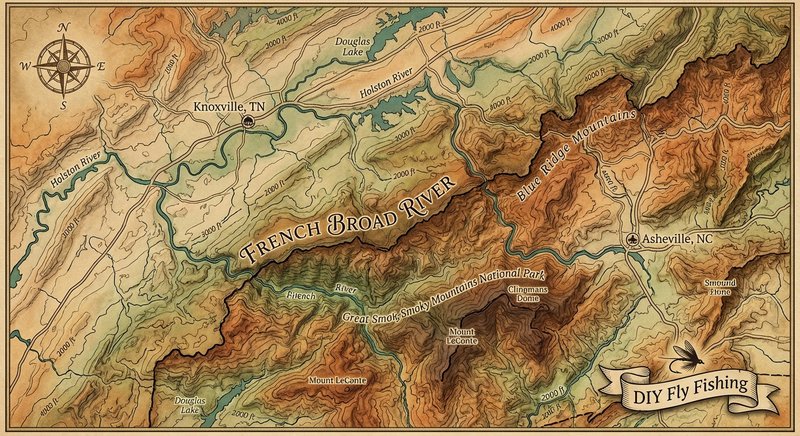
French Broad River
Fly fishing in Tennessee · Beginner · Best seasons: Spring, Summer, Fall
Target Species
Smallmouth Bass, Musky, Walleye
About This Water
Large river with excellent smallmouth bass and musky. Float fishing popular.
Fishing Recommendations
The French Broad River in East Tennessee is a legendary piece of water. While it begins as a free-flowing mountain river in North Carolina, the Tennessee section—specifically the tailwater below Douglas Dam—transforms into one of the premier warm-water fly fishing destinations in the Southeast. This is "big water" fishing at its finest, offering a rugged, ledge-filled landscape that harbors some of the largest Smallmouth Bass and Musky in the region.
🎣 Location Overview
The French Broad is a powerful, wide river characterized by massive limestone ledges, deep runs, and expansive grass beds. What makes it special is the sheer volume of water and the diversity of its habitat. Below Douglas Dam, the river flows through a scenic valley towards Knoxville, where it joins the Holston to form the Tennessee River.
Anglers love the French Broad because it feels wild. Unlike the manicured trout tailwaters nearby, the French Broad is gritty and rewarding. It offers a "trophy" environment where you aren't just looking for numbers, but for high-quality, hard-fighting river fish.
🐟 Target Species & Behavior
Smallmouth Bass (The Main Attraction)
- Behavior: These are "Bronzebacks" in their truest form—lean, mean, and incredibly strong due to the heavy current.
- Holding Water: Look for "ledge sets." The riverbed is tilted rock; fish sit in the "buckets" or depressions behind these ledges. They also frequent the edges of water willow (river grass) during high summer.
- Diet: Primarily Crawfish and Threadfin Shad.
Musky (The Ghost of the River)
- Behavior: The French Broad is one of the few places in the South with a legitimate, self-sustaining Musky population. They are ambush predators.
- Holding Water: Deep wood structure, the mouths of feeder creeks, and the downstream points of large islands.
- Diet: Large suckers, shad, and even the occasional duckling or unlucky smallmouth.
Walleye
- Behavior: Often an overlooked fly rod target here. They are light-sensitive and move into shallower riffles to feed during low-light hours.
- Holding Water: Deep, slow-moving pools during the day; gravel bars and tail-outs at dusk.
📅 Best Times to Fish
- Spring (April – May): This is the prime window for trophy Smallmouth. As the water warms into the 55–65°F range, large females move to the gravel transitions to spawn. Musky are also highly active and aggressive post-spawn in May.
- Summer (June – August): The season for topwater action. Early mornings and late evenings are essential. When the sun is high, fish deep in the ledge shadows or right in the middle of heavy oxygenated riffles.
- Fall (September – November): The "Feeding Frenzy." As water temperatures drop, fish sense winter coming. This is arguably the best time for Musky and for finding schools of Smallmouth chasing shad in the flats.
- Optimal Conditions: Clearer water is better, but a "stained" tea color is ideal for Musky. Always check the TVA Release Schedule for Douglas Dam; high flows make wading impossible and drift fishing difficult.
🪰 Recommended Flies & Techniques
For Smallmouth Bass
- Topwater: Boogle Bugs (size 4), Murphey's Bass Bug, and Umpqua’s Swimming Frog. Use a "pop-and-pause" retrieve near grass lines.
- Streamers: Game Changers (white/chartreuse), Clouser Minnows (chartreuse/white), and Kelly Galloup’s Dungeon.
- Nymphing/Subsurface: Near Nuff Crawfish or Hellgrammite patterns fished under a heavy indicator through the ledge buckets.
For Musky
- Patterns: Massive 8-to-12-inch streamers. Bufords (for water displacement) and Game Changers (for realistic movement).
- Colors: Black/Orange (the "Halloween" combo) or bright Chartreuse.
- Technique: Use a 10wt or 11wt rod with a sinking tip. The "Figure-8" at the boat is mandatory—French Broad Musky are notorious for following the fly to the gunwale.
For Walleye
- Patterns: Heavy clousers or leech patterns in purple, black, or gold. They must be on the bottom.
💡 Pro Tips & Local Knowledge
- Read the Ledges: The French Broad's geology is unique. The ledges often run perpendicular or diagonal to the current. The biggest fish sit on the upstream side of the ledge in the "cushion" or in the deep "bucket" immediately downstream.
- The "Seven Islands" Stretch: The area around Seven Islands State Birding Park is some of the most productive water on the river. It features complex braiding and numerous islands that create perfect ambush points.
- Watch the Flow: If Douglas Dam is running more than two generators, the river becomes a different beast. It is best fished from a drift boat or a high-quality fishing raft. Wading is only recommended during "low power" periods (zero or one generator).
- Stealth Matters: Despite being a big river, the water can get very clear. Long casts and a quiet approach to the ledges will significantly increase your hook-up rate on pressured Smallmouth.
⚠️ Important Information
- Access:
- Douglas Dam Tailwater: Good wade access right below the dam.
- Hwy 66 Bridge: Public boat ramp in Sevierville.
- Seven Islands State Birding Park: Excellent for hand-launching kayaks or rafts.
- Regulations: A valid Tennessee Fishing License is required. There are specific "Quality Trout Zones" nearby, but on the French Broad, pay close attention to Smallmouth Bass size and creel limits, which can vary by season to protect the trophy fishery.
- Safety: The French Broad is wide and powerful. If you are wading and notice the water rising or becoming turbid, exit immediately. The rocks are exceptionally slick; felt soles or studs are highly recommended.
- Gear Note: For Smallmouth, a fast-action 6wt or 7wt rod is ideal to punch through the frequent afternoon winds. For Musky, do not bring less than a 10wt, and always use a wire bite tippet.
Bug Hatches & Matching Flies
| Hatch | Type | Peak months | Time of day | Hook sizes | Matching flies |
|---|---|---|---|---|---|
| Midges Chironomidae | midge | January, February, March, December | All Day | #18-24 | Zebra Midge #18-22, Griffith's Gnat #20-24, Morgan's Midge #20-22 |
| Blue Winged Olive Baetis | mayfly | March, April, October, November | Afternoon | #18-22 | RS2 #20-22, Parachute BWO #18-22, Pheasant Tail Nymph #18-20 |
| Sulphurs Ephemerella invaria/dorothea | mayfly | May, June, July | Late Afternoon/Evening | #14-18 | Sulphur Comparadun #16-18, Split Case Sulphur #14-16, Sulphur Spinner #16-18 |
| Cinnamon Caddis Hydropsyche | caddis | May, June, September | Evening | #14-18 | Elk Hair Caddis (Tan) #14-16, Holy Grail #14-18, Pupa #16-18 |
| White Fly Ephoron leukon | mayfly | August, September | Late Evening/Night | #12-14 | White Wulff #12-14, Snowshoe White Fly #12-14 |
| Light Cahill Stenacron / Stenonema | mayfly | June, July | Afternoon/Evening | #12-14 | Light Cahill Dry #12-14, Gold Ribbed Hare's Ear #12-14 |
| Tricos Tricorythodes | mayfly | July, August, September | Early Morning | #20-24 | Trico Spinner #22-24, Trico Drown #20-22 |
| Golden Stonefly Acroneuria | stonefly | May, June | Morning/Evening | #6-10 | Pat's Rubber Leg #6-10, Golden Stimulator #8-12 |