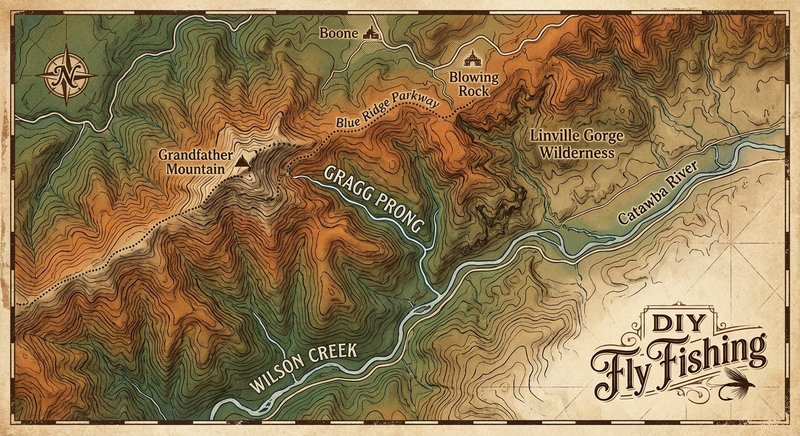
Gragg Prong
Fly fishing in North Carolina · Intermediate · Best seasons: Spring, Summer, Fall
Target Species
Brown Trout, Rainbow Trout
About This Water
Wilson Creek tributary with wild trout. Less pressured backcountry fishing.
Fishing Recommendations
Welcome to one of the crown jewels of the Pisgah National Forest. As your guide, I can tell you that Gragg Prong is not just a fishing destination; it is a quintessential Southern Appalachian wild trout experience. Located in the Wilson Creek Wild and Scenic River corridor, this is a "blue line" stream for the angler who values scenery, solitude, and the vibrant colors of wild fish over sheer size.
🎣 Location Overview
Gragg Prong is a high-gradient tributary of Wilson Creek, characterized by crystal-clear plunge pools, massive boulders, and some of the most stunning waterfalls in North Carolina (including the famous Hunt-Fish Falls).
What makes it special is its ruggedness. This is a freestone stream that drops rapidly in elevation. You aren't fishing long, slow runs here; you are "pocket picking." Anglers love it because it remains relatively cool during the summer months compared to lower-elevation streams, and the fish are 100% wild. There are no stockies here—every fish you catch was born in these mountain waters.
🐟 Target Species & Behavior
- Wild Rainbow Trout: These are the primary residents. They are opportunistic, aggressive, and incredibly athletic. Expect them to be in the faster "bubble curtains" and at the heads of pools.
- Wild Brown Trout: The "ghosts" of Gragg Prong. They tend to hold in the deeper, darker undercut banks or beneath the foam lines of the larger plunge pools. They are far more wary than the rainbows.
Behavior: Because the water is nutrient-poor, these fish are competitive. They don't have the luxury of passing up a meal. However, they are extremely "spooky." If they see your shadow or feel the vibration of a heavy footstep on the bank, the pool is "put down" for the next hour.
📅 Best Times to Fish
Optimal Seasons
- Spring (April – June): This is the prime window. The water temperatures hit the "magic" 50–55°F range, and the major hatches (Quill Gordons, March Browns, and Light Cahills) occur.
- Summer (July – early September): Unlike lower rivers, Gragg Prong stays fishable thanks to canopy shade and elevation. Focus on terrestrials (ants and beetles).
- Fall (Late September – November): Stunning foliage and the Brown Trout spawn. The fish become more aggressive as they prepare for winter.
Best Times of Day
- Spring/Fall: 10:00 AM to 4:00 PM (Wait for the sun to warm the water slightly).
- Summer: Dawn and Dusk. The "blue hour" just before dark can be magical with light Cahill or yellow sallie activity.
🪰 Recommended Flies & Techniques
Top Fly Patterns
- Dry Flies:
- Yellow Stimulator (Size 14-16): Mimics Stoneflies and is highly buoyant in rough water.
- Royal Wulff or Tennessee Wulff (Size 16): Excellent attractor pattern for wild fish.
- Parachute Adams (Size 16-20): The gold standard for matching small mayflies.
- Nymphs:
- Pheasant Tail (Size 16-18): Mimics almost any mayfly nymph.
- Prince Nymph (Size 14-16): The extra flash helps in the bubbly plunge pools.
- Terrestrials:
- Black Foam Beetles or Cinnamon Ants (Size 16-18): Deadly in mid-summer.
Effective Techniques
- Dry-Dropper: This is the most effective way to fish Gragg Prong. Use a buoyant Stimulator as your "indicator" and hang a small Pheasant Tail nymph 18–24 inches below it.
- High-Sticking: Because of the complex currents, keep as much fly line off the water as possible to avoid drag. Focus on the soft edges of fast water.
- Bow-and-Arrow Cast: You will often be surrounded by thick rhododendron. Master this cast to get your fly into tight spots without a backcast.
💡 Pro Tips & Local Knowledge
- The "One-Cast" Rule: In these small pools, your first cast is your best chance. If you botch the drift, the fish will likely retreat to the shadows.
- Approach from Below: Always fish upstream. Wild trout face into the current; if you walk downstream, they will see you coming from a mile away.
- Focus on the Waterfalls: The area around Hunt-Fish Falls is popular and gets pressure, but if you hike a half-mile above or below the main falls, the fishing pressure drops significantly.
- Wading Safety: The rocks in Gragg Prong are notorious for being "greased lightning." Wear felt-soled boots or boots with studs. A wading staff is a life-saver here.
⚠️ Important Information
Access
- Access is primarily via Roseboro Road (FR 981). You can park at the trailhead for the Hunt-Fish Falls Trail (Trail #263).
- Be prepared for a hike. The trail down to the water is steep. What goes down must come up at the end of the day!
Regulations
- Wild Trout Waters: Gragg Prong is classified as "Wild Trout Waters" by the NCWRC.
- Lures/Bait: Only single-hook artificial lures/flies are permitted. No natural bait is allowed.
- License: You must have a valid North Carolina Fishing License with the "Trout" privilege.
Special Considerations
- Cell Service: Expect zero cell service once you leave the town of Collettsville or Linville. Download your maps for offline use.
- Flash Floods: This is a steep drainage. If it starts raining heavily, get out of the gorge immediately. The water level can rise several feet in a matter of minutes.
Bug Hatches & Matching Flies
| Hatch | Type | Peak months | Time of day | Hook sizes | Matching flies |
|---|---|---|---|---|---|
| Quill Gordon Epeorus pleuralis | mayfly | March, April | Mid-day | #12-14 | Quill Gordon Dry #12-14, Pheasant Tail Nymph #12-14 |
| March Brown (American) Maccaffertium vicarium | mayfly | April, May | Afternoon | #10-14 | March Brown Dry #10-12, Hare's Ear Nymph #10-14 |
| Blue Winged Olive Baetis spp. | mayfly | March, April, September, October | Overcast Mid-day | #18-22 | BWO Parachute #18-22, RS2 #20-22 |
| Yellow Sally Isoperla spp. | stonefly | May, June, July | Late Afternoon/Evening | #14-16 | Yellow Sally Stimulator #14-16, Little Yellow Stone Nymph #14-16 |
| Light Cahill Stenonema ithaca | mayfly | May, June, July | Evening | #12-16 | Light Cahill #12-16, Gold Ribbed Hare's Ear #14-16 |
| Cinnamon Caddis Hydropsyche spp. | caddis | May, June, August | Morning/Evening | #14-18 | Elk Hair Caddis (Tan) #14-18, LaFontaine's Deep Sparkle Pupa #14-16 |
| Golden Stonefly Acroneuria spp. | stonefly | June, July | Morning/Evening | #8-12 | Golden Stimulator #8-12, Pat's Rubber Legs #8-12 |
| Terrestrials (Ants and Beetles) Formicidae / Coleoptera | terrestrial | July, August, September | All Day | #12-18 | Black Foam Ant #14-18, Crowe Beetle #12-16 |