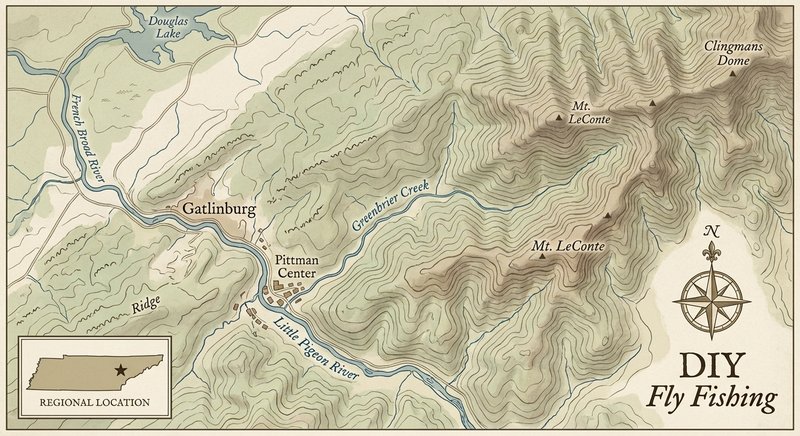
Greenbrier Creek
Fly fishing in Tennessee · Intermediate · Best seasons: Spring, Summer, Fall
Target Species
Rainbow Trout, Brown Trout
About This Water
Less crowded Smokies stream with wild trout. Remote fishing near Greenbrier area.
Fishing Recommendations
Welcome to the Great Smoky Mountains National Park (GSMNP). As your guide, I’m excited to walk you through one of the most iconic "blue ribbon" experiences in the Southeast: the Greenbrier section of the Middle Prong of the Little Pigeon River.
While locals often just call it "Greenbrier," this is a quintessential mountain freestone stream that offers some of the best high-gradient pocket water fishing in Tennessee.
🎣 Location Overview
The Greenbrier area is a gem located just outside of Gatlinburg, TN. What makes it special is its classic "stair-step" morphology. The water tumbles over massive moss-covered boulders, creating endless plunges, deep pools, and oxygen-rich riffles.
Unlike the larger, more exposed rivers in the park, Greenbrier is heavily forested. This canopy keeps the water cool even in the heat of summer, making it a refuge for wild trout. Anglers love it because it offers a true wilderness feel with relatively easy access, and the fish here are known for being opportunistic and aggressive—though the crystal-clear water demands a stealthy approach.
🐟 Target Species & Behavior
- Wild Rainbow Trout: These are the primary residents. They are vibrant, feathery, and incredibly fast. They hold in the "quick water"—the heads of pools and the seams right next to fast currents.
- Wild Brown Trout: The "monsters" of Greenbrier. While less common than rainbows, large browns (12–16 inches, which is big for this water) lurk in the deeper, darker undercut banks and beneath large boulders, especially in the lower reaches of the creek.
- Behavior: These fish are wild, not stocked. They are extremely wary of overhead shadows. However, because food is relatively scarce in these nutrient-poor freestone streams, they aren't usually "picky" about fly patterns; they are much more concerned with presentation and stealth.
📅 Best Times to Fish
Optimal Seasons
- Spring (March – May): This is the "Golden Era." As water temps hit the 50°F mark, the insect life explodes. This is your best chance for prolific dry fly action.
- Summer (June – August): While other rivers get too warm, Greenbrier stays fishable. Focus on the higher elevations of the creek where the water stays cooler.
- Fall (September – November): A favorite for many. The water levels are usually lower, requiring light tippets. The Brown Trout begin to move and become more aggressive as they prepare for the spawn.
Best Times of Day
- Spring/Fall: Mid-morning to late afternoon (10:00 AM – 4:00 PM) when the sun warms the water enough to trigger bug activity.
- Summer: Early morning (dawn till 10:00 AM) and "the magic hour" (last two hours of light).
🪰 Recommended Flies & Techniques
Top Fly Patterns
- Dry Flies:
- Yellow Stimulator (Size 14-16) - Mimics the ubiquitous Yellow Sallies.
- Parachute Adams (Size 16-20) - The ultimate generalist.
- Elk Hair Caddis (Tan or Olive, Size 14-18).
- Nymphs:
- Pheasant Tail (Bead-head, Size 16-18).
- Prince Nymph (Size 14-16) - Great for attracting attention in fast water.
- Greenie Weenie - A local Smokies staple (Size 14).
- Terrestrials (Summer):
- Pink Lady or Chernobyl Ant.
Effective Techniques
- Dry-Dropper Rig: This is the "bread and butter" of Greenbrier. Use a high-visibility dry fly (like a Stimulator) and hang a small Pheasant Tail nymph 18-24 inches below it.
- High-Sticking: Because of the complex currents, keep as much fly line off the water as possible to avoid drag. You are often fishing only 10–15 feet of line.
💡 Pro Tips & Local Knowledge
- The "Sneak": Before you cast, stay low. If you can see the fish, they have likely already seen you. Wear drab clothing (greens and browns) to blend into the forest canopy.
- Work Upstream: Always fish upstream. Trout face into the current; if you approach from behind them, you stay in their blind spot.
- Don't Overlook the "Thin" Water: Many anglers walk past 4-inch deep riffles to get to the big pools. In the summer, active rainbows will hold in very shallow, highly oxygenated water.
- The Ramsey Cascade Trail: For those willing to hike, take the trail toward Ramsey Cascades. The further you get from the parking lot, the less pressured the fish are, and the more likely you are to find a "Smokies Slam" (Rainbow, Brown, and Brook trout).
⚠️ Important Information
- Access: Turn off Hwy 321 east of Gatlinburg into the Greenbrier entrance of the Great Smoky Mountains National Park. Follow the gravel road along the river. There are numerous pull-offs.
- Regulations:
- A valid Tennessee or North Carolina fishing license is required (either is valid throughout the Park).
- Strictly Artificial Lures Only. No corn, bread, or scented baits.
- Single Hook Only.
- Size limits: Minimum 7 inches for trout. (Most fly anglers here practice 100% catch and release to preserve the wild population).
- Safety: The rocks in Greenbrier are notoriously slick. Felt-soled boots or studs are highly recommended. Also, be "Bear Aware"—this is prime black bear habitat. Keep all food locked in your vehicle.
Guide's Final Word: Greenbrier isn't about catching the biggest fish of your life; it's about the technical challenge of mountain fishing in one of the most beautiful cathedrals of nature in the world. Tight lines!
Bug Hatches & Matching Flies
| Hatch | Type | Peak months | Time of day | Hook sizes | Matching flies |
|---|---|---|---|---|---|
| Quill Gordon Epeorus pleuralis | mayfly | March, April | Midday | #12-14 | Quill Gordon Dry #12-14, Quill Gordon Nymph #12-14 |
| Blue Quill Paraleptophlebia | mayfly | March, April | Late Morning/Afternoon | #16-18 | Blue Quill Dry #16-18, Pheasant Tail Nymph #16-18 |
| March Brown Maccaffertium vicarium | mayfly | April, May | Afternoon | #12-14 | American March Brown #12-14, Hare's Ear Nymph #12-14 |
| Yellow Sally Isoperla | stonefly | May, June, July | Late Afternoon/Evening | #14-16 | Yellow Stimulator #14-16, Little Yellow Stone Nymph #14-16 |
| Cinnamon Caddis Hydropsyche | caddis | May, June, September | Evening | #14-18 | Elk Hair Caddis (Cinnamon) #14-16, LaFontaine's Deep Pupa #14-16 |
| Light Cahill Stenacron canadense | mayfly | June, July | Evening | #12-14 | Light Cahill #12-14, Cream Variant #14 |
| Golden Stonefly Acroneuria | stonefly | June, July | Evening/Night | #6-10 | Golden Stone Nymph #8-10, Kaufmann's Stimulator #8-12 |
| Blue Winged Olive Baetis | mayfly | February, March, October, November | Midday | #18-22 | BWO Parachute #18-22, RS2 #20-22 |
| Terrestrials Various | terrestrial | July, August, September | All Day | #10-16 | Black Foam Beetle #14-16, Green Weenie #12-14 |
| Common Midge Chironomidae | midge | December, January, February | Midday | #20-24 | Zebra Midge #20-22, Griffith's Gnat #20-22 |