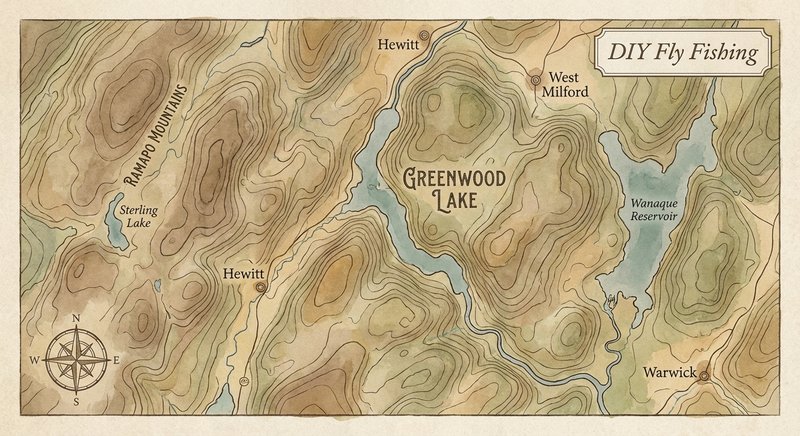
Greenwood Lake
Fly fishing in New Jersey · beginner · Best seasons: spring, fall
Target Species
Rainbow Trout, Brown Trout
About This Water
Border lake with Passaic County access. Stocked trout and scenic mountain views.
Fishing Recommendations
Greenwood Lake is a unique and challenging destination for fly anglers. Straddling the border of West Milford, New Jersey, and Warwick, New York, this 9-mile long glacial lake is primarily known as a warm-water powerhouse (Bass and Muskie). However, for the fly angler targeting trout, it offers a specific and rewarding "big water" experience that differs significantly from the state's famous limestone streams.
Here is your comprehensive guide to fly fishing for trout on Greenwood Lake.
🎣 Location Overview
Greenwood Lake is a large, deep, and often busy impoundment. What makes it special for trout anglers is the Stocked Trout Program managed by both NJ and NY, combined with the lake's depth (reaching 60 feet), which allows for "holdover" trout to survive the summer heat.
While many NJ anglers stick to the Musconetcong or the Pequest, fly fishing Greenwood Lake feels more like fishing a Great Lake or a Western reservoir. The water is generally clear to slightly stained. Anglers love it because the trout here grow quickly and fight hard, often feeding on the abundant landlocked alewives (herring), leading to "football" shaped rainbows and browns.
🐟 Target Species & Behavior
Rainbow Trout
These are the primary targets during the spring stockings. They tend to cruise the upper 5–10 feet of the water column early in the season. They are highly opportunistic and will chase small baitfish or school up near the mouths of incoming cold-water tributaries.
Brown Trout
The Browns in Greenwood Lake are the prize. They are more elusive and tend to hold deeper or tighter to structure (docks, rocky drop-offs) than the Rainbows. Brown Trout here are piscivorous (fish-eaters) and are often caught by anglers swinging or stripping large streamers that mimic the lake’s baitfish population.
📅 Best Times to Fish
Optimal Seasons
- Spring (April – Early June): This is the prime window. The water is cool, and trout are active in the shallows following stocking.
- Fall (October – November): As water temperatures drop, trout move back toward the shorelines and surface. This is the best time to find large holdover Browns looking to bulk up before winter.
Best Times of Day
- Dawn and Dusk: On a large lake with significant boat traffic, the "Golden Hours" are critical. Trout move into the shallows to feed when the light is low and the lake is calm.
- Overcast Days: Cloud cover encourages trout to stay active in shallower water throughout the day.
🪰 Recommended Flies & Techniques
Top Fly Patterns
- Streamers (The "Bread and Butter"):
- Game Changers (White/Silver): To mimic the alewives.
- Woolly Buggers (Olive or Black, Size 6-10): A universal constant.
- Muddler Minnows: Great for twitching near the surface.
- Nymphs (Under an indicator near tributary mouths):
- Zebra Midges (Size 18-22): Red or Black.
- Pheasant Tail Nymphs (Size 14-16): Classic forage.
- Dry Flies (Sporadic):
- Adams or Elk Hair Caddis: Use these if you see evening rises near the northern end of the lake.
Effective Techniques
- The "Slow Strip" Streamer Retrieve: Use a Sink-Tip line (Type 3 or 5). Cast toward rocky points or drop-offs, let it sink for 5–10 seconds, and use erratic strips to mimic a wounded baitfish.
- Float Tube/Kayak Stealth: Because the trout can be spooky in the clear water, a kayak or float tube allows you to approach the shoreline quietly compared to a gas-powered boat.
- Tributary Mouth Fishing: Focus your efforts where small streams enter the lake. These areas bring in oxygen, nutrients, and cooler water.
💡 Pro Tips & Local Knowledge
- Focus on the "Small Side": The northern end (New York side) and the western shoreline tend to have more "fishy" structure and less commercial development than the southern New Jersey end.
- The Bridge Structure: The area around the "Greenwood Lake Turnpike" bridge can create bottlenecks for baitfish, making it a prime ambush spot for larger Browns.
- Wind is your Friend: A slight chop on the water breaks up the surface, making trout less wary of your leader and fly line. Fish the windward shore where baitfish get pushed by the breeze.
- Check the Stocking Schedule: The NJ Division of Fish & Wildlife publishes a schedule. Fishing 24–48 hours after a stocking at the public access points can be incredibly productive, though crowded.
⚠️ Important Information
Access Information
- Brown’s Point (NJ): A popular public access spot for shore casting or launching a kayak.
- Greenwood Lake State Park (NY): Provides excellent access on the northern end.
- Marinas: Several private marinas offer boat rentals, which is highly recommended for reaching the deeper holes.
Regulations & Permits
- Dual Jurisdiction: You must have a valid New Jersey fishing license if fishing the southern half and a New York license for the northern half. Many anglers carry both to be safe, as the border is in the middle of the water.
- Trout Stamp: A NJ Trout Stamp is required if you are targeting or possessing trout in the NJ portion.
- Horsepower: There are no horsepower limits on the lake, so be prepared for wake from large boats during mid-day.
Special Considerations
- Invasive Species: Ensure you wash your gear and boat/kayak thoroughly. Greenwood Lake has struggled with invasive water milfoil and water chestnut; don't be the one to spread it to the nearby trout streams!
Bug Hatches & Matching Flies
| Hatch | Type | Peak months | Time of day | Hook sizes | Matching flies |
|---|---|---|---|---|---|
| Midges Chironomidae | midge | March, April, October, November | All Day | #18-24 | Zebra Midge #18-22, Griffith's Gnat #20-24, Palomino Midge #18-22 |
| Blue-Winged Olive Baetis spp. | mayfly | April, May, September, October | Afternoon | #18-22 | RS2 #20-22, Parachute BWO #18-22, Pheasant Tail #18-20 |
| Spotted Sedge Hydropsyche | caddis | May, June, July | Evening | #14-18 | Elk Hair Caddis #14-16, LaFontaine's Deep Sparkle Pupa #14-18, Pupa Sedge #16 |
| Giant Mayfly (Hex) Hexagenia limbata | mayfly | June, July | Late Evening/Night | #6-10 | Hexagenia Spinner #6-8, Hex Nymph #8-10, Michigan Night Rider #8 |
| Damselfly Enallagma spp. | terrestrial | June, July, August | Afternoon | #10-14 | Marabou Damsel Nymph #10-12, Adult Damsel #12-14, Blue Adult Damsel #12 |
| Light Cahill Stenacron interpunctatum | mayfly | June, July | Evening | #12-14 | Light Cahill Dry #12-14, Cream Usual #14, Gold Ribbed Hare's Ear #12-14 |
| Trico Tricorythodes | mayfly | July, August, September | Morning | #22-26 | Trico Spinner #22-24, Trico Nymph #22, Sunken Trico #24 |
| Terrestrials (Ants/Beetles) Formicidae / Coleoptera | terrestrial | July, August, September | Mid-day/Afternoon | #12-18 | Black Foam Ant #14-18, Chernobyl Ant #10-12, Crowe Beetle #12-16 |