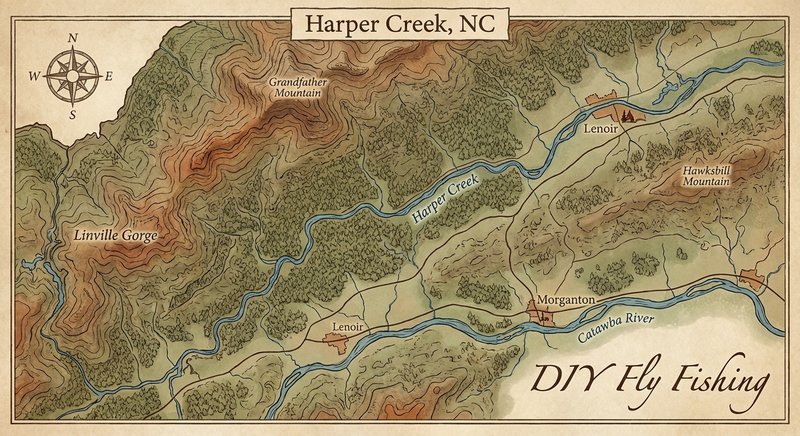
Harper Creek
Fly fishing in North Carolina · Intermediate · Best seasons: Spring, Summer, Fall
Target Species
Brown Trout, Rainbow Trout
About This Water
Backcountry stream with wild trout. Beautiful waterfalls and pools.
Fishing Recommendations
Harper Creek, nestled in the Wilson Creek Wild and Scenic River area of the Pisgah National Forest, is one of North Carolina’s premier "blue-ribbon" wild trout gems. Unlike the roadside access of the main stem of Wilson Creek, Harper Creek requires effort to reach, making it a sanctuary for those who value solitude and wild, vibrant fish.
🎣 Location Overview
Harper Creek is a rugged, high-gradient mountain stream characterized by crystal-clear water, dramatic waterfalls, and deep plunge pools. It is located in the Grandfather District of the Pisgah National Forest, near Mortimer, NC.
What makes Harper Creek special is its remoteness. To fish the best water, you must hike. The terrain is steep and the rhododendron thickets are dense, creating a "cathedral-like" canopy over the water. This is quintessential Appalachian "pocket water" fishing. Anglers love it because the fish are 100% wild, the scenery (including the 60-foot Harper Creek Falls) is breathtaking, and the pressure is significantly lower than nearby roadside streams.
🐟 Target Species & Behavior
The creek is home to Wild Rainbow Trout and Wild Brown Trout.
- Wild Rainbows: These are the primary residents. They are opportunistic, aggressive, and exceptionally colorful. They typically hold in the faster "pocket water," at the head of pools, or in the "bubble line" where oxygen and food are most abundant.
- Wild Browns: The "ghosts" of the creek. They are more selective and hold in the deeper, darker undercut banks or at the very tail-outs of large pools during low light.
- Behavior: Because the water is nutrient-poor, these fish are competitive. However, because the water is gin-clear, they are incredibly "spooky." If they see your shadow or feel the vibration of a heavy footstep, the pool is "done" for thirty minutes.
📅 Best Times to Fish
- Spring (March – May): The prime window. Rising water temperatures trigger the first major hatches (Quill Gordons and March Browns). The fish are hungry after winter and less wary.
- Summer (June – August): Excellent for "dry fly or die" purists. The canopy keeps the water cool even when valley floors are hot. Focus on early mornings and late evenings.
- Fall (September – November): A magical time. The Brown trout move into their spawning colors, and the Brook trout (found in the highest reaches) become aggressive. The low water requires extreme stealth.
- Optimal Conditions: Aim for 24–48 hours after a rain. You want the water to have a slight "tea" stain, which masks your presence and emboldens the fish.
🪰 Recommended Flies & Techniques
Top Fly Patterns
- Dry Flies:
- Yellow Stimulator (Size 12-16) – Mimics stoneflies and is highly buoyant.
- Royal Wulff (Size 14-16) – An attractor classic that is easy to see in foam lines.
- Parachute Adams (Size 16-20) – For matching generic mayfly hatches.
- Elk Hair Caddis (Size 14-18) – Tan or Olive.
- Nymphs:
- Pheasant Tail (Size 16-20) – Beadhead for weight.
- Prince Nymph (Size 14-18) – Great for the deeper plunge pools.
- Sexy Walt’s Worm (Size 16) – Simple and effective in fast water.
- Terrestrials (Summer):
- Green Inchworms (Size 14-16) – A staple when the rhododendrons overhang the water.
- Black Ants or Foam Beetles (Size 16-18).
Techniques & Presentation
- Dry-Dropper Rig: This is the most effective way to fish Harper Creek. Use a buoyant dry fly (like a Stimulator) and hang a small nymph 18–24 inches below it.
- The "Bow-and-Arrow" Cast: You will often find yourself in tunnels of vegetation. Mastering this cast is essential for hitting tight spots under low-hanging branches.
- Short Line Nymphing: In the plunge pools, you rarely need to cast more than 15 feet. High-sticking your rod to keep the line off the conflicting currents will ensure a natural drift.
💡 Pro Tips & Local Knowledge
- Fish Upstream: Always move upstream as you fish. Trout face into the current; if you approach from behind, you are less likely to be seen.
- Focus on the "Hidden" Water: Most hikers stop at the major falls. If you hike above the main Harper Creek Falls, you will find miles of water that see very few anglers.
- The Rhododendron Reach: When the sun is high, fish the shadows cast by the rhododendrons. Wild trout hate being in direct sunlight where they are visible to ospreys and herons.
- Leader Selection: Use a 7.5-foot or 9-foot leader tapered to 5X or 6X. Fluorocarbon tippet is recommended for the dropper nymph as it is nearly invisible and sinks faster.
⚠️ Important Information
- Access: The primary access is via the Harper Creek Trail (#260). You can access this from Brown Mountain Beach Road or from the top via FS 464 (Pineola Rd). Be prepared for a 2–5 mile round-trip hike.
- Regulations: Harper Creek is managed under Wild Trout Waters regulations by the NC Wildlife Resources Commission (NCWRC).
- Single-hook, artificial lures only.
- No natural bait allowed.
- Minimum size limits and creel limits apply (though most local anglers practice 100% Catch & Release here).
- Safety:
- Slippery Rocks: The rocks in the Wilson Creek corridor are notoriously slick (often called "Greased Lightning"). Felt soles or aluminum-studded wading boots are highly recommended.
- Flash Floods: This canyon can rise rapidly during heavy mountain thunderstorms.
- Wildlife: This is bear and timber rattlesnake country. Be alert and carry out all trash.
- Permits: A valid North Carolina Fishing License with a Trout "privilege" is required.
Bug Hatches & Matching Flies
| Hatch | Type | Peak months | Time of day | Hook sizes | Matching flies |
|---|---|---|---|---|---|
| Quill Gordon Epeorus pleuralis | mayfly | March, April | Mid-day | #12-14 | Quill Gordon Dry #12-14, Hare's Ear Nymph #12-14 |
| Blue Winged Olive Baetis | mayfly | March, April, October, November | Afternoon | #18-22 | Parachute Adams #18-22, Pheasant Tail Nymph #18-20, RS2 #20-22 |
| March Brown Maccaffertium vicarium | mayfly | April, May | Afternoon | #10-14 | March Brown Dry #10-12, Gold Ribbed Hare's Ear #12-14 |
| Yellow Sally Isoperla | stonefly | May, June, July | Late Afternoon/Evening | #14-16 | Yellow Sally Dry #14-16, Little Yellow Sloan #14-16 |
| Light Cahill Stenacron interpunctatum | mayfly | June, July | Evening | #12-16 | Light Cahill #12-16, Cream Variant #14-16 |
| Grannom Caddis Brachycentrus | caddis | April | All Day | #14-16 | Elk Hair Caddis (Olive/Black) #14-16, Pupa Emerger #14-16 |
| Giant Black Stonefly Pteronarcys dorsata | stonefly | April, May | Morning | #4-8 | Pat's Rubber Legs #6-10, Prince Nymph #8-12 |
| Cinnamon Caddis Hydropsyche | caddis | June, July, August, September | Evening | #14-18 | Tan Elk Hair Caddis #14-18, Soft Hackle Hare's Ear #16-18 |
| Terrestrials (Ants/Beetles) Formicidae / Coleoptera | terrestrial | July, August, September | All Day | #12-18 | Black Foam Beetle #12-16, Cinnamon Ant #16-18 |