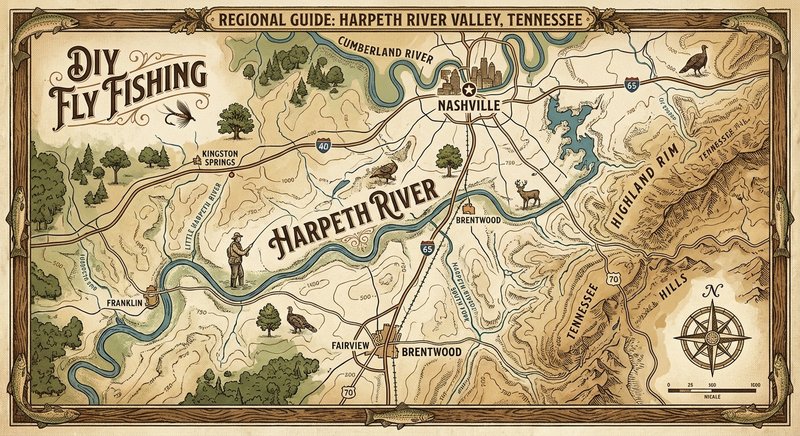
Harpeth River
Fly fishing in Tennessee · Beginner · Best seasons: Spring, Summer, Fall
Target Species
Smallmouth Bass, Largemouth Bass
About This Water
Nashville area stream with smallmouth bass. Good urban fishing opportunity.
Fishing Recommendations
Welcome to the Harpeth River, a true gem of Middle Tennessee. As a State Scenic River, the Harpeth offers some of the finest warm-water fly fishing in the Southeast, right in the backyard of Nashville. It is a classic "low-gradient" river characterized by limestone bluffs, sycamore-lined banks, and a mix of slow, deep pools and rocky riffles.
Here is your comprehensive guide to fly fishing the Harpeth River.
🎣 Location Overview
The Harpeth River is a quintessential pastoral stream that winds through the heart of the Highland Rim. What makes it special is its accessibility and its productivity; despite flowing through suburban Franklin and Nashville, it maintains a wild feel.
The water is chemically "hard" due to the limestone bedrock, which leads to high nutrient levels and a robust food web. Anglers love the Harpeth because it is a "lazy" river—perfect for a slow float in a kayak or canoe, or for wading during the low-water months of summer. It’s not a big, powerful river; it’s an intimate one where accuracy and stealth trump long-distance casting.
🐟 Target Species & Behavior
While you'll find plenty of panfish and the occasional gar, the focus here is the Micropterus family.
- Smallmouth Bass: The "Bronzeback" is the king of the Harpeth. They prefer the "moving" parts of the river. Look for them in the transition zones where a riffle enters a pool, or tucked tightly against the limestone bluff walls where the current is strongest. They are aggressive but can be incredibly spooky in the clear water of mid-summer.
- Largemouth Bass: Found primarily in the long, slow, deep "slack water" stretches. They hold tight to "woody debris"—downed trees, root balls, and log jams.
- Diet: The Harpeth is a crawfish factory. If you aren't sure what to tie on, make it orange, brown, or olive. They also feed heavily on shad, shiners, and large invertebrates like Hellgrammites.
📅 Best Times to Fish
The Harpeth is a seasonal fishery that reacts quickly to rainfall.
- Spring (April – June): This is prime time for big fish. As the water warms into the 60s, bass become aggressive pre-spawn and post-spawn.
- Condition: Watch the gauges. If the river is "blown out" (muddy and high), stay home. You want "Green" water—not crystal clear, but with a few feet of visibility.
- Summer (July – Early September): The water drops and clears. This is Topwater Season.
- Time of Day: Early morning (dawn till 10 AM) and late evening (7 PM till dark) are essential. During the heat of the day, fish deep under overhanging shade.
- Fall (Late September – November): As the water cools, bass feed heavily to prepare for winter. The "Popper-Dropper" becomes deadly here.
🪰 Recommended Flies & Techniques
Top Patterns
- Streamers: Clouser Minnows (Chartreuse/White), Gamechangers (Small, 3-inch), and the Murdich Minnow (a local favorite for Smallmouth).
- Crayfish: Near ‘Nuff Crayfish, Whitlock’s Near ‘Nuff, or a simple Rubber-Legged Dragon Craw.
- Topwater: BoogleBugs (Poppers) in "Electric Yellow" or "Frog," and Foam Stealth Bombers.
- Sub-surface: Pat’s Rubber Legs (Black or Olive) or a Wooly Bugger.
Techniques
- The "Slow Crawl": When using crayfish patterns, don't strip them. Let them sink to the bottom and "tick" them along the rocks with tiny twitches of the rod tip.
- The Bluff Bang: Cast your popper within an inch of the limestone bluff walls. Let it sit until the rings disappear, then give it one sharp pop.
- Swing the Riffles: In faster water, swing a streamer through the current just like you would for trout. Smallies often sit at the very tail-out of a riffle.
💡 Pro Tips & Local Knowledge
- The "Shadow Line": In the summer, the Harpeth can get very warm. Fish will congregate in the shadows cast by the high bluffs or overhanging trees. If your fly is in the sun, you’re likely out of the strike zone.
- Wade Stealth: If you are wading, move upstream. The Harpeth has a silty bottom in many places; walking downstream sends a plume of mud and "vibrations" straight to the fish you are trying to catch.
- Focus on the "Hidden" Spots: Everyone fishes the parks (Harpeth River State Park). The best fishing is often found by launching a kayak at one bridge and floating to the next, accessing the water that bank-anglers can't reach.
- The 48-Hour Rule: The Harpeth drainage is large. If there is a heavy rain in Franklin, the river in Bellevue will be muddy for at least 48 hours. Check the USGS gauge at Bellevue before you drive out.
⚠️ Important Information
- Access: Key access points include The Narrows of the Harpeth, Newsom’s Mill, Harpeth River State Park, and various bridge crossings in Williamson and Davidson counties.
- Regulations: A valid Tennessee Fishing License with a "Freshwater" designation is required. Check the TWRA (Tennessee Wildlife Resources Agency) guide for specific size and creel limits, as some sections have special "Smallmouth Management" regulations.
- Safety: While the river is generally slow, "strainers" (fallen trees in moving water) are the biggest danger to kayakers. Always wear a PFD.
- Private Property: The riverbed is often private. Stay in your boat or keep your feet in the water; avoid walking up onto the banks unless you are at a designated public access point.
Tight lines, and enjoy the beauty of the Harpeth!
Bug Hatches & Matching Flies
| Hatch | Type | Peak months | Time of day | Hook sizes | Matching flies |
|---|---|---|---|---|---|
| Blue Winged Olive Baetis | mayfly | March, April, October, November | Late Morning/Afternoon | #18-22 | Parachute Adams #18-22, RS2 #20-22, Pheasant Tail #18-20 |
| Tan Caddis Hydropsyche | caddis | April, May, June | Evening | #14-16 | Elk Hair Caddis #14-16, Holy Grail Caddis #14-16, LaFontaine's Deep Sparkle Pupa #14-16 |
| White Fly Ephoron leukon | mayfly | August, September | Dusk/Late Evening | #12-14 | Ephoron Dun #12-14, White Wulff #12, White Spinner #12-14 |
| Midges Chironomidae | midge | January, February, March | All Day | #20-24 | Zebra Midge #20-22, Griffith's Gnat #20-22, Top Secret Midge #22-24 |
| Trico Tricorythodes | mayfly | July, August, September | Early Morning | #20-24 | Trico Spinner #22-24, Trico Dun #22, Sunken Trico Spinner #22 |
| Golden Stonefly Acroneuria | stonefly | May, June | Evening/Night | #8-12 | Pat's Rubber Leg #8-12, Kaufmann's Stone #8-10, Golden Stimulator #10-12 |
| Damselfly Enallagma | terrestrial | June, July, August | Afternoon | #10-14 | Marabou Damselfly Nymph #12-14, Adult Damsel #12, Damsel Bugger #10 |
| Common Terrestrials Formicidae / Coleoptera | terrestrial | July, August, September | All Day | #12-18 | Black Foam Ant #16-18, Dave's Hopper #10-12, Beetle Bailey #14-16 |