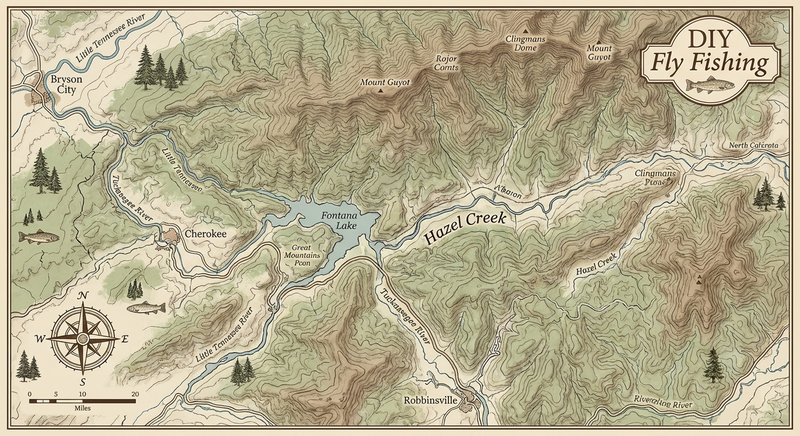
Hazel Creek
Fly fishing in North Carolina · Advanced · Best seasons: Spring, Summer, Fall
Target Species
Rainbow Trout, Brown Trout, Smallmouth Bass
About This Water
Remote backcountry stream in Great Smoky Mountains. Excellent wild trout fishing.
Fishing Recommendations
Hazel Creek is widely considered the "Holy Grail" of fly fishing in the Great Smoky Mountains National Park (GSMNP). It is a legendary freestone stream, not just for its fishing, but for its rich history and its remote, wilderness character.
As your guide, I’m going to break down how to tackle this bucket-list destination.
🎣 Location Overview
Located on the North Shore of Fontana Lake, Hazel Creek is one of the most remote and storied trout streams in the Eastern United States. Before the park was established, it was home to the thriving lumber town of Proctor. Today, the forest has reclaimed the town, leaving behind chimney stacks and a sense of haunting beauty.
The water is a classic Appalachian freestone stream: crystal clear, cold, and boulder-strewn. What makes it special is its size and nutrient load. Hazel is larger than most park streams, allowing for deeper pools and larger-than-average trout. Because there is no road access, the fish aren't as pressured as those on the roadside streams, though they remain incredibly wild and wary.
🐟 Target Species & Behavior
- Rainbow Trout: The most common resident. They hold in the faster "pocket water" and at the heads of pools. They are opportunistic feeders but will spook at the sight of a fly line.
- Brown Trout: Hazel Creek is famous for its wild brown trout. These fish can reach 20+ inches here, which is rare for the Smokies. They are nocturnal and predatory, holding in deep undercut banks, under submerged logs, and in the dark shadows of large boulders.
- Smallmouth Bass: Found primarily in the lower two miles of the creek near the confluence with Fontana Lake. They move into the lower creek reaches during the heat of summer to find moving water and forage.
📅 Best Times to Fish
- Spring (March – May): The Prime Window. This is when the legendary hatches occur (Quill Gordons, March Browns, and Yellow Sallies). The water temperatures are rising, and the trout are hungry after winter.
- Summer (June – August): Excellent for dry fly fishing. The higher elevations of Hazel stay cool. This is also the best time for Smallmouth in the lower sections using poppers.
- Fall (September – early November): The "Second Prime." As water temperatures drop, brown trout become aggressive ahead of their spawn. The foliage is world-class, though water levels can be low, requiring extreme stealth.
- Time of Day: In the heat of summer, fish early and late. For big Browns, the "Magic Hour" (dusk) is when the monsters come out to hunt.
🪰 Recommended Flies & Techniques
Top Fly Patterns
- Dry Flies:
- Yellow Stimulator (Sizes 12-16): Mimics Stoneflies and looks like a "cheeseburger" to a trout.
- Parachute Adams (Sizes 14-18): The ultimate generalist.
- Elk Hair Caddis (Sizes 14-16): Best for the broken pocket water.
- Never-Sink Terrestrials: Ants and beetles in late summer.
- Nymphs:
- Pheasant Tail (Size 14-18): Standard dropper.
- Prince Nymph (Size 12-14): Great for the deeper, faster runs.
- Girdle Bug (Pat’s Rubber Legs): Key for enticing those large Hazel Creek Browns.
- Streamers:
- Black or Olive Woolly Bugger (Size 6-10): Essential for the lower reaches and for targeting big browns during high water.
Techniques
- The "Dry-Dropper" Rig: This is the bread and butter of Hazel Creek. Use a buoyant dry (like a Stimulator) with a 18-24 inch fluorocarbon dropper to a Pheasant Tail.
- Stealth Fishing: You must fish "upstream." If the fish see your shadow or feel the vibration of your wading, the pool is "done" for thirty minutes.
- High-Sticking: In the pocket water, keep as much fly line off the water as possible to avoid drag.
💡 Pro Tips & Local Knowledge
- The "Lumber Town" Strategy: Focus on the stretches near the old Proctor townsite (near Campsite 86). The creek is wide here with massive pools that hold the largest fish.
- Don't ignore the "Thin" water: In the summer, rainbows will often sit in water so shallow their backs are almost showing, provided there is a high dissolved oxygen content (bubbles).
- The "Brown Trout Secret": If you are targeting a trophy, fish during a light rain. The overcast skies and "color" in the water give the big browns the confidence to leave their lairs.
- Wading: The rocks in Hazel are notoriously slippery ("Smoky Mountain Grease"). Use felt-soled boots or studs, and a wading staff is highly recommended.
⚠️ Important Information
Access (The Hard Part)
There are only two real ways to get to Hazel Creek:
- The Boat Shuttle: Most anglers take a ferry from Fontana Village Marina. They will drop you at the mouth of the creek and pick you up at a pre-arranged time.
- The Hike: You can hike in via the Lakeshore Trail, but it is a grueling 10+ mile trek one-way. This is best reserved for multi-day backpacking trips.
Regulations & Permits
- Licenses: You need either a North Carolina OR a Tennessee freshwater fishing license. Both are valid throughout the Park.
- Regulations: Hazel Creek is "Artificial Lures Only" (Single Hook). No corn, bread, or scented baits.
- Limit: 5 fish per day (7-inch minimum), but most serious anglers practice 100% Catch and Release here to preserve the wild genetics.
Special Considerations
- Bears: This is high-density Black Bear country. If you are camping (Campsites 86, 84, or 83), you must use the provided cable systems to hang your food and gear.
- Cell Service: Non-existent. Bring a satellite messenger (like a Garmin inReach) if you are traveling alone.
- Lake Levels: Check the TVA Fontana Lake levels. If the lake is "Full Pool," the lower mile of Hazel Creek becomes a flat, flooded estuary, pushing the trout further upstream.
Bug Hatches & Matching Flies
| Hatch | Type | Peak months | Time of day | Hook sizes | Matching flies |
|---|---|---|---|---|---|
| Quill Gordon Epeorus pleuralis | mayfly | March, April | Midday | #12-14 | Quill Gordon Dry #12-14, Quill Gordon Wet #12-14 |
| Blue Quill Paraleptophlebia adoptiva | mayfly | March, April | Late morning to Afternoon | #16-18 | Blue Quill #16-18, Pheasant Tail #16-20 |
| March Brown Maccaffertium vicarium | mayfly | April, May | Afternoon | #10-14 | American March Brown #10-12, March Brown Emerger #12-14 |
| Yellow Sally Isoperla spp. | stonefly | May, June, July | Late Afternoon/Evening | #14-16 | Yellow Sally Stimulator #14-16, Little Yellow Stone Nymph #14-16 |
| Light Cahill Stenacron interpunctatum | mayfly | May, June | Evening | #12-14 | Light Cahill Dry #12-14, Gold Ribbed Hare's Ear #12-14 |
| Slate Drake Isonychia bicolor | mayfly | June, September, October | Late Afternoon | #10-12 | Isonychia Parachute #10-12, Prince Nymph #10-14 |
| Blue Winged Olive Baetis spp. | mayfly | March, April, October, November | Midday/Overcast days | #18-22 | BWO Sparkle Dun #18-20, RS2 #20-22 |
| Cinnamon Caddis Hydropsyche spp. | caddis | May, June, August | Evening | #14-18 | Elk Hair Caddis (Tan/Cinnamon) #14-18, LaFontaine's Deep Sparkle Pupa #14-16 |
| Terrestrials Formicidae / Coleoptera | terrestrial | July, August, September | All Day | #12-18 | Black Foam Beetle #14-16, Cinnamon Ant #16-18 |
| Golden Stonefly Acroneuria spp. | stonefly | June, July | Evening/Night | #6-10 | Golden Stone Nymph #8-10, Kaufmann's Stone #6-10 |