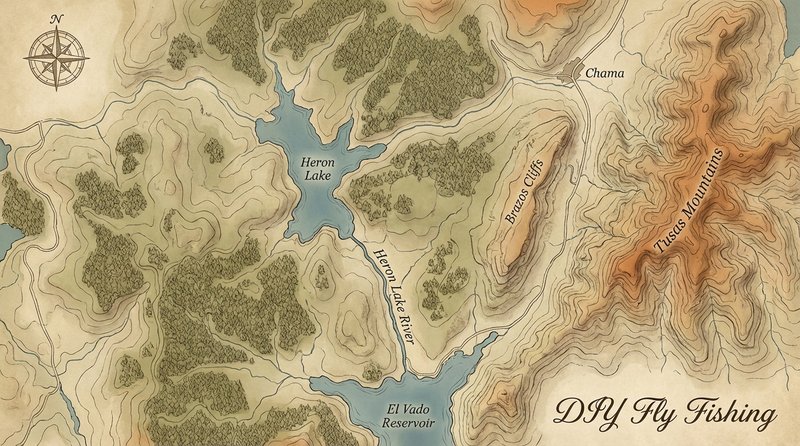
Heron Lake
Fly fishing in New Mexico · Beginner · Best seasons: Spring, Summer, Fall
Target Species
Rainbow Trout, Kokanee Salmon, Lake Trout
About This Water
Large reservoir with excellent trout and kokanee fishing. No-wake lake for peaceful fishing.
Fishing Recommendations
Heron Lake is a high-altitude gem located in the scenic mountains of Northern New Mexico near Tierra Amarilla. Unlike many western reservoirs dominated by jet skis and powerboats, Heron is a designated "quiet lake" (no-wake speeds only). This makes it a premier destination for fly anglers in float tubes, kayaks, or small boats who value stealth and tranquility.
Here is your comprehensive guide to fly fishing Heron Lake.
🎣 Location Overview
Heron Lake is a deep, cold-water reservoir sitting at approximately 7,186 feet of elevation. It is part of the San Juan-Chama Project, meaning water levels can fluctuate significantly based on downstream demand.
What makes Heron special is its clarity and silence. The water is crystal clear, often allowing you to see submerged boulders and drop-offs 15–20 feet down. Because of the no-wake rule, the water remains calm, allowing fly anglers to effectively work the shorelines and shelves without fighting heavy swells. It is widely considered the best place in New Mexico to target trophy-sized Lake Trout on the fly.
🐟 Target Species & Behavior
Lake Trout (Mackinaw)
These are the kings of Heron Lake. They are apex predators that feed heavily on Kokanee Salmon and Rainbow Trout.
- Behavior: Usually deep-dwellers, but they move into the "shallows" (10–30 feet) during the spring and late fall when water temperatures are low.
- Feeding: They want high-protein meals. Think large streamers that mimic small salmon or trout.
Rainbow Trout
Heron holds a mix of holdover "wild" rainbows and state-stocked fish.
- Behavior: They cruise the rocky points and transition zones where shallow shelves drop into deep water.
- Feeding: They are opportunistic, feeding on midge hatches, scuds (amphipods), and small minnows.
Kokanee Salmon
Landlocked Sockeye salmon that school in open water.
- Behavior: They are pelagic, moving in large schools. They are difficult to target with a fly rod in open water during summer, but they become accessible near the Willow Creek inlet during their fall spawning run.
📅 Best Times to Fish
- Spring (Ice-Out to Late June): This is the prime window for fly anglers. As the ice melts, Lake Trout move into the shallows to feed. Rainbow trout are also very active along the shorelines.
- Summer (July - August): Fishing becomes more technical. Fish move deeper to find the thermocline (colder water). You will need a heavy sinking line (Type 5 or 7) to reach them. Early morning and late evening are the only productive windows.
- Fall (September - November): As water temperatures drop, Lake Trout return to the shallows. The Kokanee Salmon begin their move toward the inlets to spawn, providing a frenzy of activity for predators.
- Time of Day: The "Heron Wind" usually kicks up by 1:00 PM. Early morning (dawn to 11:00 AM) is almost always the most productive and safest time to be on the water.
🪰 Recommended Flies & Techniques
For Lake Trout (The "Big Game" Approach)
- Technique: Use an 8-weight rod with a fast-sinking integrated line. Cast toward rocky points or drop-offs, let the fly sink for 20–30 seconds, and use a "strip-strip-pause" retrieve.
- Flies:
- Game Changers (White/Pearl or Rainbow patterns)
- Large Bunny Leeches (White or Olive, 4–6 inches long)
- Clouser Minnows (Blue/White to mimic Kokanee)
For Rainbow Trout (The "Tactical" Approach)
- Technique: Use a 5 or 6-weight rod. In the spring, "indicator nymphing" along the dams or rocky shores can be deadly. In the evening, look for rising fish and switch to dries.
- Flies:
- Scuds: Olive or Orange (Heron has a massive scud population).
- Midges: Zebra Midges (Size 18–22) in black or red.
- Dries: Parachute Adams or Elk Hair Caddis during summer evenings.
For Kokanee (The "Inlet" Approach)
- Technique: When they congregate near Willow Creek in the fall, use a swinging technique or a slow strip.
- Flies: Small, bright "attractor" patterns like Red Copper Johns or Pink Glo-Bugs.
💡 Pro Tips & Local Knowledge
- The "Shelf" Factor: Use a topographic map or a fish finder to locate where the "shelf" is. Heron has many areas where the water goes from 5 feet to 40 feet instantly. Fish sit right on that edge waiting for baitfish to drifted over.
- Willow Creek Inlet: This is the most famous spot on the lake. Even if you don't have a boat, you can hike into the Willow Creek area. It’s a magnet for every species in the lake.
- Stealth is Key: Because the water is so clear, long leaders (9–12 feet) are often necessary for Rainbows. For Lake Trout, a shorter 4–6 foot fluorocarbon leader (15-20lb) is fine as they are less leader-shy when chasing big streamers.
- The "Ridge" Rock: Look for the vertical rock walls on the western side of the lake. These deep walls hold Lake Trout even during the warmer months.
⚠️ Important Information
- Access: Heron Lake State Park requires a daily or annual pass. There are several boat ramps (Sailing Cat, Ridge Rock), but some may be closed if water levels are low.
- Regulations: Check the current New Mexico Department of Game and Fish (NMDGF) rib. Kokanee salmon have specific seasons and bag limits. Lake Trout often have no bag limit to encourage the growth of the Kokanee population—check current proclamations.
- Safety: This is a high-altitude lake. Weather changes in minutes. If you see dark clouds over the Brazos Cliffs to the east, get off the water immediately.
- Gear Prep: If targeting Lake Trout, ensure your reels have a smooth drag. A 20-pound Laker will peel line faster than you expect.
Guide’s Final Word: Heron is a "thinking angler’s" lake. It doesn't give up its secrets easily, but for the fly fisher who enjoys the challenge of deep-water tactics and the reward of a wild, high-mountain environment, there is nowhere better in the Southwest.
Bug Hatches & Matching Flies
| Hatch | Type | Peak months | Time of day | Hook sizes | Matching flies |
|---|---|---|---|---|---|
| Chironomids Chironomidae | midge | April, May, September, October | All Day | #12-22 | Zebra Midge #16-20, Ice Cream Cone #12-16, Griffith's Gnat #18-22 |
| Callibaetis (Speckled Duns) Callibaetis | mayfly | June, July, August | Morning/Early Afternoon | #12-16 | Callibaetis Spinner #14-16, Hare's Ear Nymph #12-16, Pheasant Tail #14-16 |
| Damselflies Enallagma | terrestrial | June, July | Morning/Afternoon | #10-14 | Marabou Damsel #10-12, Adult Blue Damsel #12-14 |
| Scuds (Freshwater Shrimp) Gammarus | midge | March, April, October, November | All Day | #12-18 | Ray Charles #14-16, Orange Scud #12-18 |
| Cinnamon Caddis Hesperophylax | caddis | July, August, September | Evening | #12-16 | Elk Hair Caddis #12-14, LaFontaine's Emerger #14-16 |
| Water Boatmen Corixidae | terrestrial | September, October | Afternoon | #14-18 | Prince Nymph #14-16, Water Boatman #14-18 |
| Terrestrial Ants and Beetles Formicidae | terrestrial | July, August | Afternoon | #12-18 | Parachute Ant #14-18, Chernobyl Ant #10-12 |
| Dragonflies Anisoptera | terrestrial | July, August | Afternoon | #4-10 | Dragonfly Nymph #6-10, Woolly Bugger (Olive) #4-8 |