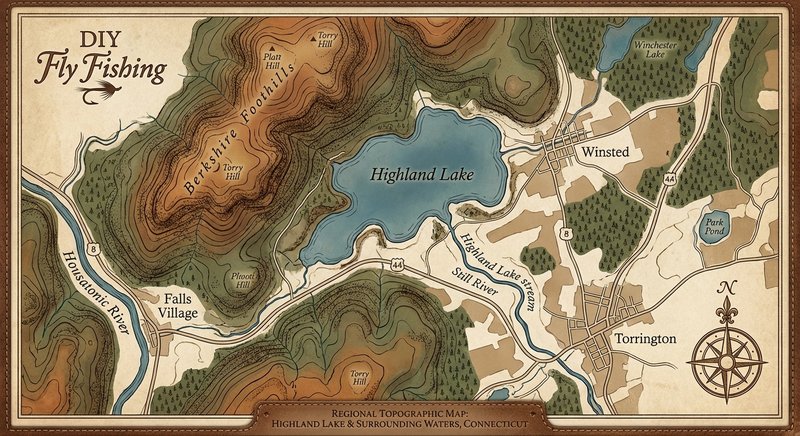
Highland Lake
Fly fishing in Connecticut · Beginner · Best seasons: Spring, Summer, Fall
Target Species
Brown Trout, Largemouth Bass
About This Water
Litchfield County lake with trout and bass. Mountain lake setting.
Fishing Recommendations
Welcome to the Litchfield Hills of Connecticut. As your guide, I’m excited to break down Highland Lake in Winchester (Winsted). At 444 acres, this is one of the premier "Trophy Trout" lakes in the state. It is a deep, clear, and spring-fed body of water divided into three distinct basins, each offering a unique micro-environment for fly anglers.
While many think of Connecticut for its rivers like the Farmington, Highland Lake offers a world-class stillwater experience for those who know how to work the water.
🎣 Location Overview
Highland Lake is a quintessential New England glacial lake. It is characterized by its clarity and its "three basin" structure.
- First Basin: Relatively shallow with significant weed growth; perfect for bass.
- Second Basin: A transition zone with mixed depths.
- Third Basin: The deepest section (reaching over 60 feet), which provides the cold-water refuge necessary for large Brown Trout to "hold over" year after year.
What makes Highland special is the Alewife population. This high-protein forage base allows Brown Trout to reach "football" proportions, often exceeding 20 inches. For the fly angler, this is a game of patience and matching the baitfish.
🐟 Target Species & Behavior
Brown Trout (The "Holdovers")
The CT DEEP stocks Highland heavily, but the real prizes are the holdovers.
- Behavior: In the spring and fall, they cruise the shorelines and drop-offs. In the summer, they retreat to the thermocline (20–30 feet down) in the third basin.
- Feeding: They are primarily piscivorous (fish-eaters). They shadow schools of Alewives.
Largemouth Bass
- Behavior: Highland has a massive population of Largemouths that thrive around the hundreds of private docks and the lush weed beds of the first basin.
- Feeding: They target bluegill, frogs, and crayfish. They are aggressive and provide excellent topwater action on fly gear.
📅 Best Times to Fish
- Spring (April – June): Prime Time for Trout. As the ice leaves and the water warms to 50–55°F, Brown Trout cruise the shallow shorelines. This is the only time you can consistently catch trophy trout on a floating or intermediate line.
- Summer (July – August): Bass Season. Bass are active early and late in the day. For Trout, you must fish at night or use heavy sinking lines (Type 6 or 7) to reach the 25-foot depths.
- Fall (September – November): The Trophy Window. As water temperatures drop, big Browns move back into the shallows to feed aggressively before winter. The weed lines begin to die back, making bass more concentrated.
Best Times of Day:
- Trout: 5:00 AM to 9:00 AM. Brown Trout are light-sensitive; once the sun hits the water, they dive deep.
- Bass: Low light periods (dawn/dusk) are best for topwater.
🪰 Recommended Flies & Techniques
For Brown Trout
- Patterns:
- The Alewife Special: Grey Ghost, Black Ghost, or any sparse white/silver streamer (Size 4-8).
- Gamechangers: Small 3-inch white/pearl articulated streamers.
- Wooly Buggers: Black or Olive with copper flash (Size 6).
- Technique: Use an Intermediate Line in the spring. Cast toward the shore and strip back with a "stop-and-go" motion to mimic a wounded alewife. In summer, switch to a Full Sink Line and "count down" your fly to the thermocline.
For Largemouth Bass
- Patterns:
- Dahlberg Divers: Yellow or Frog patterns.
- Poppers: Hard-body foam poppers in white/red.
- Clouser Minnows: Chartreuse/White (Size 2).
- Technique: Focus on "Dock Hopping." Skip your fly as far under the private docks as possible. Let the rings disappear, then give it two sharp twitches.
💡 Pro Tips & Local Knowledge
- The Third Basin Drop-off: If you are hunting trophy Brown Trout, focus on the "shelves" in the third basin where the water drops from 10 feet to 40 feet rapidly. Trout sit on these edges waiting for alewives to be pushed off the shallow flats.
- The "Wake Boat" Factor: Highland Lake is popular with recreational boaters. During summer weekends, the lake becomes a washing machine by 10:00 AM. Experienced fly anglers are off the water by 9:00 AM.
- Night Fishing for Browns: In late October, try fishing a large black streamer near the state boat launch or the "Sucker Brook" inlet at night. Large Browns move into these areas under the cover of darkness.
- Match the Flash: The water is very clear. If your fly is too bulky, the fish will spook. Think "sparse and flashy" to mimic the translucent nature of an alewife.
⚠️ Important Information
- Access: The primary access is the State Boat Launch located on the north end (West Lake Street). It is well-maintained with ample parking, but it fills up fast on weekends.
- Regulations: Highland Lake is a Trophy Trout Lake.
- Check current CT DEEP Fishing Guide for specific creel limits (usually 3 trout per day, but there may be length minimums).
- A Connecticut Fishing License with a Trout & Salmon Stamp is required.
- Vessel Safety: If fishing from a kayak or belly boat, be highly visible. Use a safety flag, as powerboats move fast in the center of the lake.
- Invasive Species: Ensure your boat and gear are "Clean, Drain, Dry." Highland Lake has struggled with invasive aquatic plants, and we want to keep it from getting worse.
Tight lines, and enjoy the beauty of Highland Lake—it's one of the best stillwater fly fishing challenges in the Northeast!
Bug Hatches & Matching Flies
| Hatch | Type | Peak months | Time of day | Hook sizes | Matching flies |
|---|---|---|---|---|---|
| Chironomids (Midges) Family Chironomidae | midge | April, May, September | All day | #18-24 | Zebra Midge #18-22, Griffith's Gnat #20-24, Brooks Sprout Midge #20-22 |
| Hendrickson Ephemerella subvaria | mayfly | April, May | Afternoon | #12-14 | Red Quill #12-14, Hendrickson Nymph #12-14, Pheasant Tail #14-16 |
| Grannom Caddis Brachycentrus | caddis | May | Morning/Evening | #14-16 | Elk Hair Caddis (Olive) #14-16, LaFontaine's Deep Sparkle Pupa #14-16, Holy Grail #14-16 |
| Hex (Great Olive Winged Drake) Hexagenia limbata | mayfly | June, July | Dusk/Night | #6-10 | Hexagenia Dry #6-8, Large Hare's Ear #8-10, Hex Cripple #8 |
| Damselfly Enallagma | terrestrial | June, July, August | Afternoon | #10-14 | Marabou Damselfly Nymph #10-12, Adult Damselfly #12-14 |
| Light Cahill Stenacron / Stenonema | mayfly | June, July | Evening | #12-16 | Light Cahill #12-16, Gold Ribbed Hare's Ear #14-16 |
| Cinnamon Caddis Hydropsyche | caddis | July, August | Evening | #16-18 | Cinnamon Elk Hair Caddis #16-18, Iris Emerger #16-18 |
| Terrestrials (Ants and Beetles) Formicidae / Coleoptera | terrestrial | July, August, September | Afternoon | #12-20 | Chernobyl Ant #12-14, Black Foam Beetle #14-18, Cinnamon Flying Ant #16-20 |