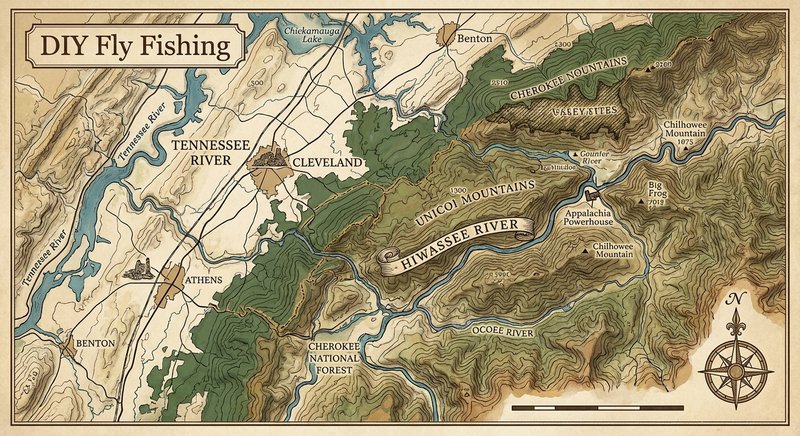
Hiwassee River
Fly fishing in Tennessee · Beginner · Best seasons: Spring, Summer, Fall, Winter
Target Species
Brown Trout, Rainbow Trout
About This Water
Southeast Tennessee tailwater with excellent wade fishing. Good populations of brown and rainbow trout.
Fishing Recommendations
The Hiwassee River in Reliance, Tennessee, is one of the most beautiful and unique tailwaters in the Southeast. Managed by the Tennessee Valley Authority (TVA) via the Apalachia Dam, it is a "State Scenic River" that offers a big-water feel reminiscent of the legendary rivers in Montana or Idaho.
Here is your guide to mastering the Hiwassee.
🎣 Location Overview
The Hiwassee is characterized by its massive width, crystal-clear water, and unique geological "shelves." Unlike the narrow mountain streams nearby, the Hiwassee is a wide, powerful river that flows through a deep gorge in the Cherokee National Forest.
What makes it special is the topography. The riverbed is composed of long, jagged rock ledges that run perpendicular to the current. These ledges create "steps" or "buckets" that provide perfect holding water for trout. Because it is a tailwater, the water stays cold year-round, making it a reliable fishery even in the heat of a Tennessee summer.
🐟 Target Species & Behavior
- Rainbow Trout: These are the primary residents. You’ll find a mix of recently stocked fish and "holdovers" that have survived multiple seasons. They tend to congregate in the oxygenated water at the base of the ledges and in the "slick" water just above a drop-off.
- Brown Trout: The Hiwassee holds some truly massive, wild-behaving Brown Trout. They are far more elusive and tend to hug the deeper undercut banks or sit in the dark shadows of the largest rock shelves. During low light or high water, they become aggressive predators.
Behavior Note: Hiwassee trout are notorious for being "surface-oriented." Even when there isn't a massive hatch, they are often looking up, making this one of the best dry-fly tailwaters in the South.
📅 Best Times to Fish
- Spring (March – May): Peak season. This is when the legendary Grannom Caddis and March Brown hatches occur. The water temperatures are rising, and fish are most active.
- Summer (June – August): Excellent for drift boat fishing. While other rivers get too warm, the Hiwassee stays cool. This is the time for terrestrials (beetles, ants, and hoppers) and the famous Isonychia hatch.
- Fall (September – November): The "Iso" hatch continues, and the scenery is world-class. Brown trout begin to move and become more aggressive as they prepare for the spawn.
- Winter (December – February): A great time for technical nymphing and midge fishing. The crowds are gone, and on sunny afternoons, you can often find fish rising to tiny Blue Winged Olives (BWOs).
Prime Window: Always check the TVA Generation Schedule. Low water (0 generators) is best for wading. High water (1–2 generators) is strictly for drift boats or rafts.
🪰 Recommended Flies & Techniques
Top Fly Patterns
- Dry Flies:
- Isonychia Parachute (Size 10-12) — The king of Hiwassee flies.
- Elk Hair Caddis (Size 14-18) — Tan or Olive.
- Parachute Adams (Size 16-22) — A must-have for midge and BWO hatches.
- Nymphs:
- Pheasant Tail (Size 14-18) — Mimics almost everything.
- Pat’s Rubber Legs (Size 8-12) — Effective in high water.
- Zebra Midge (Size 18-22) — Red or Black, essential for winter.
- Streamers:
- Woolly Bugger (Black or Olive).
- Gamechanger or Sparkle Minnow — For targeting trophy Browns during high water.
Techniques
- The "Hiwassee Swing": Because of the ledges, swinging soft hackles or wet flies is incredibly effective. Cast across and slightly downstream, letting the fly swing through the "buckets."
- Dry-Dropper: A high-visibility Isonychia pattern with a small Pheasant Tail dropped 2 feet behind it is the "standard" Hiwassee rig.
- Long Leaders: The water can be glassy. Use 9-to-12-foot leaders tapered to 5X or 6X tippet to avoid spooking fish.
💡 Pro Tips & Local Knowledge
- The "Buckets": Don't just cast blindly. Look for the dark lines in the water—those are the deep troughs between rock ledges. Trout sit right on the edge of the drop-off waiting for food to tumble over.
- Stealth and Footing: The rocks on the Hiwassee are notoriously slick (often called "Hiwassee Ice"). Felt soles and studs are highly recommended. Move slowly; the ripples from your wading can spook fish 40 feet away in the flat sections.
- Watch the Water: If you are wading and notice leaves/debris suddenly floating by or the water becoming slightly turbid, exit the river immediately. The pulse from the dam moves faster than you think.
- Focus Areas:
- The Powerhouse: The top of the fishable water. High concentration of fish.
- Childers Creek: Great access for wading and very productive during the spring hatches.
- The "Ledges" stretch: Located between the powerhouse and Reliance; this is prime drift-boat territory.
⚠️ Important Information
- Access: Main access points are the Apalachia Powerhouse (top), Childers Creek (middle), and the Reliance Bridge (bottom).
- Regulations:
- The section from the Apalachia Powerhouse downstream to the mouth of Sourwood Creek is a "Trophy Section."
- From Oct. 1 through April 30, it is Catch and Release Only, and only artificial lures/flies are permitted.
- Always check the TWRA website for the most current regulations.
- TVA App: Download the "TVA Lake Info" app. Check the "Apalachia" dam release schedule religiously before heading out.
The Hiwassee is a "big" river that rewards "big" casts and patient observation. If you can time the Isonychia hatch in the late afternoon on a summer day, you’ll experience some of the finest fly fishing the United States has to offer. Tight lines!
Bug Hatches & Matching Flies
| Hatch | Type | Peak months | Time of day | Hook sizes | Matching flies |
|---|---|---|---|---|---|
| Blue-Winged Olive (BWO) Baetis spp. | mayfly | February, March, October, November | Late Morning/Afternoon | #18-22 | RS2 #20-22, Parachute BWO #18-20, WD-40 #20-22 |
| Sulphur Ephemerella dorothea | mayfly | May, June | Late Afternoon/Evening | #14-18 | Sulphur Parachute #16-18, Pheasant Tail Nymph #16-18, CDC Sulphur Emerger #16-18 |
| Grannom Caddis Brachycentrus | caddis | April | Mid-day/Afternoon | #14-16 | Elk Hair Caddis (Olive/Black) #14-16, Holy Grail #14-16, Pupa-low-bill #16 |
| Light Cahill Stenacron / Stenonema | mayfly | June, July | Evening | #12-14 | Light Cahill #12-14, Gold Ribbed Hare's Ear #12-14 |
| Slate Drake (Isonychia) Isonychia bicolor | mayfly | June, September, October | Afternoon/Evening | #10-12 | Iso Parachute #10-12, Isonychia Nymph #10-12, Prince Nymph #10-14 |
| Midges Chironomidae | midge | January, February, December | All Day | #20-26 | Zebra Midge #20-22, Griffith's Gnat #20-24, Morgan's Midge #22-24 |
| Golden Stonefly Acroneuria | stonefly | May, June | Morning/Afternoon | #6-10 | Pat's Rubber Leg #8-10, Stimulator (Yellow) #8-12 |
| Terrestrials Formicidae / Coleoptera | terrestrial | July, August, September | Mid-day/Afternoon | #12-16 | Black Foam Beetle #14-16, Chernobyl Ant #8-12, Cinnamon Ant #16-18 |