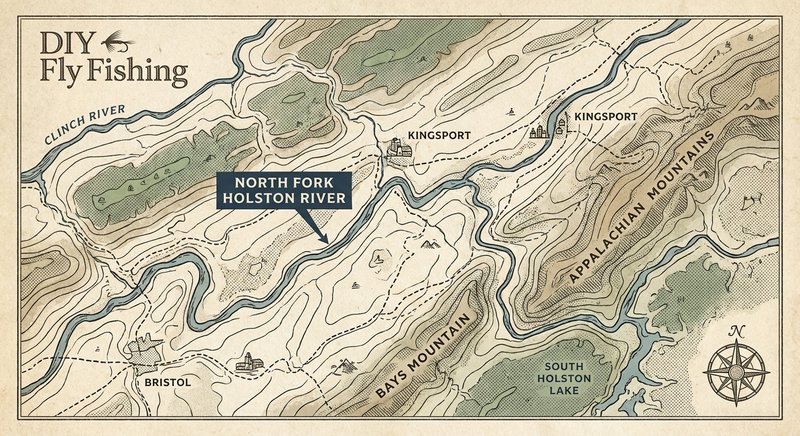
Holston River (North Fork)
Fly fishing in Tennessee · Intermediate · Best seasons: Spring, Summer, Fall
Target Species
Rainbow Trout, Brown Trout
About This Water
Mountain stream in northeast Tennessee with wild trout. Remote and scenic fishing.
Fishing Recommendations
The Holston River system in East Tennessee is a crown jewel of Southern fly fishing. However, there is a very important distinction to make for any visiting angler: The North Fork of the Holston is nationally famous as a world-class Smallmouth Bass fishery.
If you are targeting Rainbow and Brown Trout, you are likely looking for the South Fork of the Holston (The "SoHo") or the Lower Holston (below Cherokee Dam). For this guide, I will focus on the South Fork Holston, as it is the premier trout destination in the region that perfectly aligns with your requested species and seasons.
🎣 Location Overview
The South Fork Holston is a tailwater flowing from the South Holston Dam near Bristol, TN. It is widely considered one of the finest trout fisheries in the Eastern United States.
What makes it special is the Weir Dam (a "stepped" aeration structure) located about a mile below the main dam. This structure oxygenates the cold, nutrient-rich water released from the bottom of the lake, creating a "spring creek" environment. The water stays a consistent 45–55°F year-round, allowing for incredible insect biomass and massive fish growth. The river is characterized by long, glassy flats, technical riffles, and deep emerald pools.
🐟 Target Species & Behavior
- Brown Trout: The SoHo is famous for its wild Brown Trout population. Roughly 80% of the fish in this river are wild. They are cunning, often holding in the "skinny" water near the banks or in deep undercut ledges. During hatches, they rise with a very subtle, rhythmic sip.
- Rainbow Trout: These fish are hard-fighters and often hold in the faster oxygenated riffles. While many are stocked, there is a significant population of "holdovers" that become just as wary as the wild browns.
- Behavior: Because the water is so clear and the fishing pressure is high, these fish are "PhD trout." They are highly observant of leader shadows and drag.
📅 Best Times to Fish
The river fishes well 365 days a year due to the tailwater temperatures, but these are the prime windows:
- Spring (April – June): This is the "Main Event." The Sulfur hatch on the Holston is legendary. From late April through June, the river can look like it’s covered in yellow popcorn.
- Summer (July – August): Excellent dry fly fishing continues. While other rivers overheat, the SoHo stays ice-cold. Look for Tricos in the early mornings and Beetles/Ants (terrestrials) against the banks.
- Fall (September – November): A favorite for many guides. The crowds thin out, and the Blue Winged Olives (BWO) begin to hatch on overcast days. Large Brown Trout become more aggressive as they prepare for the late-fall spawn.
- Prime Conditions: Overcast, drizzly days are best for hatches. Always check the TVA Release Schedule; high water (generating) requires a boat, while low water (pulse/off) is perfect for wading.
🪰 Recommended Flies & Techniques
Dry Flies (The Holston Specialty)
- Sulfurs (Size 16–20): CDC Comparaduns, Puff Daddies, and Sparkle Duns.
- Tricos (Size 20–24): Female Spinners and CDC Duns.
- Midges (Size 20–26): Morgan’s Midge or a simple Griffith’s Gnat.
- Terrestrials: Black Foam Ants and Cricket patterns (Summer).
Nymphing
- The "SoHo Rig": A long leader (9–12ft) with a very small strike indicator (or just a piece of wool) and tiny flies.
- Patterns: Zebra Midges (Black/Silver or Red), Pheasant Tails (Size 18-22), and Scuds (Grey or Olive, Size 16-20).
Streamers
- Patterns: Black or Olive Wooly Buggers, or articulated patterns like the "Galloup’s Dungeon" in low light.
- Technique: Focus on the deep holes near the banks when the generators are running.
💡 Pro Tips & Local Knowledge
- The "Long and Fine" Rule: Because the water is glassy, you must use long leaders (12–15 feet) and light tippet. 6X and 7X fluorocarbon are the standard here. If you aren't getting bites, you are likely too heavy on your tippet.
- The Shadow Factor: These fish are extremely "spooky." Avoid wearing bright colors and try not to wade deeply into the pools where you intend to fish. Cast from the shallows into the seams.
- The Weir Dam Area: This is the most popular spot for wading. If it’s crowded, head downstream to the "Boone Tailwater" section or access points like Beidleman Creek or Rockhold Log Church.
- Learn the "Pulse": TVA often "pulses" the water (turns on one generator for an hour). This pushes bugs around and can trigger a feeding frenzy. Use the TVA Lake Info app religiously.
⚠️ Important Information
- Access: There are several public access points managed by the TWRA (Tennessee Wildlife Resources Agency). The "Grid" at the dam and the Weir Dam are the most accessible for wading.
- Regulations:
- There is a Protected Slot Limit: Trout between 16 and 22 inches must be released immediately.
- Only one fish over 22" may be harvested. (Most fly anglers practice 100% Catch & Release here).
- Safety: NEVER wade the river without checking the generation schedule. The water rises rapidly—feet per minute—and can trap you on islands or mid-stream ledges.
- License: You need a Tennessee Fishing License with a Trout Supplement.
Guide’s Final Word: The South Fork Holston is a technical river that rewards patience and precise casting. If you can catch a wild Brown on a Size 20 dry fly here, you can catch a trout anywhere in the world.
Bug Hatches & Matching Flies
| Hatch | Type | Peak months | Time of day | Hook sizes | Matching flies |
|---|---|---|---|---|---|
| White Mayfly Ephoron leukon | mayfly | August, September | Evening/Dusk | #12-14 | White Wulff #12-14, Snowshoe White Miller #12-14, Ephoron Nymph #12 |
| Blue-Winged Olive Baetis spp. | mayfly | March, April, October, November | Afternoon | #18-22 | RS2 #18-22, Parachute Adams #18-22, Pheasant Tail #18-20 |
| Sulfur Ephemerella invaria/dorothea | mayfly | May, June | Evening | #14-18 | Sulfur Parachute #14-16, Comparison Dun #16-18, Sulfur Emerger #16 |
| Tan Caddis Hydropsyche | caddis | April, May, June | Morning/Evening | #14-18 | Elk Hair Caddis #14-18, Holy Grail #14-16, Frenchie #14-18 |
| Yellow Sally Isoperla spp. | stonefly | May, June, July | Late Afternoon/Evening | #14-16 | Yellow Sally Foam Dry #14-16, Iron Lotus #14-16 |
| Slate Drake Isonychia bicolor | mayfly | June, September, October | Afternoon | #10-12 | Iso Parachute #10-12, Prince Nymph #10-14, Zug Bug #10-12 |
| Zebra Midge Chironomidae | midge | January, February, March, December | All Day | #18-24 | Zebra Midge #18-22, Griffith's Gnat #20-22, Top Secret Midge #20-24 |
| Terrestrials Formicidae/Coleoptera | terrestrial | July, August, September | All Day | #10-16 | Chernobyl Ant #8-12, Black Foam Beetle #12-16, Fur Ant #14-18 |