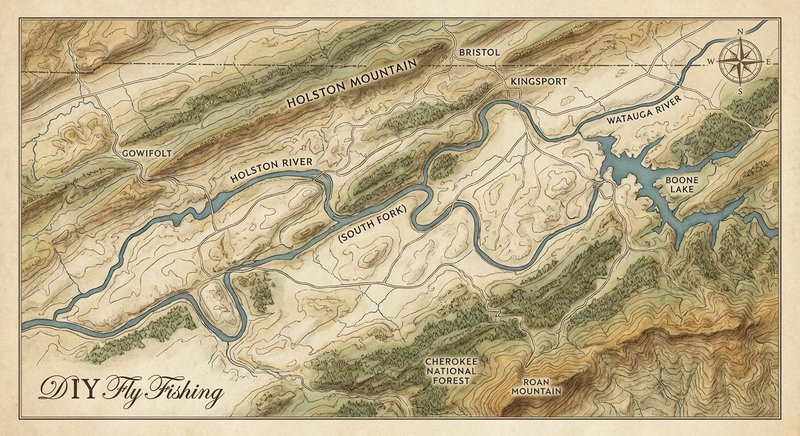
Holston River (South Fork)
Fly fishing in Tennessee · Intermediate · Best seasons: Spring, Summer, Fall
Target Species
Rainbow Trout, Brown Trout
About This Water
Above South Holston Lake with wild trout. Less crowded than the famous tailwater below.
Fishing Recommendations
The South Fork of the Holston River (affectionately known as the "SoHo") is widely considered one of the premier tailwater fisheries in the Eastern United States. Located in Northeast Tennessee, just downstream of the South Holston Dam, it offers world-class trout fishing in a stunning Appalachian setting.
As your guide, here is everything you need to know to find success on these hallowed waters.
🎣 Location Overview
The South Fork Holston is a tailwater, meaning its flow and temperature are controlled by the Tennessee Valley Authority (TVA) via the South Holston Dam. This creates a stable environment of cold, oxygenated water (usually between 45–55°F) year-round.
What makes the SoHo special is its biomass. The river is incredibly fertile, supporting a massive population of aquatic insects—specifically Sulphurs. Unlike many Eastern rivers that rely on stocking, the South Holston boasts a prolific wild trout population, particularly its legendary Brown Trout. The river features a mix of wide, shallow riffles, deep limestone ledges, and long, glassy pools that challenge even the most seasoned dry-fly anglers.
🐟 Target Species & Behavior
- Brown Trout: The stars of the river. Roughly 85% of the trout here are wild. They are cunning, picky, and can grow to trophy sizes (20+ inches). They tend to hold near undercut banks, deep ledge drops, and in the "nervous water" at the head of pools during hatches.
- Rainbow Trout: While some are wild, many are stocked to supplement the fishery. They are generally more aggressive than the browns and can be found in the faster riffles and oxygenated runs.
Behavior Note: These fish are highly "educated." Because of the river's clarity and heavy fishing pressure, they have excellent eyesight. Precise presentations and long, fine leaders are non-negotiable here.
📅 Best Times to Fish
- Spring (March – May): Excellent nymphing and the start of the Blue Winged Olive (BWO) hatches. As May approaches, the legendary Sulphurs begin to show.
- Summer (June – August): Prime Time. The South Holston is famous for its "Sulphur Blizzard." On many days, you can find rising fish from noon until dark. Even in the heat of July, the tailwater stays ice-cold.
- Fall (September – November): Great BWO hatches return. In late fall, the Brown Trout begin their spawning run. Note: Be mindful of spawning closures (see below).
The Generation Factor: Your fishing day is dictated by the TVA Release Schedule.
- Low Flow (No Generators): Ideal for wade fishing and technical dry fly work.
- High Flow (Generators Running): The river becomes a "big water" float fishery. This is the best time for streamers and heavy nymphing from a drift boat.
🪰 Recommended Flies & Techniques
Top Fly Patterns
- Dry Flies:
- Sulphurs: CDC Sparkle Dun, Parachute Sulphur, Puff Daddy (Size 16–20).
- Midges/BWOs: Griffith’s Gnat, Morgan’s Midge, Blue Winged Olive (Size 18–24).
- Nymphs:
- The "SoHo Specials": Ray Charles (Grey or Pink), Zebra Midge (Black/Silver), Pheasant Tail, and Scuds (Size 16–22).
- Streamers:
- Black or Olive Wooly Buggers, Sparkle Minnows, or Galloup-style articulated flies for high-water trophy hunting.
Techniques
- Technical Dry Fly: When the Sulphurs are hatching, use a 12-foot leader tapered to 6X or 7X fluorocarbon. Reach casts and slack-line mends are essential to avoid drag in the complex currents.
- The "SoHo Rig" (Nymphing): A standard indicator rig works, but many locals use a "high-stick" method or Euro-nymphing in the riffles. Because the bottom is covered in jagged limestone, use just enough weight to get down without constant snagging.
- Streamer Stripping: On high water, pound the banks with streamers. Big Browns move out of the deep holes to hunt during generation.
💡 Pro Tips & Local Knowledge
- The "Puff" Factor: On the SoHo, the fish often prefer CDC (Cul de Canard) flies. The way CDC sits in the film mimics the natural Sulphur emerger better than hackled flies.
- Watch the "Stoplight": The river has a weir dam (the "Griddle") near the main dam. When the water starts to rise, it moves fast. If you are wading, always keep an ear out for the siren or keep an eye on a specific rock to monitor rising levels.
- The "Ray Charles": If you aren't sure what to tie on, a size 18 Grey Ray Charles (a simple sowbug pattern) is the most consistent producer on the river.
- Low and Slow: During hatches, don't just cast at every splash. Observe the rise rhythm of a specific fish. The biggest browns often have the most subtle, "sip" style rises.
⚠️ Important Information
Access Points
- Osceola Island: Located right below the dam. Excellent wading access and a loop trail.
- Emmett Bridge: A popular mid-river access point for both waders and boat launches.
- Big Springs: Offers great wading water but requires a bit of a walk.
Regulations & Permits
- License: You need a Tennessee Fishing License with a Trout Stamp.
- Spawning Closure: A large section of the upper river (from the 421 Bridge up to the dam) is typically closed to all fishing from November 1st through January 31st to protect spawning Brown Trout. Always check the current TWRA (Tennessee Wildlife Resources Agency) proclamations before heading out.
- TVA App: Download the "TVA Release" app on your phone. Check the South Holston Dam schedule religiously; your life and your fishing depend on it.
Special Considerations
The South Holston is a "catch and release" culture among locals, especially for wild Brown Trout. While regulations allow for some harvest, practicing Keepemwet principles ensures this world-class fishery remains vibrant for years to come.
Bug Hatches & Matching Flies
| Hatch | Type | Peak months | Time of day | Hook sizes | Matching flies |
|---|---|---|---|---|---|
| Sulphurs Ephemerella invaria / dorothea | mayfly | May, June, July, August | Afternoon/Evening | #14-20 | Split Case Sulphur #16-18, Puff Daddy Sulphur #16-20, Comparison Dun #14-18 |
| Blue Winged Olives (BWO) Baetis | mayfly | February, March, October, November | Late Morning/Afternoon | #18-24 | Pheasant Tail #18-22, RS2 #20-24, BWO Parachute #18-22 |
| Midges Chironomidae | midge | January, February, December | All Day | #18-26 | Zebra Midge #18-22, Top Secret Midge #20-24, Griffith's Gnat #18-22 |
| Craneflies Tipulidae | terrestrial | August, September, October | Morning/Afternoon | #8-12 | Crane Fly Larva #10-12, Daddy Long Legs #8-12 |
| Black Caddis (Grannom) Brachycentrus | caddis | April, May | Morning/Evening | #14-18 | Holy Grail #14-16, Elk Hair Caddis (Black) #14-18 |
| Sowbugs Asellidae | crustacean | March, April, May | All Day | #14-18 | Ray Charles #14-18, Tailwater Sowbug #16-18 |
| Tricos Tricorythodes | mayfly | August, September | Early Morning | #22-26 | Trico Spinner #22-26, Sunken Trico #22-24 |
| Beetles and Ants Coleoptera / Formicidae | terrestrial | June, July, August, September | All Day | #12-18 | Black Foam Beetle #14-16, Cinnamon Ant #16-18 |