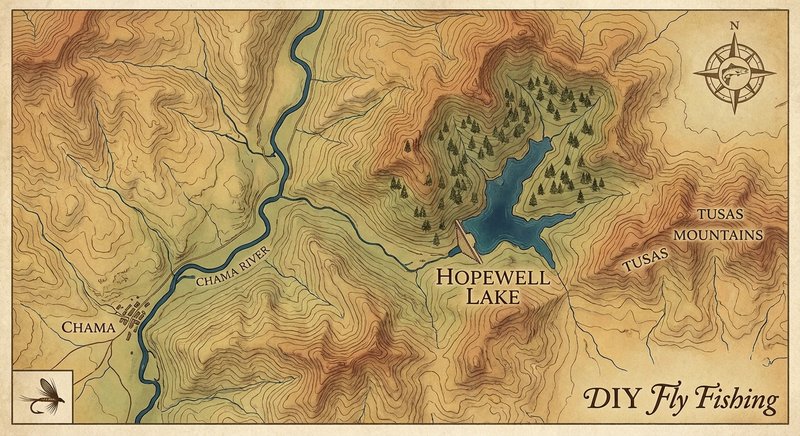
Hopewell Lake
Fly fishing in New Mexico · Beginner · Best seasons: Summer, Fall
Target Species
Rainbow Trout, Cutthroat Trout
About This Water
High elevation lake near Tres Piedras. Excellent rainbow trout fishing.
Fishing Recommendations
Welcome to the high country. As your guide, I’m excited to break down Hopewell Lake. Sitting at an elevation of approximately 9,900 feet in the Carson National Forest between Tres Piedras and Tierra Amarilla, Hopewell is a high-alpine gem. It’s one of the most accessible "mountain escapes" in Northern New Mexico, offering classic western scenery and eager trout.
Here is your comprehensive guide to fly fishing Hopewell Lake.
🎣 Location Overview
Hopewell Lake is a pristine, 20-acre high-altitude lake surrounded by sub-alpine meadows and dense stands of spruce and pine. What makes it special is the combination of easy access (right off US Highway 64) and a remote feel.
The water is typically crystal clear but can develop weed growth along the margins as the summer progresses. It is a "tea-colored" lake at times due to tannin from the surrounding forest, but it remains highly productive. Because of its elevation, the air stays cool even when the valleys are scorching, making it a sanctuary for both trout and anglers.
🐟 Target Species & Behavior
The lake is managed primarily for trout, with a focus on both recreational stocking and native species conservation.
- Rainbow Trout: These are the most common residents. They tend to cruise the shoreline in the mornings and drop to the deeper center of the lake as the sun rises. They are opportunistic feeders but can become "bright-light shy" by midday.
- Rio Grande Cutthroat Trout: The pride of New Mexico. These native fish are often found near the inlets or cruising the rocky drop-offs. They are known for their striking orange slashes and aggressive takes on dry flies.
- Brook Trout: While less common than Rainbows, there is a wild population of Brookies that frequent the cooler, shaded eastern banks and the small feeder streams.
Behavior: In this thin air, trout metabolisms are high. They feed heavily on midges, damselflies, and scuds. They often "patrol" specific routes along weed lines, moving in predictable circles.
📅 Best Times to Fish
Optimal Seasons
- Summer (June – August): This is prime time. The ice usually clears by late May. June offers incredible midge hatches, while July and August bring out the terrestrial activity (grasshoppers and ants).
- Fall (September – October): My personal favorite. The crowds thin out, and the Brookies and Cutthroats begin to display their spawning colors. The fish feed aggressively to bulk up for the long winter.
Best Times of Day
- The "Magic Hour": 30 minutes before sunrise until 9:30 AM. The water is usually glass-calm, allowing you to spot rising fish from a distance.
- Evening Rise: 6:00 PM until dusk. The wind usually dies down, and the midge and caddis activity picks up significantly.
🪰 Recommended Flies & Techniques
Top Fly Patterns
- Dry Flies:
- Parachute Adams (Size 16-20) – The ultimate searcher pattern here.
- Elk Hair Caddis (Size 14-16) – Great for the evening hatch.
- Amy’s Ant or Foam Beetles (Size 12-14) – Deadly in August and September.
- Nymphs/Sub-surface:
- Zebra Midge (Red or Black, Size 18-22) – Hang this 2 feet under a dry fly.
- Olive Scud (Size 14-16) – The lake is full of freshwater shrimp.
- Hare’s Ear Nymph (Size 16).
- Streamers:
- Woolly Bugger (Olive or Black, Size 10-12) – The go-to for larger Rainbows.
Effective Techniques
- Dry-Dropper: Use a buoyant dry fly (like a Stimulator) with a small Zebra Midge or Pheasant Tail dropped 18–24 inches below it. This covers two zones of the water column.
- The "Slow Strip": If using a streamer, use a slow, erratic "inch-worm" retrieve. Alpine trout often prefer a slow-moving target over a fast flee.
- Float Tubing: While shore fishing is productive, a float tube or kayak allows you to reach the deeper channels and the far eastern shore which is harder to access by foot.
💡 Pro Tips & Local Knowledge
- The Inlet Focus: Seek out the small trickles of water entering the lake, especially on the north/northwest side. These inlets bring in fresh oxygen and nutrients; Cutthroats often congregate here.
- Mind the Wind: Hopewell is notorious for a "1:00 PM Breeze." If the wind kicks up, don't pack up. Switch to a weighted streamer or a levee pattern and fish the "windward" shore where the insects are being pushed.
- The Stealth Factor: Because the water is clear, these fish can be spooky. Avoid wearing bright colors (stick to olives and tans) and try to keep a low profile when fishing from the bank.
- Sight Fishing: On calm days, walk the high banks on the south side. You can often spot trout cruising the shallows. Instead of casting at them, cast 5-10 feet in front of their path and let the fly sit still.
⚠️ Important Information
- Access: Located off Hwy 64. There is a developed campground (Hopewell Lake Campground) which is excellent for overnight stays.
- Regulations: New Mexico Department of Game and Fish (NMDGF) regulations apply. A valid New Mexico fishing license and a Habitat Management & Access Validation (HMAV) are required.
- Gear Recommendations: A 4-weight or 5-weight rod is perfect. Use 5x or 6x tippet for dries, as the fish can be leader-shy in the clear water.
- Weather Warning: At 10,000 feet, afternoon thunderstorms are common and dangerous. If you see lightning or hear thunder, get off the water immediately.
- Wildlife: This is bear and elk country. Keep a clean camp and keep your distance from wildlife.
Enjoy the crisp air and the pull of a high-country Cutthroat. Tight lines!
Bug Hatches & Matching Flies
| Hatch | Type | Peak months | Time of day | Hook sizes | Matching flies |
|---|---|---|---|---|---|
| Callibaetis (Speckled Winged Mayfly) Callibaetis ferrugineus | mayfly | July, August, September | Morning/Afternoon | #12-16 | Parachute Adams #14-16, Callibaetis Nymph #12-16, RS2 #16 |
| Chironomids (Midges) Chironomidae | midge | June, July | All Day | #18-24 | Zebra Midge #18-22, Griffith's Gnat #20-22, Ice Cream Cone #18 |
| Cinnamon Caddis Hydropsyche | caddis | July, August | Evening | #14-18 | Elk Hair Caddis (Cinnamon) #14-16, LaFontaine's Deep Sparkle Pupa #16 |
| Black Carpenter Ants Camponotus | terrestrial | July, August | Afternoon | #12-16 | Black Foam Ant #14-16, Chernobyl Ant #12 |
| Blue-Winged Olive (BWO) Baetis | mayfly | May, September, October | Late Morning/Afternoon | #18-22 | BWO Sparkle Dun #20-22, Pheasant Tail Nymph #18-20 |
| Blood Midges Chironomus plumosus | midge | June | Morning | #10-14 | San Juan Worm (Red) #12-14, Jumbo Blood Midge #12 |
| Trico Tricorythodes | mayfly | August, September | Early Morning | #20-24 | Trico Spinner #22-24, Trico Male Dun #22 |
| Damselflies Enallagma | terrestrial | July, August | Late Morning/Afternoon | #10-14 | Marabou Damsel Nymph #12-14, Adult Damsel (Blue) #12 |