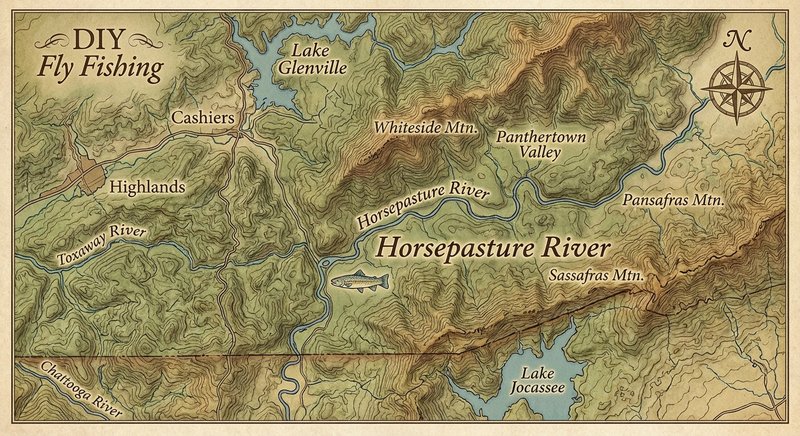
Horsepasture River
Fly fishing in North Carolina · Advanced · Best seasons: Spring, Summer, Fall
Target Species
Brown Trout, Rainbow Trout
About This Water
Wild and scenic river with excellent wild trout. Dramatic waterfalls section.
Fishing Recommendations
The Horsepasture River is one of the crown jewels of the Blue Ridge Mountains. Designated as a "National Wild and Scenic River," it offers some of the most dramatic scenery and technical pocket-water fishing in North Carolina.
As your guide, here is the deep-dive intel you need to successfully fish the Horsepasture.
🎣 Location Overview
Located in Transylvania County near Sapphire, NC, the Horsepasture River is famous for its "Verticality." This isn't your typical meandering meadow stream; it is a rugged, high-gradient river that tumbles over five major waterfalls (including the famous Rainbow Falls and Turtleback Falls) as it drops off the Blue Ridge Escarpment into Gorges State Park.
The water is classic freestone—crystal clear, cold, and nutrient-poor, meaning the fish are wild, beautiful, and opportunistic. Anglers love it because it offers a "backcountry" feel without requiring a 10-mile hike, though the terrain is physically demanding. You are fishing in deep gorges surrounded by temperate rainforest, which creates a prehistoric, secluded atmosphere.
🐟 Target Species & Behavior
The Horsepasture is primarily a Wild Trout fishery.
- Wild Rainbow Trout: These are the primary residents. They are exceptionally vibrant with crimson stripes and heavy spotting. They are energetic and tend to hold in the faster "bubble curtains" and the heads of plunge pools.
- Wild Brown Trout: The "ghosts" of the river. The larger browns hold in the deep, dark plunge pools beneath the waterfalls and under undercut ledges. They are much more light-sensitive and wary than the rainbows.
- Behavior: Because the water is so clear, these fish are incredibly spooky. They have a small "window" of vision in the broken pocket water. If they see your silhouette or a splashy line, the pool is "done" for thirty minutes.
📅 Best Times to Fish
Spring (Late March – Early June)
This is the prime window. The aquatic insect life is at its peak.
- Conditions: Look for Quill Gordon and March Brown hatches in April.
- Timing: Mid-day is best as the water warms up.
Summer (June – August)
While other NC rivers get too warm, the Horsepasture’s high elevation and heavy canopy keep it fishable.
- Conditions: High humidity and afternoon thunderstorms.
- Timing: "Low light or no light." Be on the water at dawn or the last two hours of dusk. Terrestrial fishing (ants/beetles) is spectacular now.
Fall (September – November)
The most beautiful time to be in the gorge.
- Conditions: The water levels are usually lower and clearer.
- Timing: The October Caddis hatch is a highlight. Brown trout become more aggressive as they prepare for the spawn (please avoid stepping on gravel "redds" in late November).
🪰 Recommended Flies & Techniques
Dry Flies
- Stimulators (Size 12-16): Orange or Yellow. Great for imitating stoneflies or large terrestrials.
- Parachute Adams (Size 14-18): The ultimate "searching" pattern for these waters.
- Elk Hair Caddis (Size 14-16): Best for the evening rise.
- Terrestrials: Black Foam Ants, Beetles, and Dave’s Hoppers.
Nymphs
- Pheasant Tail (Size 16-20): A staple for the Horsepasture.
- Pats Rubber Legs (Size 8-12): Essential for the deep plunge pools to get down fast.
- Frenchie or Perdigons: Effective for "Euro-nymphing" the tight pockets.
Techniques
- Dry-Dropper: This is the most effective way to fish the Horsepasture. Use a buoyant dry (like a Stimulator) with a small beaded nymph (like a Rainbow Warrior) 18-24 inches below it.
- Short-Line Nymphing: Because the river is so rocky, long casts lead to drag. Stay close, keep your rod tip high, and fish the "seams" where fast and slow water meet.
- Stealth Approach: Wade upstream. Never fish "down" to a pool, as the fish face into the current and will see you coming.
💡 Pro Tips & Local Knowledge
- The "Waterfall Effect": Don't just fish the pools. Fish the very edges of the whitewater where the falls hit the pool. Trout sit in the oxygenated "soft" spots right against the rock face waiting for stunned insects.
- The Gorges State Park Stretch: Accessing the river through Gorges State Park (the Raymond Fisher trail) allows you to reach the lower sections which see slightly less pressure than the areas near the Highway 64 bridge.
- Watch the Rocks: The rocks in the Horsepasture are notoriously slippery—often covered in a thin layer of "black snot" algae. Studded wading boots and a wading staff are not optional; they are safety requirements.
- Light Leaders: Because the water is gin-clear, use 5x or 6x fluorocarbon tippet. It makes a massive difference in the number of strikes you’ll get.
⚠️ Important Information
- Regulations: Much of the Horsepasture is classified as Wild Trout Waters. This means:
- Artificial lures/flies only (no bait).
- Single hook only.
- Minimum size limits and creel limits apply (check the current NCWRC handbook as these can change).
- Permits: A standard North Carolina Fishing License with a "Trout Privilege" is required.
- Safety Warning: This river is dangerous. Flash floods can occur during summer storms. Furthermore, never attempt to swim or wade near the lip of the waterfalls. The currents are stronger than they look, and several fatalities occur in this corridor annually.
- Cell Service: Expect zero cell service once you drop into the gorge. Tell someone where you are going and when you’ll be back.
Guide’s Final Word: The Horsepasture is a "quality over quantity" river. You might not catch 50 fish, but the ones you do catch will be wild, stunning, and earned in one of the most beautiful settings in the Eastern United States.
Bug Hatches & Matching Flies
| Hatch | Type | Peak months | Time of day | Hook sizes | Matching flies |
|---|---|---|---|---|---|
| Quill Gordon Epeorus pleuralis | mayfly | March, April | Mid-day to Afternoon | #12-14 | Quill Gordon Dry #12-14, Epeorus Nymph #12-14 |
| Hendrickson Ephemerella subvaria | mayfly | April | Afternoon | #12-14 | Hendrickson Dark #14, Red Quill #12-14, Pheasant Tail Nymph #12-14 |
| Yellow Sally Isoperla spp. | stonefly | May, June, July | Late Afternoon/Evening | #14-16 | Yellow Sally Stone #14-16, Little Yellow Sloan #14-16 |
| Light Cahill Stenacron interpunctatum | mayfly | June, July | Evening/Dusk | #12-16 | Light Cahill #12-16, Cream Usual #14-16 |
| Cinnamon Caddis Hydropsyche spp. | caddis | May, June, August | All Day/Evening | #14-18 | Elk Hair Caddis (Tan) #14-18, Holy Grail Nymph #14-16 |
| Giant Black Stonefly Pteronarcys dorsata | stonefly | April, May | Evening (Adults) / All Day (Nymphs) | #4-8 | Girdled Stone (Pat's Rubber Legs) #6-10, Black Stimulator #8-10 |
| Blue Winged Olive (BWO) Baetis spp. | mayfly | March, April, October, November | Mid-day (especially on overcast/rainy days) | #18-22 | BWO Parachute #18-22, RS2 #20-22 |
| Eastern Terrestrials (Ants/Beetles) Formicidae / Coleoptera | terrestrial | July, August, September | All Day | #12-18 | Black Foam Beetle #14-16, Cinnamon Ant #16-18, Green Weenie #12-14 |
| March Brown Maccaffertium vicarium | mayfly | May | Afternoon | #10-12 | March Brown Western #12, Hare's Ear Nymph #10-12 |