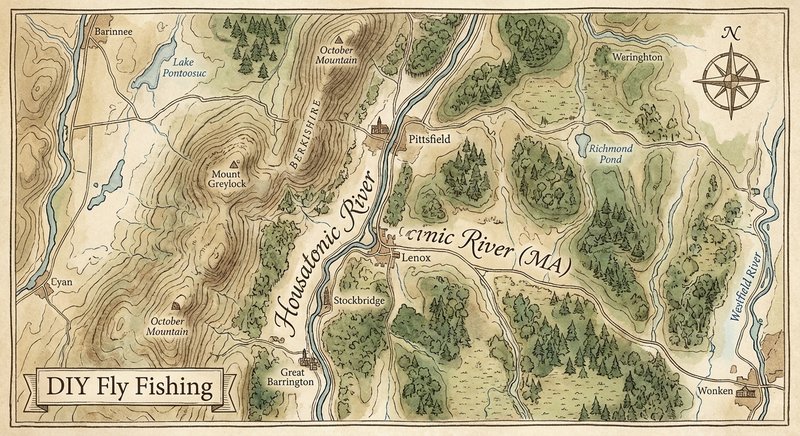
Housatonic River (MA)
Fly fishing in Massachusetts · Intermediate · Best seasons: Spring, Summer, Fall
Target Species
Brown Trout, Rainbow Trout
About This Water
Berkshire County river with wild brown trout. Scenic mountain valley.
Fishing Recommendations
The Housatonic River—affectionately known as the "Housy"—is the crown jewel of Western Massachusetts fly fishing. Flowing through the scenic Berkshire Mountains, this river is a highly productive, limestone-influenced system that offers a "big water" experience rarely found elsewhere in Southern New England.
As a guide, I consider the Housy a "thinking angler’s" river. It is rich, fertile, and can be temperamental, but it rewards those who understand its hatches and its heavy-duty residents.
🎣 Location Overview
The Massachusetts stretch of the Housatonic, particularly from Dalton down to the Connecticut border, is characterized by its high alkalinity. This "limestone" chemistry leads to incredible bug life and faster growth rates for trout.
Unlike the rocky, tumbling mountain streams nearby, the Housy features a diverse mix of slow, deep meandering pools, heavy oxygenated riffles, and extensive "pocket water." What makes it special is the size of the fish; while many New England streams yield 10-inch fish, the Housy is a place where a 20-inch Brown Trout is a legitimate possibility on any given cast. It feels more like a Montana river than a Massachusetts one.
🐟 Target Species & Behavior
- Brown Trout: These are the kings of the Housy. They are notoriously structure-oriented. Look for them tucked under overhanging banks, behind large woody debris, or in the "guts" of deep pools. They are predatory; while they rise for bugs, the trophy-sized Browns often prefer a well-presented sculpin or crayfish.
- Rainbow Trout: Generally found in the faster, more oxygenated water. In the spring and early summer, look for them in the riffles and at the "heads" of pools where the water is turbulent and well-aerated. They are more opportunistic feeders than the Browns and will often move further to intercept a fly.
📅 Best Times to Fish
- Spring (Mid-April – June): This is the prime window. As the water warms into the 50s, the hatches begin in earnest. This is your best chance for dry fly action with Hendricksons and March Browns.
- Summer (July – August): Proceed with caution. The Housy is prone to high water temperatures. If the water exceeds 68°F, fishing should stop to protect the trout. However, the late-summer "White Fly" hatch in August can provide legendary evening dry fly fishing if temperatures stay cool.
- Fall (September – October): My favorite time. The crowds thin out, the water cools, and the Brown Trout become aggressive and territorial as they prepare for the spawn. Streamer fishing is at its peak.
🪰 Recommended Flies & Techniques
Dry Flies
- The Classics: Hendrickson (size 12-14), March Brown (size 10-12), and Light Cahill (size 14).
- The "Housy Special": White Miller/White Fly (size 12-14). In August, this hatch can be a blizzard.
- Terrestrials: In mid-summer, foam ants and beetles (size 14-18) dropped near the banks are deadly.
Nymphs
- Pats Rubber Legs: (Size 6-10) The Housy has a massive population of Golden Stoneflies.
- Pheasant Tail & Hare’s Ear: (Size 12-18) Standard prospecting flies.
- Zebra Midges: (Size 18-22) Crucial for picky fish in slower runs.
Streamers
- Sculpin Patterns: The river is full of sculpins. Use weighted patterns in olive or tan.
- Woolly Buggers: Black or Olive (size 6-10). A universal winner on this river.
Techniques
- Nymphing: Use a "tight-line" or Euro-nymphing setup in the riffles. In the deeper pools, an indicator rig with a long leader is necessary to get down to the fish.
- The "Housy Twitch": When fishing the White Fly hatch, don't just let it dead-drift. A slight, rhythmic twitch often triggers a strike from a big Brown.
💡 Pro Tips & Local Knowledge
- Focus on the "Trophy Sections": The stretch in Stockbridge and Lee (specifically the Catch and Release areas) holds the highest concentration of large, holdover fish.
- Wading Safety: The Housy has a lot of silt and "slick" rocks. It also has sudden drop-offs. A wading staff and studded boots are highly recommended.
- Fish the Wood: If you see a fallen tree in the water, fish it thoroughly. The biggest Browns in the river use timber as their primary ambush points.
- The Night Shift: During the summer months, the best fishing often happens in the final 30 minutes of daylight. Don't leave the river until it's too dark to tie a knot.
⚠️ Important Information
- Regulations: Large sections of the Housatonic in MA are designated as Catch and Release Only. Always check the current MassWildlife abstracts before heading out.
- PCBs & Consumption: Due to historical industrial pollution, there is a permanent Do Not Eat advisory for all fish in the Housatonic River. This is strictly a sport fishery.
- Water Levels: The Housy can become dangerous or unfishable after heavy rain. Check the USGS gauge at Great Barrington. Ideally, you want flows between 200cfs and 600cfs for safe wading.
- Permits: A valid Massachusetts Freshwater Fishing License is required.
Guide’s Final Word: The Housatonic isn't an easy river, but it is a rewarding one. Bring your heavy 5-weight or 6-weight rod, be prepared to lose some flies to the wood, and keep your eyes on the water—big things happen here.
Bug Hatches & Matching Flies
| Hatch | Type | Peak months | Time of day | Hook sizes | Matching flies |
|---|---|---|---|---|---|
| Hendrickson Ephemerella subvaria | mayfly | April, May | Afternoon | #12-14 | Red Quill #12-14, Hendrickson Emerger #12-14, Pheasant Tail #12-14 |
| White Fly Ephoron leukon | mayfly | August | Evening | #12-14 | White Wulff #10-14, Ephoron Spinner #12-14, White Miller #12-14 |
| Isonychia Isonychia bicolor | mayfly | June, July, August, September | Late Afternoon/Evening | #10-12 | Iso Parachute #10-12, Zug Bug #10-12, Prince Nymph #10-14 |
| March Brown Maccaffertium vicarium | mayfly | May, June | Afternoon | #10-12 | March Brown American #10-12, Gold Ribbed Hare's Ear #10-12, March Brown Wet #10-12 |
| Blue-Winged Olive Baetis | mayfly | April, May, September, October | Late Morning/Afternoon | #18-22 | BWO Sparkle Dun #18-22, RS2 #20-22, Baetis Nymph #18-22 |
| Light Cahill Stenonema ithaca | mayfly | June, July | Evening | #12-14 | Light Cahill Dry #12-14, Cream Usual #14, Cahill Wet #14 |
| Grannom Caddis Brachycentrus | caddis | April, May | Morning/Afternoon | #14-16 | Elk Hair Caddis (Olive) #14-16, Pupa Larva #14-16, Deep Sparkle Pupa #14-16 |
| Golden Stonefly Acronuria | stonefly | June, July | Evening/Night | #6-10 | Golden Stone Nymph #6-10, Stimulator (Yellow) #8-12, Pats Rubber Legs #8-10 |
| Trico Tricorythodes | mayfly | July, August, September | Early Morning | #22-26 | Trico Spinner #22-26, Trico Dun #22-24 |
| Giant Black Stonefly Pteronarcys dorsata | stonefly | May, June | Night/Twilight | #4-8 | Black Stone Nymph #4-8, Kaufmanns Stone #6-8 |